This owner of a 50-year-old Katong hobby shop aims to keep model-building alive in screen-obsessed world
Younger generations are spending more time online, but 61-year-old Peter Chiang believes the benefits of a hands-on hobby such as model-building make his efforts to keep these hobbies alive worth it.
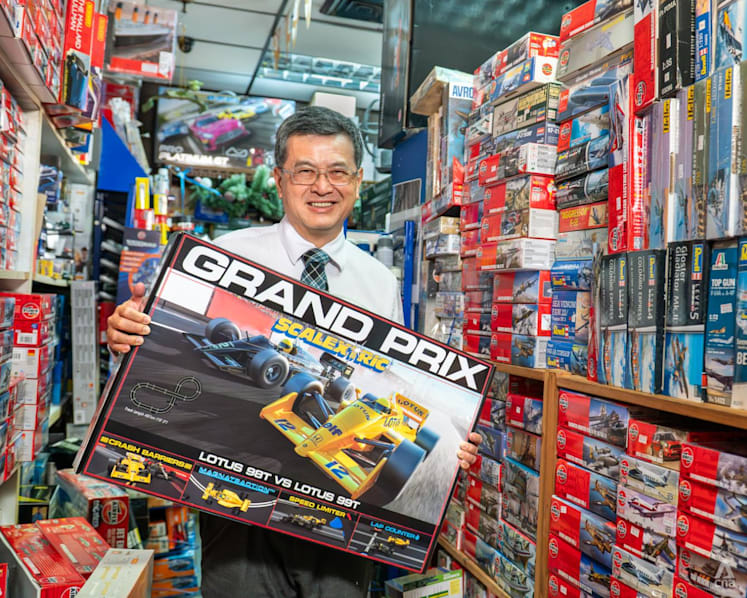
Mr Peter Chiang, 61, owner of Hobby Bounties & Morgan Hobbycraft Centre, holds up a Scalextric Grand Prix race set on Apr 8, 2026. (Photo: CNA/Liew Zhi Xin)

This audio is generated by an AI tool.


When I first meet Mr Peter Chiang, he's in a pair of dress pants, long-sleeved shirt and tie.
I was a little surprised that in Singapore's hot and humid weather, the 61-year-old would eschew the locals' de facto uniform of T-shirt and shorts when outside an office.
After all, who would have more licence to dress down than the owner of a scale model hobby shop that deals with a wide, whimsical array of toy figurines, model kits and collectibles?
But Mr Chiang appeared no less comfortable in his formal get-up than I felt in my T-shirt and jeans. During my visit to his shop on Wednesday (Apr 8), one of his long-time customers-turned-friends quipped that he was "born wearing a tie".





Mr Chiang attributed his day-to-day style in part to his schooling years in the United Kingdom where, in his words, "this is considered informal".
Another habit he traces back to his formative UK years: He signs off his text messages with "Yours sincerely, Peter" – a level of formality I have not encountered outside of the comically deadpan Captain Raymond Holt from the popular sitcom Brooklyn Nine-Nine.
He even signs off comments on Facebook this way. "I treat everyone the same," he said.
When it comes to discussing his business, the 50-year-old Hobby Bounties & Morgan Hobbycraft Centre, Mr Chiang's tone and seriousness matches the formality of his appearance.
For instance, he was sombre when discussing the challenges facing the business – which have been rapidly growing more acute in a day and age where children would sooner stay glued to screens for hours on end than find an offline hobby.
"We can't compete against that because it's easy and quickly within reach," he said.
But when it comes to talking about scale models, it seems as if the five-year-old in him that first picked up this hobby instantly comes alive again.
Showing us around his cozy, cluttered shop at Katong Shopping Centre, he was practically glowing as he pointed to interesting collections housed in the shop display window and stacked boxes within. With each and every piece, he rattled off historical facts or pop cultural provenance like a walking encyclopaedia.
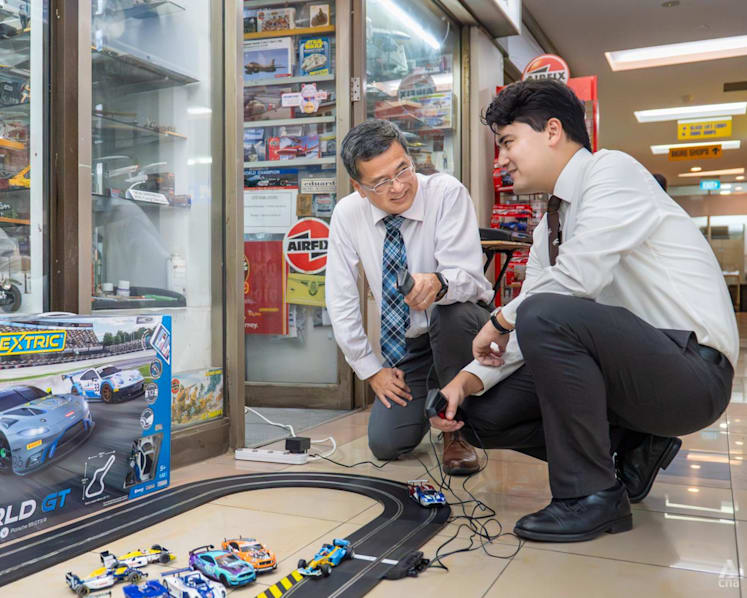
Despite his stiff formal attire, he did not hesitate to kneel down in front of his shop to demonstrate a quick slot-car race with a customer and gamely posed for photos with model trains and rockets.
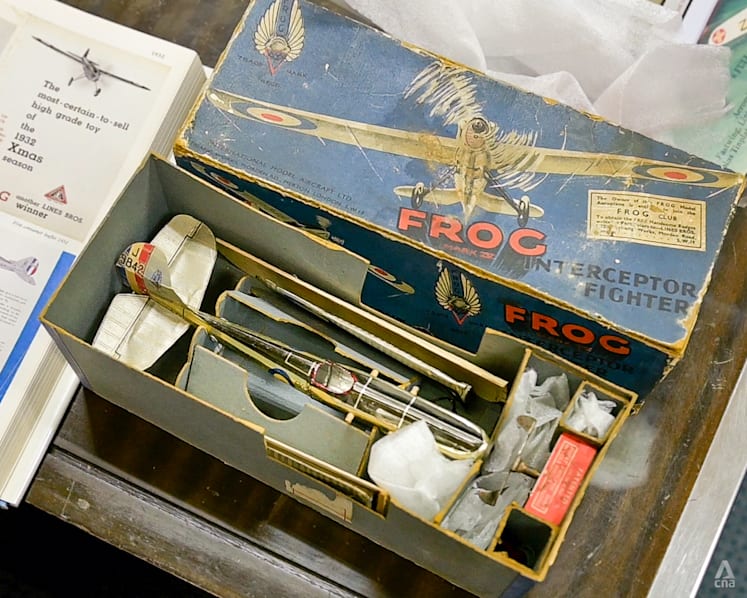
Even after we wrapped up a long day of filming and interviews, Mr Chiang still found the energy to climb onto a stool, rifle through a cupboard to dig out one of the oldest pieces he had on hand: a model propeller aircraft dating back to the 1930s.
He hadn't used any gloves to handle any items throughout the day, but my curiosity was piqued when he went glove-free even with this nearly century-old toy. It was a stark contrast to the picture in my mind of curators gingerly handling particularly old or treasured specimens.
But it seems that when it comes to his beloved toys, Mr Chiang's stiff upper lip softens completely.
He waved off my question about gloves, saying: "If you can't do this, you can't do that, that takes the fun out of it. Then what is the point?"
FROM HOBBY TO BUSINESS TO COMMUNITY
To say that miniature models play an outsized role in Mr Chiang's life would be an understatement.
Mr Chiang's father – former Member of Parliament Chiang Hai Ding, who was a history professor and diplomat – instilled a keen interest in history in him and his three younger siblings from a young age.
Yet, when the time came to decide on his tertiary education and career path, Mr Chiang ended up picking the contrasting field of aeronautical engineering – and it was all thanks to his models, a hobby he'd had since the 1970s.
"My parents took me to a shop called the Orchard Store, where I saw an Airfix kit of P.1127 – a prototype British Hawker Harrier, the one that flies vertically upwards," he said.
"I bought that. And after that, I just went for the second kit, (then) the third kit."
That sparked a lifelong passion for learning how aircraft worked in real life, which led him to a career in aerospace engineering. He still owns an aerospace consultancy business, while simultaneously handling the hobbycraft business.
Model-building isn't Mr Chiang's only hobby. He enjoys historical novels and sci-fi movies, and readily names ABBA and Queen among his favourite musical artists.
However, kit-building is not only Mr Chiang's first love – it's his most consistent.
By his own estimate, he has built more than 1,000 models over the decades, and still devotes at least an hour every day to building them. "This morning, before I came, I was building some more," he admitted.
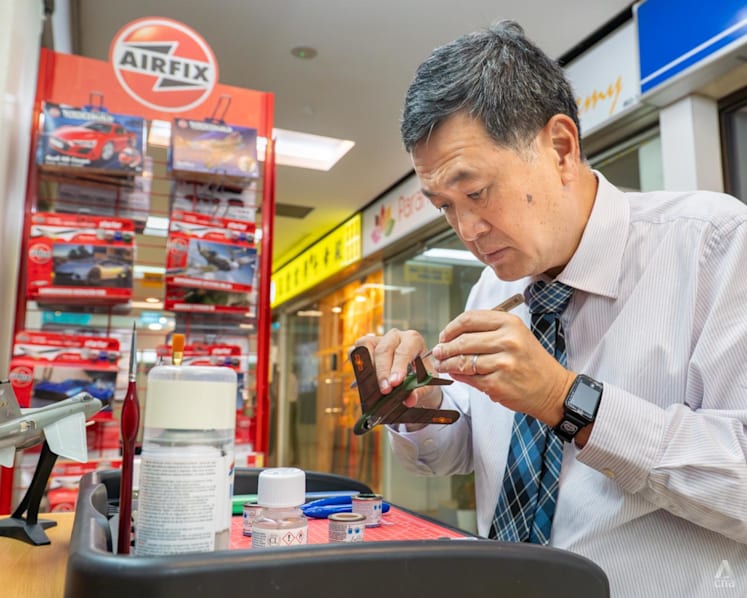
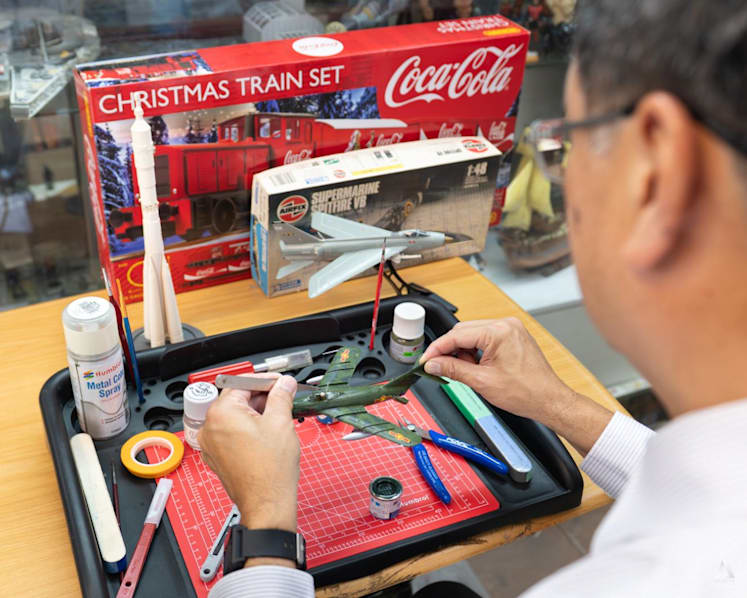
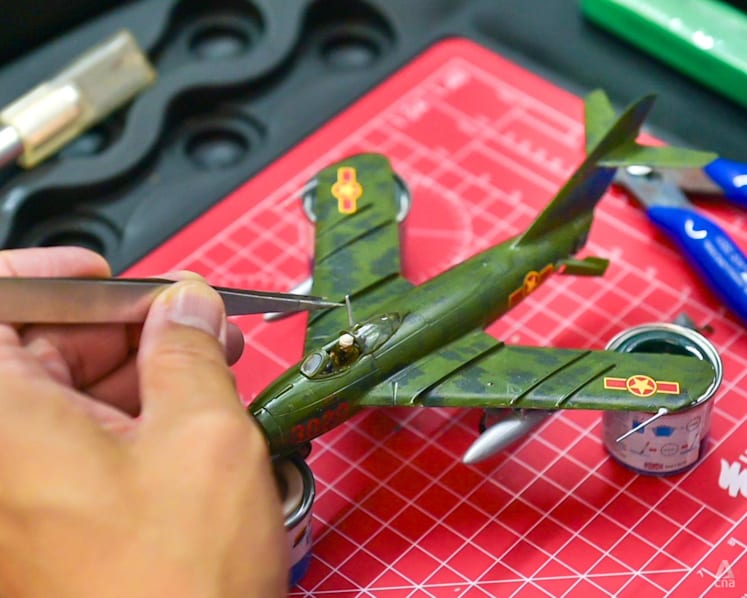
The just-concluded Artemis II manned expedition to the moon inspired him to complete a space-related diorama recently.
Married with no children, Mr Chiang added that his wife did try kit-building once but didn't quite take to it – though he's found some upside to them having divergent interests.
"She occasionally complains about the glue smell, the thinner smell and the paint smell, but it also allows her more time to watch television. There's no competition for the television."
In 1986, Mr Chiang chanced upon a departmental store clearing its stock of Airfix brand kits at cheap prices. It was then he set up Hobby Bounties, bought the stock in bulk and sold them through Morgan Hobbycraft Centre, which was founded 10 years earlier.
In 2006, when the remaining owner of Morgan Hobbycraft Centre retired, Mr Chiang took over the reins of that shop too. Ever since, he's been running both businesses in tandem from the same premises.
For decades now, Hobby Bounties and Morgan Hobby Craft Centre has been drawing in people passionate about scale model building.
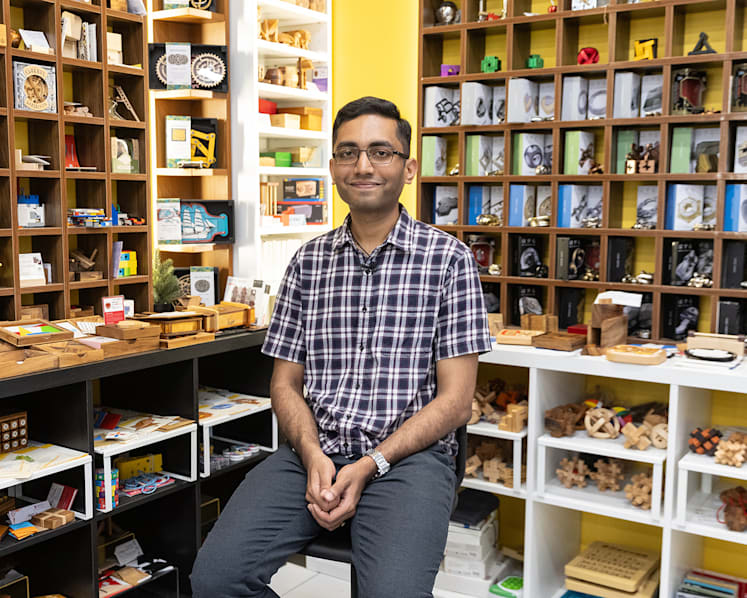
Like Mr Chiang, Dr Suresh Nathan, an orthopaedic surgeon, said the hobby played a key role in his career path. He began building models with his older brother in the 1970s, and that eventually drew him to his current specialisation in the medical field.
"Part of building (scale models) requires you to have a certain mechanical engineering mindset – you're cutting things, sticking them together and forming structures," said Dr Nathan, 58.
"In medical school, when the time came to specialise, I just naturally wanted to do something mechanical – and that was orthopaedic surgery."
For Mr Jake Moon, 30, who came to Singapore from the United States three years ago, this shop gave him more than just a way to continue a hobby he'd cultivated back home.
"I've learned so much about Singapore and the Singaporean experience because I'm interacting with (people in this group) in a very casual way," said Mr Moon, who worked as a writer and is now in Singapore on a dependant's pass.
"It's not like I'm sitting down and interviewing these people about the experience. I'm living it with them."
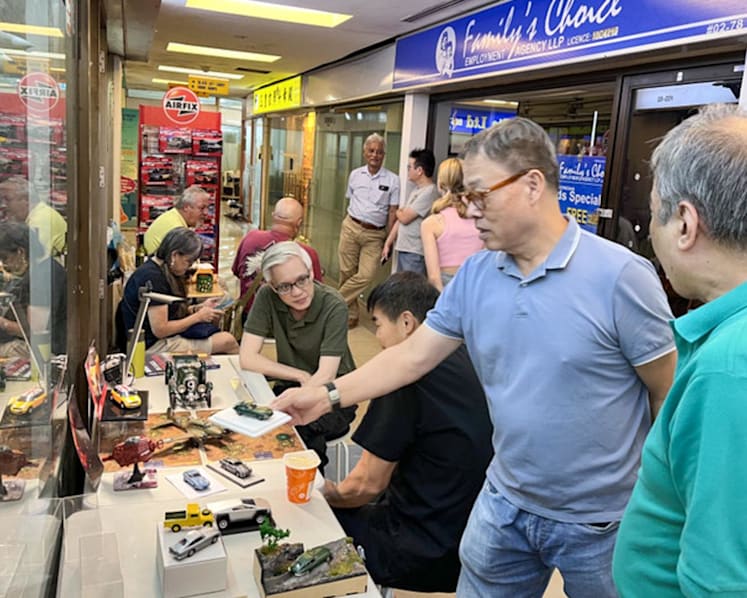
The shop has been organising a monthly gathering for hobbyists for about 25 years now, said Mr Chiang.
"This created a community of like-minded hobbyists who welcome all. It is also a gathering for people to seek advice on this hobby or just make friends," he said.
MAN ON A MISSION
Wandering through the small shop, the cramped 300 sq ft space felt more like an overstuffed, if slightly disorganised, mini-museum for genre geeks rather than a retail business.
As a casual fan of sci-fi and superhero movies, I found myself caught up in recognising spacecrafts or characters from franchises I knew – some in old, yellowed but unopened boxes dating back to the 1970s or 1980s, stacked ceiling-to-floor along the walls of the shop.
Coming down from the excitement of endless pop culture discoveries, I finally sat down with Mr Chiang and asked him how the business was doing.
Not well, he said matter-of-factly, adding that the business was not profitable, though he declined to share further details or figures.
"We aim to be (financially) neutral, but it's a struggle."
Mr Chiang's biggest competition isn't Pokemon, board games or any of the new-fangled toys you might see in malls today that incorporate interactive technology. It's the very thing you might be reading this article on right now – the mobile screen device.
Teens in Singapore are now spending an average of almost 8.5 hours daily looking at screens. Last year, the Ministry of Health said that screentime among children has reached a "critical point" and rolled out official guidelines for screen use in schools.
Some of the shop's regulars told me that while they try to share the hobby with their children, the faster pace of modern life and heavier workload in schools today meant that scale modelling almost always has to take a backseat.
"I can't change that. I just accept it, c'est la vie," said Mr Chiang, using the French phrase for "such is life".
For the past 20 years, Mr Chiang, together with some of his close regulars-turned-friends, has been organising an annual scale aircraft model competition with various partners. This is on top of the monthly gatherings at the shop and quarterly building competitions.
It's a significant amount of community-building effort for what is, at the end of the day, a loss-making venture.
But what motivates Mr Chiang to keep going is, to him, far bigger than money.
Firstly, he hopes to inspire an ambition and passion in the next generation for how machines and technology work, rather than simply what they can do – like how he himself was inspired to enter the aerospace industry after picking up a scale aircraft model.
"I hope there'll be more aeronautical engineers, because the aeronautical industry suffers from a lack of hand-skilled engineers – both artisans, which are mechanics, and licensed aircraft engineers."
As for the wider population who may never develop an inclination to join the aerospace industry, he said the hobby helps to build practical motor skills and spatial reasoning, as well as less tangible capabilities such as stamina and industry.
"You can play a computer game and just stop after a few minutes. (With scale models), you need to go for hours before you get the satisfaction of completing it."
"This virtue of patience is missing big-time today."
Previously, Mr Chiang's "c'est la vie" outlook about the losing battle for people's attention and interest had sounded almost nonchalant. But now, when I circled back to the same question, he had this to say:
"Rather than sit there and think about something, we just do things. We're organising, we're trying to do events – and that's my little part that I am doing for society."