Iran apologises to Gulf but strikes escalate, war surges across region
Iran's apparent strategy of maximum chaos has driven up the costs of the conflict by raising energy prices and hurting global business and logistics links.
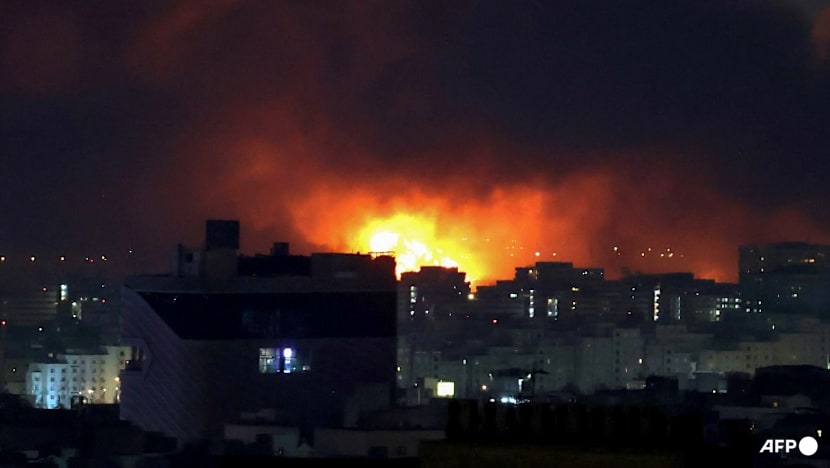
Smoke and fire rise from the site of airstrikes at Mehrabad International Airport in Tehran on Mar 7, 2026. (Photo: AFP/ATTA KENARE)
BEIRUT/WASHINGTON/TEL AVIV: Israel and Iran traded more attacks as a Middle East war entered a second week on Saturday, and Iran's president apologised to neighbouring states in a bid to cool anger across the Gulf but stirred criticism from hardliners at home.
"I personally apologise to neighbouring countries that were affected by Iran’s actions,” Iranian President Masoud Pezeshkian said, urging them not to join US-Israeli attacks on Iran.
He dismissed US President Donald Trump's demand for the Islamic Republic's unconditional surrender as "a dream", but said its temporary leadership council had agreed to suspend attacks on nearby states unless strikes on Iran originated from their territory.
Trump nonetheless cast Iran's apology as a surrender, while saying the country would be "hit very hard" on Saturday and warned the US could widen its attacks.

IRAN SAYS IT TARGETED US BASES
Pezeshkian’s comments caused a political stir in Iran, prompting his office to reiterate Iran's military would respond firmly to attacks from US bases in the region.
Hours later, the president repeated his statement on social media but left out the apology from his speech that had angered hardliners, including the powerful Revolutionary Guards.
Hamid Rasai, a hardline cleric and lawmaker, wrote on X, "Mr. Pezeshkian, your stance was unprofessional, weak and unacceptable."
One former Revolutionary Guards commander denounced the idea of an apology in a statement on social media.
The judiciary chief, Mohseni-Ejei, a hardline member of the three-man council temporarily holding the powers of the supreme leader, said the territory of some regional countries was being used, openly and secretly, for attacks against Iran, and retaliatory strikes would continue.
Hours after Pezeshkian's announcement, Iran's Revolutionary Guards said their drones struck a US air combat centre at Al Dhafra Air Base, near Abu Dhabi, capital of the United Arab Emirates. Reuters could not independently verify that report.
Dubai authorities said an Asian man was killed in the western Al Barsha area after debris from an aerial interception fell onto a vehicle. Earlier, Emirates airline briefly suspended flights to and from Dubai, with the authorities citing a minor incident resulting from a fall of debris after an interception. Dubai authorities also said debris from a third interception caused a minor incident on the facade of a tower in the Dubai Marina and that no injuries were reported.
The Revolutionary Guards also targeted US forces at a base in Bahrain, Iranian state media said. Blasts were also heard in Doha, a Reuters witness said.
GULF STATES HIT BY DRONES AND MISSILES
The US-Israeli war on Iran has already spilt beyond Iran's borders, as Tehran has responded by hitting Israel and Gulf Arab states hosting US military installations, and Israel has launched fresh attacks in Lebanon after the Iran-aligned militia Hezbollah fired across the border.
Gulf states voiced outrage that their civilian infrastructure - hotels, ports and oil facilities - was struck despite their having had no part in the US-Israeli attacks.
The UAE, Kuwait, Qatar, Bahrain, Oman, Saudi Arabia and Iraq have all reported drone or missile attacks over the past week.
"The UAE has thick skin and bitter flesh - we are no easy prey," Sheikh Mohammed bin Zayed Al Nahyan, the UAE president, said on Friday when visiting those injured in strikes. The comments were aired on Abu Dhabi TV on Saturday and were his first public comments since the Iranian strikes against the Gulf.
ISRAEL WARNS LEBANON TO REIN IN HEZBOLLAH
With the conflict spreading, Israel warned Lebanon of a "very heavy price" if it did not rein in Hezbollah, as it pounded the group's strongholds with airstrikes and mounted a deadly airborne raid in the east.
On Saturday morning, more buildings in the Hezbollah-controlled southern suburbs of Beirut had been reduced to mounds of smoking rubble, dust and tangled wires, Reuters video showed.
Heavy Israeli bombardment had followed an evacuation order for civilians. The total death toll from Israel's attacks on Lebanon since Monday has risen to 294, the health ministry said.
The US-Israeli attacks have killed at least 1,332 Iranian civilians and wounded thousands, according to Iran's UN ambassador, Amir Saeid Iravani. Huge explosions were heard in parts of Tehran, state media reported, while Israel said it had struck Iranian missile sites and command centres.
Iranian attacks have killed 10 people in Israel, and at least six US service members have been killed.
IRAN REJECTS TRUMP CALL FOR SAY IN CHOOSING NEW LEADER
Iran's apparent strategy of maximum chaos has driven up the costs of the conflict by raising energy prices, hurting global business and logistics links and shaking trust in the stability of a critical region for the world's economy.
Kuwait's national oil company began cutting output on Saturday, adding to earlier oil and gas cuts from Iraq and Qatar.
The war has roiled global markets, and oil prices have hit multi-year highs with the Strait of Hormuz effectively shut.
Trump has said the US Navy could escort ships in the Gulf. But Iran's Revolutionary Guards challenged him to do so, with spokesperson Alimohammad Naini saying Iran "welcomes" and is "awaiting" any US presence in the strait, state media said.
Trump reiterated his demand for a say in selecting Iran's new supreme leader, a notion rejected by Iravani.
Hardline clerics have called for the swift selection of a new supreme leader, Iranian media reported on Saturday. Ayatollah Hossein Mozafari, one of the 88-member Assembly of Experts, the clerical body charged with choosing the next leader, was quoted as saying the assembly could meet in the next 24 hours to decide.
"President Pezeshkian's openness to de-escalation within our region - provided that our neighbours' airspace, territory, and waters are not used to attack the Iranian People - was almost immediately killed by President Trump's misinterpretation of our capabilities, determination and intent," said Iranian Foreign Minister Abbas Araqchi in a statement.
"If Mr Trump seeks escalation, it is precisely what our Powerful Armed Forces have long been prepared for, and what he will get."