







US debuts LUCAS kamikaze drone in Iran after fast-tracked Pentagon procurement

A plume of smoke rises after a strike on the Iranian capital Tehran, on Mar 3, 2026. (File photo: AFP/Atta Kenare)
The United States successfully debuted a low-cost suicide drone in combat in Iran just eight months after its Pentagon unveiling, as the US pushes to accelerate weapons programmes.
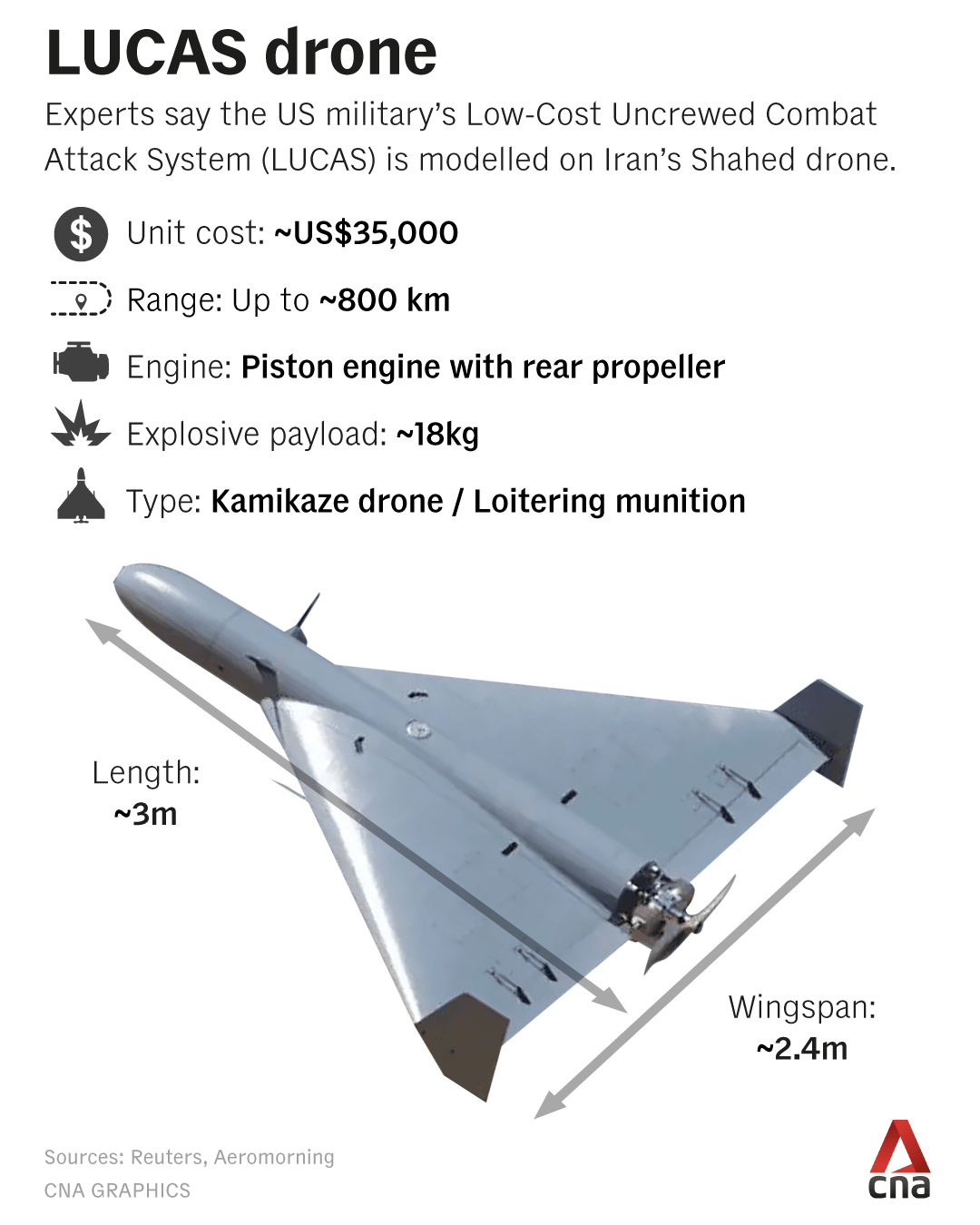
The Low-Cost Uncrewed Combat Attack System (LUCAS) drone, manufactured by Arizona's SpektreWorks, was showcased in July 2025 when Defense Secretary Pete Hegseth walked the Pentagon's inner courtyard with more than a dozen companies competing to supply the military with new equipment.
Drones have become central to modern warfare following their effective use in the Ukraine war, including Iran-made Shahed systems flown by Russia that the LUCAS closely resembles.
The sector is also among the most fiercely competitive in the US defence industry, with SpektreWorks vying for Pentagon contracts against major defence primes and a wave of Silicon Valley–backed startups such as Anduril, Shield AI and AeroVironment.





US Central Command said LUCAS drones are modelled after the Shahed.
RAPID DEPLOYMENT
The rapid fielding of the LUCAS represents a departure from traditional Pentagon acquisition timelines, which typically span years from initial development to operational deployment. Defence officials said the compressed timeline reflects lessons learned from observing drone warfare in Ukraine, where both sides have employed thousands of low-cost unmanned systems.
The LUCAS deployment comes as the Pentagon pushes to rapidly expand American industrial capacity for producing inexpensive, attritable drones under the US$1 billion Drone Dominance Program authorised in the One Big Beautiful Bill Act of 2025.
The LUCAS drone uses an open architecture that allows different payloads and communications systems, and can be deployed either for strikes or as a target drone, according to company materials. It can be launched from the ground or a truck.
At about US$35,000 each, it is far cheaper than the MQ-9 Reaper, which costs roughly US$20 million to US$40 million, but is reusable and far more sophisticated.
The government owns the LUCAS design intellectual property, meaning multiple manufacturers could produce the system, though SpektreWorks currently holds manufacturing contracts.
SpektreWorks declined to comment for this story.

DRONES USE STARLINK AND VIASAT SATELLITES
During its development at the Pentagon, the LUCAS drone was paired with satellite communications systems, including Viasat’s MUSIC and SpaceX’s Starlink or Starshield, according to two sources familiar with the programme. Reuters could not determine what connectivity systems are being used during the current Iran operations.
Neither SpaceX nor Viasat returned requests for comment.
A startup called Noda provides the software to control the drones, known as an "orchestrator" that allows warfighters to control multiple autonomous systems, one of the sources familiar with the programme said.
Noda declined to comment. Reuters could not determine if NODA was being used during the Iran operation.
Drone experts told Reuters the LUCAS design shares similarities with Iran's Shahed drone, which Tehran has supplied to Russia for use in Ukraine. The Shahed is believed to be a copy of Israel's Harpy loitering munition, according to defence analysts.
The Harpy design has been widely replicated by countries, including China and Taiwan.
The LUCAS also bears resemblance to the Drone Anti-Radar, a loitering munition jointly developed in the 1970s and 1980s.




