Trump says Iran war will end 'very soon'
Speaking at a news conference in Florida, the US president also said he will waive some sanctions on oil to ensure an adequate supply and lower prices.
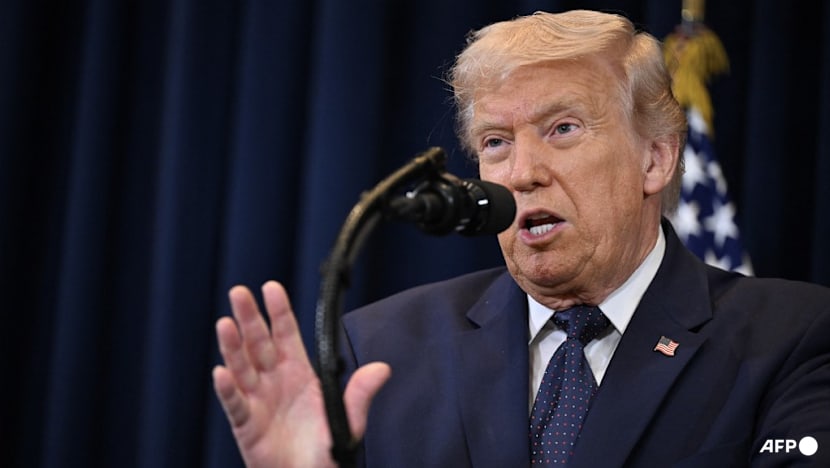
US President Donald Trump speaks to reporters at Trump National Doral Miami on Mar 9, 2026, in Doral, Florida. (File photo: AFP/Getty Images/Roberto Schmidt)
DORAL, Florida: President Donald Trump said on Monday (Mar 9) that US military operations in Iran would be ending soon, reassuring markets that have been thrust into chaos by a war still reverberating across the Middle East.
The war had sent stock markets slumping and oil prices soaring on Monday as Tehran, under new leader Mojtaba Khamenei, fired a fresh barrage of missiles at its Gulf neighbours and signalled that the strategic Strait of Hormuz would likely remain closed.
But Wall Street climbed into positive territory on Trump's signals of a short war, with Tokyo and Seoul also opening strongly on Tuesday, despite the president's continued threats to expand the campaign if Iran did not fall in line.
Oil prices also reversed course, falling as much as 5 per cent a day after benchmark crude rocketed past US$100 a barrel - its highest level since Russia's invasion of Ukraine in 2022.
"It's going to be ended soon, and if it starts up again they'll be hit even harder," Trump told a news conference in Florida, after telling lawmakers that the campaign would be a "short-term excursion".
"I think soon. Very soon," Trump told reporters at his Doral National golf club near Miami, Florida, when asked if he thought the war could end in days or weeks.
"Everything they have is gone, including their leadership."
But Trump also pressed for what he called "ultimate victory" against Tehran's clerical establishment, which over the weekend picked the son of slain supreme leader Ali Khamenei as its new chief.
Iran's Revolutionary Guards replied Tuesday that they, not the Americans, would "determine the end of the war".
Trump said the United States was saving some of the "most important" targets in Iran for possible later strikes if needed, including the country's electrical grid.
The US leader also threatened an attack of "incalculable" size if Tehran blocks oil supplies coming through the Strait of Hormuz, as crude prices spike over the Middle East war.
"And if Iran does anything to do that, they'll get hit at a much, much harder level," Trump told the news conference.
"We will hit them so hard that it will not be possible for them or anybody else helping them to ever recover that section of the world, if they do anything."
At the same time, Trump played down the scale of the conflict, which has not been approved by the US Congress, repeatedly calling it an "excursion" rather than a war.
Republican Trump has faced criticism over the mixed messages coming from his administration about the goals of the Iran war, particularly over whether he is seeking full-scale regime change or not.
He declined to say whether new leader Mojtaba Khamenei had a target on his back, saying only that his appointment was "not good".
But the US president, who has said he should be involved in picking Iran's new leader in the same way as with Venezuela in January, said he preferred an "internal" candidate rather than an external one.


LIFTING OIL SANCTIONS
Trump also said he will waive some sanctions on oil to ensure an adequate supply and lower prices.
"We're also waiving certain oil-related sanctions to reduce prices," Trump told reporters after talks with Russian President Vladimir Putin.
"We're going to take those sanctions off till this straightens out."
Trump did not give specifics, but the United States last week issued a temporary, 30-day waiver to allow for the sale of Russian oil currently stranded at sea to India to alleviate pressure on the global oil market.
He added that he had a "positive phone call with Putin on the Ukraine and Iran wars.
"He wants to be helpful" on the Middle East, Trump said of Putin, who backs Iran and invaded Ukraine in 2022.

Earlier, Trump's comments to broadcaster CBS that the United States was far ahead of his initial timeline of around a month had sparked optimism on the stock and oil markets.
"I think the war is very complete, pretty much. They have no navy, no communications, they've got no air force," Trump told CBS News by phone.
"Their missiles are down to a scatter. Their drones are being blown up all over the place, including their manufacturing of drones," he added. "If you look, they have nothing left. There's nothing left in a military sense."
Trump told the US broadcaster that the United States was "very far" ahead of his initially stated time frame of four or five weeks.
The US leader has given similar assessments in recent days of battle damage from the US-Israeli strikes that began on Feb 28, but had not gone as far in saying that the war was nearing an end.
Just last Friday, Trump issued a statement that Iran's "unconditional surrender" was the only acceptable outcome for ending the war.
And his comments came about an hour after the Pentagon posted on social media that the United States had "only just begun to fight."
CONFLICT MAY END WITH POLITICAL CHANGE IN IRAN: ANALYST
But some analysts say the conflict may not be as close to resolution as Trump has suggested.
Shahin Modarres, Iran team lead at think-tank ITSS Verona, said the Islamic Republic is “playing completely irrationally” in the war.
He said Tehran’s actions - including strikes on neighbouring and even allied states - have widened regional opposition against the regime and contributed to the formation of what he called a new coalition against Iran.
Modarres told CNA’s Asia First that Iran’s leadership change should not be interpreted as an “olive branch”, describing Mojtaba as a “hardliner, even worse than his father” - the late supreme leader Ali Khamenei.
With Israel playing a central role in the conflict, Modarres said the war’s endgame may hinge on political change inside Iran. In his view, “nothing less than the eradication of the Islamic Republic led by its hardliners” would be accepted.
While he said a full-scale US ground invasion is unlikely - noting that occupying a country as large as Iran would require hundreds of thousands of troops - he warned that more limited military operations remain possible.
These could include airborne deployments or special forces missions aimed at securing sensitive nuclear material or targeting key political or military figures.