analysis Asia
Indonesia’s Board of Peace dilemma: Prabowo caught between domestic backlash and US ties
Indonesia is facing mounting pressure to reconsider its membership in the US-led Board of Peace (BoP), but leaving comes with risks, analysts say.
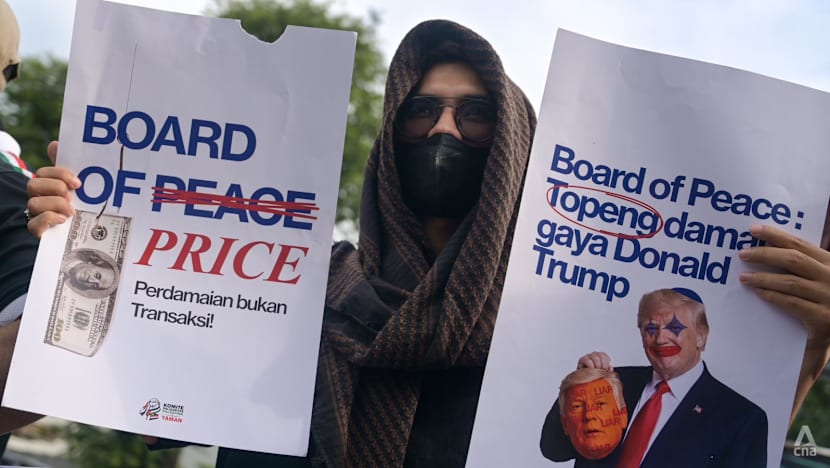
A protester outside the United States Embassy in Jakarta, Indonesia, on Mar 3, 2026. Amid tensions in the Middle East, the protestors urged the Indonesian government to revoke its membership in the Board of Peace (BoP). (Photo: CNA/Ridhwan Siregar)

This audio is generated by an AI tool.


JAKARTA: When Indonesian President Prabowo Subianto accepted the United States’ invitation to join the Board of Peace (BoP) on Jan 22, he cast it as a strategic step to achieve lasting world peace and elevate Indonesia’s global standing as a middle power.
But public scepticism of Indonesia’s BoP participation has grown in the wake of the US-Israeli war on Iran and the death of three Indonesian peacekeepers in Lebanon last month.
The board was originally established to oversee post-conflict reconstruction in Gaza.
With politicians, including figures from Prabowo’s own coalition, now urging a reassessment of Indonesia’s membership, observers say the president risks being caught between domestic backlash and preserving ties with the US.
“The Board of Peace has become the Board of Problems,” declared Teuku Rezasyah, an international relations lecturer at Indonesia’s President University.
LATEST PUBLIC SENTIMENTS
Over half of the respondents in a survey conducted last month disagree with Indonesia’s decision to join the BoP.
Conducted by three Indonesian research companies, the survey found that 50.9 per cent of more than 1,000 respondents disagreed with Indonesia’s decision to join the BoP, a body initiated by US President Donald Trump.
Only 33.8 per cent said they supported the decision while the rest were neutral, according to the findings released on Apr 2 by Indikator Politik Indonesia, Indonesian Survey Institute (LSI) and Saiful Mujani Research and Consulting (SMRC).
The result showed a marginal decline in support for BoP participation.
Before the US-Israeli war on Iran, another Indonesian research company, Media Survey Nasional (Median), conducted a similar study between Feb 10 and 14, showing that 50.4 per cent of the 1,200 respondents disagreed with Indonesia joining the BoP. In the February survey, 34.8 per cent said they supported the membership.
The latest survey was conducted between Mar 12 and 31, meaning some responses were given before the Indonesian peacekeepers were killed on Mar 29 and 30. Experts said support for the BoP would have been even lower if the study had been conducted after the deaths.
A United Nations investigation found that a projectile fired from an Israeli tank resulted in the death of a peacekeeper on Mar 29.
Two peacekeepers were killed on Mar 30 by an improvised explosive device, most likely placed by Hezbollah, according to the UN.
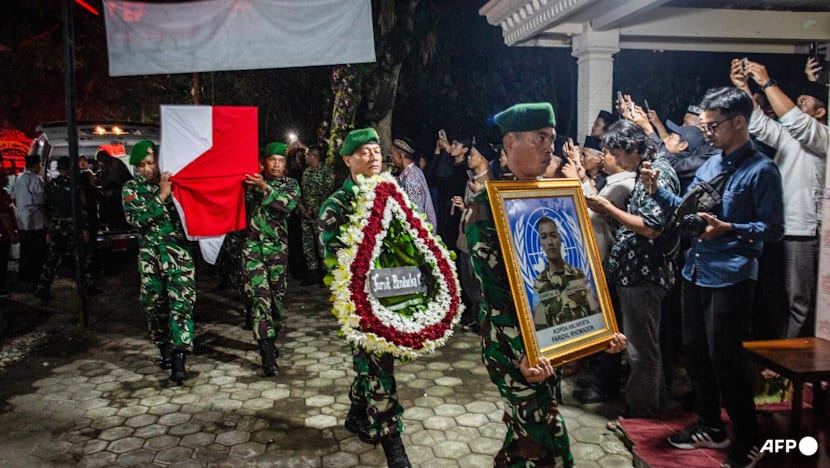
Their deaths – the first among the UN peacekeeping force in the new war between Israel and Lebanese armed group Hezbollah, which erupted on Mar 2 – have also broadened criticism of Indonesia’s BoP participation, which was initially confined to Islamic groups with strong anti-Israel sentiments and analysts wary of US intentions.
“Indonesia’s benefits and diplomatic manoeuvring within the BoP are not clearly evident, thus it is understandable that there is much public resistance (to Indonesia’s membership),” Agung Nurwijoyo, an international relations expert from University of Indonesia told CNA.


GROWING POLITICAL BACKLASH
Several political parties, including those in Prabowo’s coalition, have urged a rethink of Indonesia’s BoP involvement.
“Israel’s attack on an Indonesian soldier is a clear disregard for the very notion of ‘peace’ that is supposed to be a core value of the BoP,” Ahmad Doli Kurnia, deputy chairman of Golkar Party said in a statement on Apr 1.
“We encourage the government to rethink Indonesia’s presence in the BoP.”
Golkar is the biggest party in Prabowo’s coalition.
The Islam-based Prosperous Justice Party (PKS), another member of Prabowo’s coalition, issued a similar call on Mar 30.
“The PKS believes there needs to be a serious evaluation of Indonesia’s position in various international peace forums, including the possibility of reviewing its involvement in the BoP if it is no longer effective in upholding global peace and justice,” the party said in a statement.
Politicians from the Indonesian Democratic Party of Struggle (PDI-P), not a member of the coalition, have taken a firmer stance and called for a full withdrawal.
“The government should immediately take steps to withdraw. This is important to maintain consistency with the ‘free and active’ (foreign policy) principle mandated by our Constitution,” PDI-P politician Tubagus Hasanuddin told media outlet Kompas on Mar 3.
Hasanuddin is a member of the Indonesian parliamentary commission overseeing defence and foreign affairs.
On Mar 3, Indonesian Foreign Minister Sugiono said "all BoP discussions are on hold as all attention has shifted to the situation in Iran".
During a discussion with journalists and experts last month, Prabowo mooted the possibility of Indonesia leaving the BoP if it proves to be counterproductive to world peace and stability.
“If we conclude that there is no hope and that it is counterproductive, that it is draining our time and energy and does not serve Indonesia’s national interests, we will withdraw,” he said, as quoted by Kompas on Mar 19.
The Board of Peace and the Iran war
The BoP was originally established to ensure post-conflict reconstruction in Gaza proceeds effectively.
Trump began inviting countries to join the board in September and, on Jan 22, at the sidelines of the World Economic Forum in Davos, Switzerland, 21 countries including Indonesia signed the charter for the establishment of the BoP and became founding members.
Six more countries have since joined the BoP, including fellow Southeast Asian nations Cambodia and Vietnam.
Experts have voiced scepticism over the BoP’s effectiveness and warned that Indonesia risks being drawn into a pro-American orbit that prioritises the American president’s agenda.
Criticism grew after it was revealed that nations that accepted the invitation were given a three-year membership term, and that permanent membership would be granted to member states that contribute US$1 billion in cash.
Prabowo has said Indonesia has not pledged to pay US$1 billion and will not be doing so, emphasising that Jakarta’s role is limited to peacekeeping support.
Indonesia was also appointed a deputy commander in the International Stabilisation Force (ISF) - which will operate under the Board of Peace - as part of the Gaza peace plan, Trump said on Feb 19 at the board's inaugural meeting.
Indonesia has planned to deploy 8,000 troops to Gaza in support of the Board of Peace, according to Indonesian army chief of staff general Maruli Simanjuntak on Feb 9.
Tensions in the Middle East have caused cracks in the Trump-initiated body. BoP members Turkey and Pakistan have condemned the offensive against Iran while Egypt condemned Israel’s attack on Lebanon.
But their grievances have so far fallen on deaf ears, analysts noted.
“The United States and Israel arrogantly started a war without consulting other (BoP) members or even explaining their positions,” said Rezasyah of President University.
Iran responded by launching retaliatory strikes on US facilities in several Gulf states as well as closing the Strait of Hormuz, a narrow shipping route between Iran and the Arabian Peninsula where much of the world’s oil and gas supply passes through.
The conflict has caused crude oil prices to surge, at times passing the US$120 mark. Some experts believe prices could reach more than US$150 - more than twice the price of oil before the start of the war - if the conflict drags on.
PRABOWO FACES “DIFFICULT” CHOICE
Given the level of public and political backlash, some analysts believe Prabowo has become less unequivocal about his decision to join the BoP since the start of the US-Iran conflict.
“Prabowo … understands that this Trump-created body has become politically toxic domestically,” said Made Supriatma, a visiting fellow at Singapore’s ISEAS-Yusof Ishak Institute.
While some observers believe it is time for Indonesia to leave the BoP, others warn that doing so might jeopardise Indonesia’s relationship with the world’s biggest economy.
“No other member country has left the BoP. Prabowo doesn't want to be the first to cross Trump, because he knows that Trump will certainly retaliate against any perceived disloyalty,” Made said.
Added Rezasyah: “Trump will be in power until 2028 and after that, we cannot rule out the possibility that he will be succeeded by a Trump loyalist Republican.”

Concerns over a possible falling out with the US are not unfounded, analysts noted, given Washington’s willingness to deploy economic pressure to advance its interests.
The Trump administration initially imposed sweeping tariffs against goods imported from almost every country and territory around the world, including Indonesia which was hit with 19 per cent, before the US Supreme Court ruled in February that his policy was illegal.
Trump quickly introduced a new 10 per cent global import duty under a separate legal justification – an interim measure that will expire in July 2026.
The Trump administration also launched an investigation against 16 countries, including Indonesia, on suspicion of unfair trade practices. Experts have told CNA that these investigations – which include allegations of excess capacity and forced labour – are widely seen as an attempt to reinstate the tariffs that were struck down.
With the threat of an even bigger tariff looming over Indonesia, “the choice to leave the BoP is very difficult for Prabowo,” said Made.
Public sentiment towards the BoP could deteriorate further if the conflict drags on, particularly if it forces Indonesia to raise the price of subsidised fuel, analysts said. Such subsidies are relied upon by millions of consumers, and also for public transport and the distribution of goods.
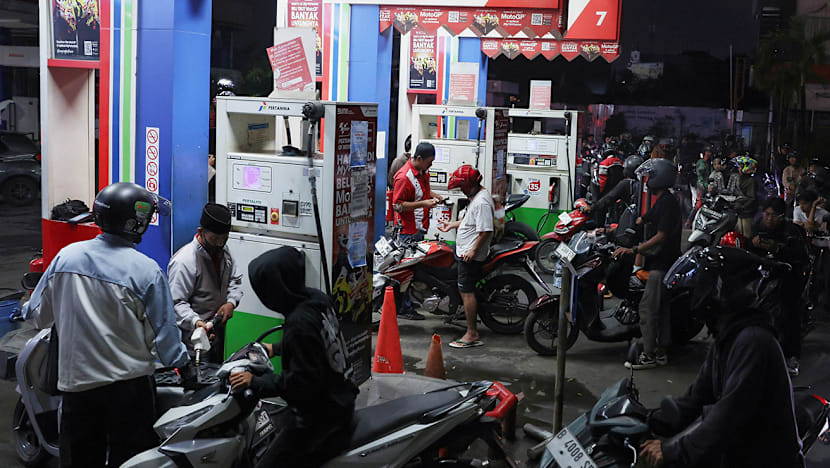
Indonesia last raised subsidised fuel prices in 2022, increasing diesel from 5,150 rupiah to 6,800 rupiah per litre, and petrol from 7,650 rupiah to 10,000 rupiah per litre. The move drove up the cost of food and household goods, fuelling widespread protests, strikes and unrest across the country.
Finance Minister Purbaya Yudhi Sadewa said on Apr 6 that the government will not raise subsidised fuel prices, at least until the end of the year.
“Subsidies are secure — there is no need to worry. We have done the math,” he told a parliamentary hearing, as quoted by BBC Indonesia.
However, several economists have questioned whether Indonesia has the fiscal capacity to sustain such subsidies if global energy prices continue to soar.


FINDING A MIDDLE GROUND
Between staying put and withdrawing from the BoP, analysts say there may be middle-ground options.
Rezasyah said Prabowo could show Washington that its decision to leave is a well-thought-out one.
“When he joined the BoP, (Prabowo) met with seven countries, many of them Islamic nations. There is still space to consult with them again on whether Indonesia should leave or stay,” he said.
By consulting other members of the BoP, Indonesia’s decision will appear less unilateral in the eyes of Washington should it decide to leave, he said. Conversely, if it chooses to stay, Indonesia’s decision would appear more thought-through in the eyes of many Indonesians.
Indonesia could also scale back its commitments. Options include postponing plans to deploy peacekeeping troops to Gaza until tensions ease, or downgrading its status from a full member to an observer if the conflict drags on.
“Public rejection of the BoP is not merely a technical policy issue, but a reflection of Indonesians’ sensitivity to global justice. The challenge for the government is to ensure that foreign policy pragmatism is not perceived as a compromise of principles,” said Agung of University of Indonesia.
The expert said Indonesia could strengthen strategic relations with the US in other fields to show that Indonesia still considers Washington an important partner, should it decide to leave the BoP or reduce its participation.
Another option is for Prabowo to leave the decision in the hands of the Indonesian parliament.
Under the country’s Constitution, all international agreements and alliances must be approved by the House of Representatives (DPR). This includes the BoP charter Indonesia signed on Jan 22 at the sidelines of the World Economic Forum in Davos, Switzerland.
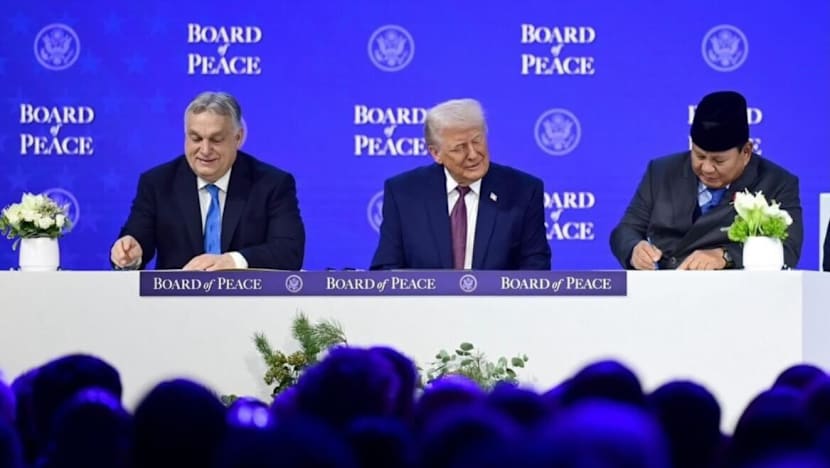
With more politicians calling for a reassessment, or even withdrawal, the BoP agreement may face hurdles during ratification.
Dave Laksono, deputy chairman of the parliamentary commission overseeing defence and security from Golkar, said lawmakers will begin the ratification process and ensure all views are considered.
“The ratification process is currently still in the discussion stage between the government and the DPR, with a focus on examining the substance and conducting a comprehensive analysis of the political, legal and national security implications,” Dave said on Apr 6, as quoted by Kompas.
Dave said he respects public calls urging Indonesia to withdraw from the BoP, but there are many things that parliament must consider.
“The final decision regarding ratification or a review of Indonesia’s membership must be placed within the framework of the nation’s strategic interests, its commitment to global peace, and coordination with international partners,” he said.
Adhe Nuansa Wibisono, a lecturer on international relations at Jakarta’s Paramadina University, welcomed the parliamentary process.
“By taking this to parliament, input and criticism from civil society groups, international relations experts and legal scholars can be channelled through a legitimate process,” he said.