analysis Asia
Sinking of Iran warship: 5 questions on US strike and whether Southeast Asia should be concerned
The shadow fleet of tankers carrying sanctioned Iranian oil and operating off the coasts of Singapore and Malaysia could become targets of the US and other actors as part of the Middle East war, say analysts.

This handout picture provided by the Iranian Defence Ministry on Mar 12, 2024 shows the Islamic Republic of Iran Navy frigate IRIS Dena (75) at sea during the "Maritime Security Belt 2024" combined naval exercise between Iran, Russia, and China in the Gulf of Oman. (Photo: AFP/Iranian Army office)

This audio is generated by an AI tool.


KUALA LUMPUR: The United States' sinking of a "prize" Iran warship off the coast of Sri Lanka suggests tankers carrying sanctioned Iranian oil that sail through busy Southeast Asian waters may not be safe either, analysts say.
While Iranian warships do not make frequent visits to the region, actors looking to disrupt Iran's income sources could target and destroy this "shadow fleet" of tankers instead, potentially creating environmental disasters and tension with coastal states in the Association of Southeast Asian Nations (ASEAN), the experts add.
For instance, the US could target commercial tankers in a military operation if Washington declares they are not being used for commercial purposes but are believed to be serving Iran’s military aims instead.
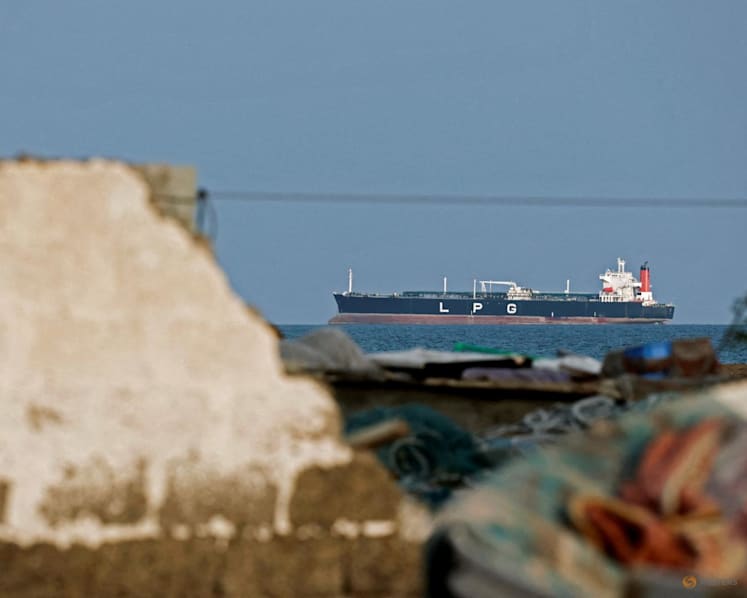
CNA reported last December that wars in Ukraine and the Middle East have pushed more of these shadow fleets of tankers into the region, according to observers. These ships carry oil from sanctioned Iran, Russia and Venezuela and transfer cargoes in the Singapore Strait to avoid detection.
They often use stolen identities and other tactics to hide their activities and evade scrutiny. Some may repaint their hulls, change flags and adopt new names to imitate legitimate ships and blend into surrounding traffic.
In 2023, Indonesia seized an Iranian-flagged supertanker suspected of being involved in the illegal transshipment of crude oil, after it spoofed its automatic identification system to show its position was in the Red Sea instead of in Indonesia’s Exclusive Economic Zone (EEZ).
According to experts, the US could also lawfully target Iran-linked merchant ships far beyond the Middle East combat theatre, if it can prove these vessels were being used for military purposes.

On Mar 4, a US submarine torpedoed the Iranian frigate IRIS Dena, with about 130 sailors on board, around 20 nautical miles off Sri Lanka's southern coast. At least 87 crew members were killed, said officials from Sri Lanka, which conducted a rescue operation.
Iran said on Mar 8 that 104 crew members were killed and 32 others injured.
"An American submarine sunk an Iranian warship that thought it was safe in international waters. Instead, it was sunk by a torpedo," US Secretary of War Pete Hegseth told reporters in Washington, calling the target Tehran’s “prize ship”.
The incident marked a dramatic expansion of the war and raised questions about the legitimacy of such a strike, including how it has impacted coastal states’ authority in their own backyard.
The United Nations Convention on the Law of the Sea (UNCLOS) defines a state’s territorial waters as extending up to 12 nautical miles (22.2km) from its baseline, with its EEZ extending up to 200 nautical miles immediately offshore.
While coastal states have resource rights in their EEZs, other states retain navigational freedoms. This means coastal states are not allowed to block Iranian or US ships from passing through.
If the Middle East conflict spreads to live strikes in the waters of Southeast Asia, regional bloc ASEAN could issue a statement condemning the move depending on where exactly it took place, although not much more especially if a major power like the US is involved, the analysts told CNA.
"Following the US Navy submarine sinking of IRIS Dena, it’s clear by now that the conflict zone can potentially widen,” said Collin Koh, a senior fellow at Singapore’s S Rajaratnam School of International Studies (RSIS).
“If the incident could take place in the Indian Ocean, and off Sri Lanka, it could definitely have the potential to replicate elsewhere.”
Here are five questions related to the US strike, and whether Southeast Asia should be concerned.
WAS THE US STRIKE NEAR SRI LANKA LEGAL?
Under the law of armed conflict, warships belonging to a state engaged in an international armed conflict are military objectives and may be lawfully targeted.
According to the San Remo Manual on International Law Applicable to Armed Conflicts at Sea, the area of naval hostilities could be conducted well beyond the waters of the belligerent parties, including in the high seas as well as neutral states’ EEZs and continental shelves, Koh said.
The San Remo manual's description of rules is widely recognised by legal scholars and states as an authoritative restatement of existing customary international law, including the law of armed conflict.

The Indian Navy has said that the sinking of the IRIS Dena took place about 20 nautical miles off Galle on the south coast of Sri Lanka.
IRIS Dena was one of three Iranian warships that had participated in a military exercise hosted by India between Feb 15 and Feb 21 in the coastal city of Visakhapatnam.
The Mar 4 torpedo attack places the warship outside Sri Lankan territorial sea, where “other user states could exercise freedom of navigation and as far as Washington is concerned, it includes the conduct of military activities”, Koh said.
CAN THE US CONDUCT STRIKES IN ANOTHER STATE'S TERRITORIAL WATERS?
However, Koh highlighted that the San Remo manual forbids hostilities in a neutral state's territorial sea, and where applicable, archipelagic waters.
In this case, Indonesia is of "huge interest and relevance" since it is an archipelagic state as defined by UNCLOS, he said.
Under UNCLOS, an archipelagic state, or one composed entirely of islands, can draw straight baselines connecting the outermost points of its islands, designating the enclosed waters as archipelagic waters.
Within these waters, the state exercises sovereignty, subject to rights of innocent passage and archipelagic sea lanes passage for foreign vessels.
In fact, the Iranian Navy ship that was sunk, IRIS Dena, visited Indonesia in 2022, while two Iranian warships visited Malaysia in February this year, noted Abdul Rahman Yaacob, a senior fellow at Verve Research, an independent think tank covering Southeast Asian foreign policy and security affairs.
If the US strikes a target in territorial waters of ASEAN states, this would constitute a violation of the country’s maritime sovereignty, he told CNA.
“Beyond strong statements, diplomatic repercussions would almost certainly follow,” said Rahman.
“Whether the particular ASEAN country will take military actions against the hostile submarines depends on several factors such as their naval capabilities and political will.”
SHOULD SOUTHEAST ASIA BE CONCERNED?
Any country should “certainly expect” Iranian frigates and corvettes to be targeted if they are outside its 12 nautical mile territorial zone, said Ridzwan Rahmat, principal defence analyst at Janes, a global security firm.
“But within Southeast Asia, there are very few places where this would happen as most are within the 12 nautical mile territory,” he told CNA.
Potential strike locations outside states’ territorial zones are the South China Sea, the Arafura Sea which overlies the continental shelf between Australia and Western New Guinea, and the Indian Ocean off Indonesia’s Sumatra, he said.
For now at least, RSIS’ Koh observed there are no known Iranian navy vessels currently operating in Southeast Asia on defence or naval diplomacy work.
“Expanding the conflict to strategic waterways in Southeast Asia appears to be a remote possibility for now, given limitations faced by Iran’s naval power projection capabilities,” he said.
“Still, notwithstanding the remote likelihood of such a contingency, ASEAN states should at least be prepared.”
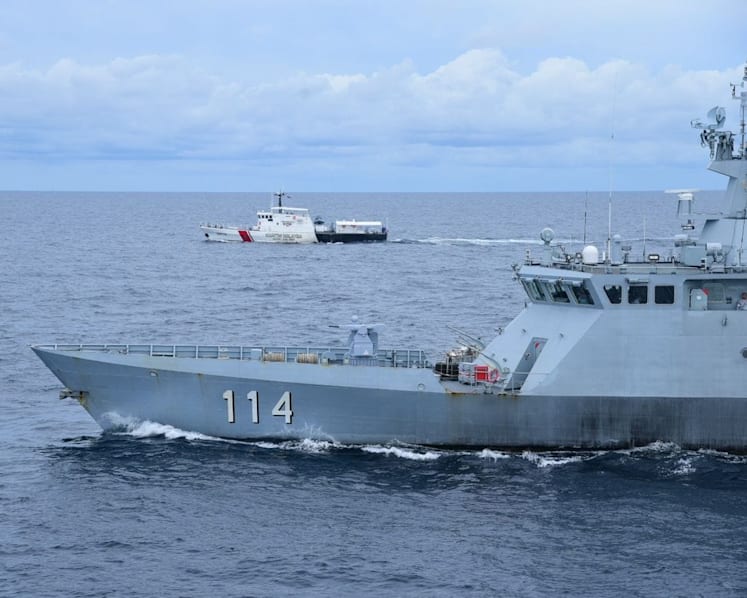
Rahman said the prospect of external powers using military force in Southeast Asia has “long concerned” several ASEAN countries.
Many fear that regional waters could become a battleground in the event of a military conflict between the US and China, he said.
He believes the IRIS Dena sinking has also opened a "Pandora’s box”: That any actor that is hostile to the US can target US warships outside the conflict zone.
While Iran’s submarines will not likely operate as far as Southeast Asia, its sympathisers could use small boats to attack US warships, including those making port visits to Southeast Asian countries, he said.
In 2000, terrorists used a small boat to hit the US destroyer USS Cole while it was refuelling in Yemen's Port of Aden, damaging the ship and killing 17 sailors.
On Mar 15, two US Navy littoral combat ships configured for minesweeping duties were spotted docked at a port in Penang, Malaysia, with the issue taking on a political slant after opposition politicians questioned how this aligned with Malaysia’s neutral stance in the Middle East war.
The USS Tulsa and USS Santa Barbara were reportedly in Malaysia for “brief logistical stops”, after previously being deployed in the Middle East.
Writing on Facebook on Mar 17, former Malaysian law minister and prominent government critic Zaid Ibrahim questioned the federal government’s alleged silence over the presence of the US ships in Penang.
“How come the Malaysian Navy is so quiet about this? It's most unusual that no announcement was made,” he said, adding that the defence or foreign minister must explain of this “friendly overture”.
“Do they not think the Iranian hypersonic missiles could not reach Malaysian ships and oil tankers?’ he asked, without stating if he was referring to Malaysian vessels in the region or elsewhere closer to the conflict zone.
Defence Minister Khaled Nordin said in a statement on the same day that the two ships had complied with established Malaysian procedures, and “there is nothing new about foreign navy vessels conducting port calls in Malaysian ports”.
On Mar 17, the US amphibious assault ship USS Tripoli was also seen off the coast of Singapore, reportedly en route to the Middle East as Washington looks to boost its military presence amid escalating regional tensions.
CNN had reported that USS Tripoli was believed to be carrying troops from the Okinawa-based 31st Marine Expeditionary Unit, a rapid-response force of 2,200 personnel.
Rahman from Verve Research said the US is an active defence partner in Southeast Asia, with many US warships visiting regional ports.
“Concerns over the security of these US warships will likely prompt ASEAN countries to step up security around them,” he told CNA.
COULD THE US TARGET IRAN-LINKED NON-NAVAL SHIPS?
Under the San Remo manual, merchant ships and tankers are civilian vessels and cannot be targeted, stressed Ridzwan from Janes.
At this point of time, only Iran has declared that it will attack US merchant vessels, he pointed out.
However, the US could also declare that Iranian tankers have shed their civilian purposes and are now serving military goals, making them legitimate targets, Ridzwan said, adding that the same applies to the shadow tankers in Southeast Asia.
“But chances are low in my opinion. Doing something like that will spook the oil market badly and this is something detrimental to Trump’s midterm elections (scheduled for Nov 3, 2026),” he said.
“He won’t do it although he could. Iran’s shadow fleet is like sitting ducks all over the world, especially around Singapore.”
While Rahman noted that Iranian warship visits to the region were “irregular”, he said ASEAN should be concerned about the number of dark fleet tankers operating off Malaysia’s Johor state that transfer crude oil believed to originate from Iran.
“Dark fleet tankers carrying sanctioned oil could be targeted by any actor who is keen to cripple Iran’s source of income,” he said.
“If these tankers are hit, we could see environmental disasters such as oil spills, affecting the maritime resources, but also the coastal communities in Malaysia, Singapore and perhaps Indonesia.”
RSIS’ Koh said Iran generally has no credible naval power projection that could be sustained beyond the Gulf region, save for the occasional naval cruisers conducting port calls to select Southeast Asian nations such as Indonesia.
But he warned that Iran’s Islamic Revolutionary Guard Corps Navy could still muster large, converted merchant ships that might operate in distant areas well outside the immediate Middle East combat zone.
“If Washington has concrete proof that the said vessel is in fact carrying out military-related operations other than commercial or private activities, it could still constitute a lawful target,” Koh added.
WHAT CAN ASEAN DO?
One step ASEAN could take is to proactively issue a statement affirming it does not tolerate hostile military actions in the territorial waters or EEZs of its member states, said Rahman from Verve Research.
“Such a declaration would send a clear signal to external powers not to bring their conflicts into Southeast Asia,” he said.
Mathiew Rajoo, partner at maritime and commercial law firm DennisMathiew, argued that strikes in ASEAN states' EEZs could be considered a grey area, highlighting that all ships have a "right of innocent passage" in an EEZ.
If a ship is suspected to be engaging in illicit activities in the EEZ, like conducting transfers while trying to mask its cargo’s origin, only the coastal state in charge of the EEZ should respond to this, he said.
If the US tries to justify a strike against a merchant ship or tanker in an EEZ by using the reason of armed conflict, Rajoo believes Washington and the coastal state will have "issues" to resolve.
“They (the coastal state) can say, ‘Why did you attack a ship that was passing through my EEZ?' It makes (the coastal state) look weak. You're not even defending your EEZ,” he told CNA.

Even if there were Iranian navy vessels operating in the region, RSIS’ Koh feels some Southeast Asian states might emulate India and Sri Lanka by “offering these ships and crews safe sanctuary to ride out the conflict, rather than having a (IRIS) Dena-style incident happen in waters under their jurisdiction”.
After participating in the military exercise hosted by India, the three Iranian warships - IRIS Dena, IRIS Bushehr and IRIS Lavan - were on Mar 1 given permission to dock at India’s ports, but for unclear reasons did not make it there that day.
IRIS Dena was torpedoed on Mar 4, while IRIS Lavan docked at the Indian port city of Kochi the same day. Sri Lanka allowed IRIS Bushehr to dock at a port in its northeast on Mar 5.
New Delhi has said “this was the right thing to do”, while Colombo said it would “never hesitate to protect humanity”.
“In the aftermath of an armed engagement in the regional waters, I also would at best expect ASEAN to issue a joint statement condemning such moves and invoking the TAC,” Koh said.
“But beyond that, we aren’t likely to see the TAC having any salutary impact on the actions of the belligerents.”
Related:
TAC refers to ASEAN’s Treaty of Amity and Cooperation in Southeast Asia, a legally-binding code for inter-state relations in the region and beyond that promotes peaceful coexistence and friendly cooperation.
While the US is a signatory to the TAC, the code does not necessarily shape realities on the ground, Rahman said.
He pointed to how Cambodia and Thailand, despite being ASEAN members, resorted to military force to address their border dispute in 2025.
"If similar incidents (such as the IRIS Dena sinking) occur within ASEAN, the organisation would likely issue a strong statement condemning the action,” Rahman added.
“Beyond that, however, ASEAN’s options are limited, especially if the actor responsible is a major power such as the US.”