Gardenia move: As Malaysia draws more Singapore manufacturers, experts flag competition fears
Companies like Gardenia, Yeo’s and APB Singapore are moving production operations from Singapore to Malaysia. While boosting investment, this could intensify competition for labour, industrial land and other limited resources, say observers.

A motorcyclist rides past a Gardenia delivery lorry in Johor Bahru on May 26, 2026. (Photo: CNA/Zamzahuri Abas)

This audio is generated by an AI tool.


JOHOR BAHRU: In Senai’s sprawling industrial belt, Gardenia Malaysia’s massive bakery sits alongside warehouses operated by tech giant Seagate and e-commerce heavyweight Shopee.
The facility, about 45km from the Tuas Second Link, is run by Singapore-listed QAF Group, owner of the Gardenia brand.
Last week, the breadmaker announced it would shift bakery production from its Pandan Loop facility in Singapore to Johor Bahru, a move that will see 141 workers retrenched.
Gardenia said the relocation is aimed at improving efficiency and staying competitive in an increasingly challenging global market.
While the company has not disclosed the exact site for the transferred production, the Senai facility is currently its only major plant in Johor.
According to QAF Group, the Senai plant can churn out 8,000 loaves of bread and 20,000 tortilla wraps every hour.
A Gardenia Malaysia employee told CNA that staff at the Senai plant have yet to be informed if more workers will be brought in following the announcement.
“We don’t know if there will be workers transferring from Singapore or if there will be new hires. Everything is still operating as usual,” said the employee, who declined to be named.
Analysts say Gardenia’s move reflects a growing trend of Singapore companies relocating manufacturing operations across the Causeway to cut costs and streamline production.





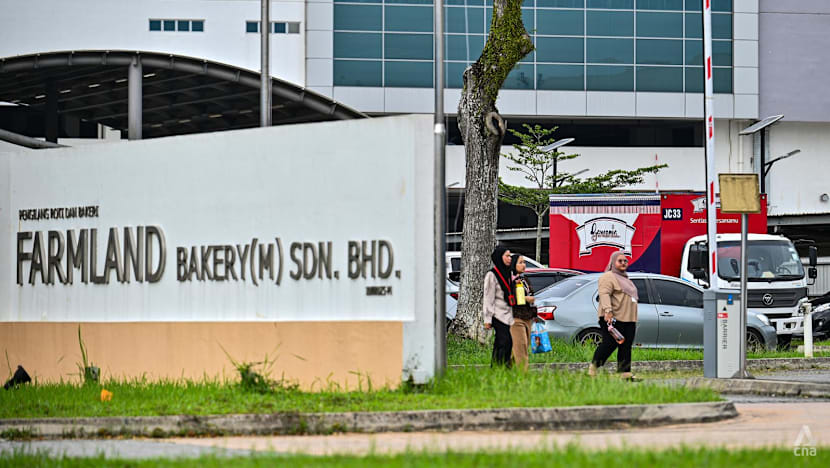
Similar shifts by major food and beverage players such as Asia Pacific Breweries Singapore (APBS) and Yeo Hiap Seng (Yeo’s) point to a broader “structural shift”, said Johor-based urban planning expert and property consultant Samuel Tan.
“Moving operations to Johor makes strong commercial sense given the changing economics of manufacturing in Southeast Asia,” added Tan, who is CEO and founder of Olive Tree Property Consultants.
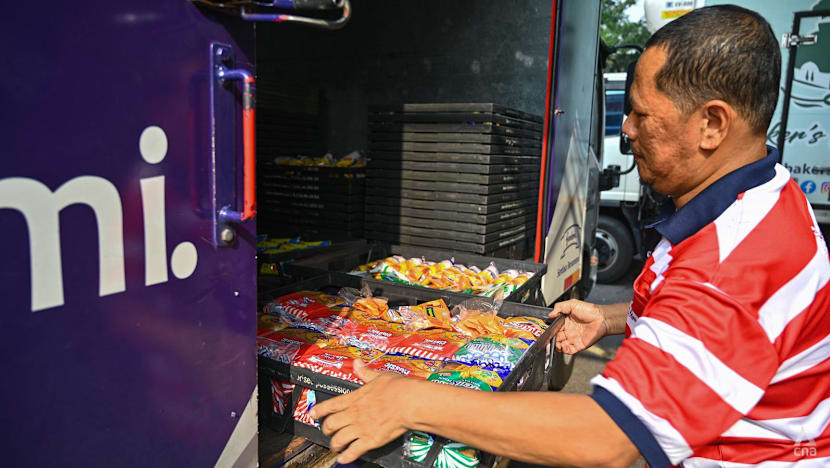
“Companies no longer need to produce goods in the same place where they sell them. Bread is perishable and delivered daily. Johor allows Gardenia to manufacture at a lower cost while still trucking fresh products into Singapore every day,” he said.
Experts said the trend is part of a wider regional supply chain realignment, with Singapore-headquartered firms increasingly shifting manufacturing-heavy operations to lower-cost neighbours like Malaysia.
The shift is expected to drive investment and economic growth, especially in Johor, which has gained momentum from incentives tied to the Johor-Singapore Special Economic Zone (JS-SEZ).
But any influx of companies could also intensify competition for labour, industrial land and other limited resources, a challenge already surfacing in Johor’s booming data centre sector.
Listen:
RISING COSTS GIVE ADDED PUSH
While Singapore firms shifting manufacturing to Malaysia is not new, analysts say the trend is accelerating as global pressures mount.
Rising costs linked to the Middle East crisis, coupled with generous tax incentives under the JS-SEZ, are pushing more companies to rethink where they produce goods.
The blueprint and masterplan for the JS-SEZ have not been launched but some Singapore companies are already moving operations across the Causeway and enjoying incentives that have been announced.
The trend of Singapore firms moving to Malaysia is part of “Singapore companies right-sizing their geography”, said Lennon Tan, president of the Singapore Manufacturing Federation (SMF).
It was “not a vote of no-confidence in Singapore” but, rather, how F&B players are restructuring their business, he said.
“F&B players like Gardenia, Yeo's and APBS are restructuring footprints — they are keeping HQ, brand, innovation, distribution and supply chain orchestration in Singapore,” said Tan.
In March, Yeo’s announced it would lay off 25 employees at its Senoko facility and shift manufacturing to Malaysia to "optimise capacity utilisation and strengthen overall manufacturing efficiency across its network".
The company said Singapore would continue to serve as its headquarters, cross-border logistics hub and smaller-scale manufacturing centre.
Separately, APBS, which brews Tiger Beer, said it would cut about 130 roles as it shifts production to other regional markets such as Malaysia and Vietnam.
Its Tuas facility is expected to be redeveloped over time to focus on logistics and innovation functions.
Meanwhile, Gardenia said that Singapore will remain the company's central hub for key functions such as brand management, product development, quality and regulatory oversight, daily distribution and supply chain operations.
Olive Tree’s Tan said Johor has become increasingly attractive because the JS-SEZ offers what he called the “most credible cross-border proposition Singapore manufacturers have ever had”.
Key incentives include a special corporate tax rate of 5 per cent for up to 15 years, sharply lower than Malaysia’s standard 24 per cent, alongside investment tax allowances of up to 100 per cent on qualifying capital expenditure for five years.



Economists say the investment wave into Johor has been turbocharged by policies tied to the JS-SEZ, creating spillover benefits across logistics, packaging, warehousing and other support industries.
In March, Johor announced RM110 billion (US$27.7 billion) in investments for 2025, the highest ever recorded by a Malaysian state. Chief Minister Onn Hafiz Ghazi said the projects are expected to create around 25,000 jobs.
Malaysia, as a whole, secured RM426.7 billion in approved investments in 2025, also a record high, with foreign investments making up nearly half the total.
Economist Sedek Jantan of IPP Financial Advisers said manufacturing investments typically create a multiplier effect.
“Every RM1 invested in manufacturing can potentially generate more than RM2 in wider economic activity over time,” he said.
Sedek added that the JS-SEZ mirrors the relationship between Hong Kong and Shenzhen in the 1990s, where Hong Kong retained higher-value corporate and financial functions while Shenzhen emerged as a manufacturing powerhouse.
He said the trend reflects a broader ASEAN supply chain realignment as companies restructure across borders to cope with weaker global demand, tighter margins and geopolitical uncertainty.

RAPID GROWTH COULD STRAIN JOHOR
Industry players warn that Johor’s investment boom may come with growing pains.
Teh Kee Sin, advisor of the SME Association of South Johor, said a sharp influx of Singapore and foreign firms could intensify competition for workers, industrial land and key resources.
“There will be stronger competition for skilled workers, which will push wages higher, while industrial rents and land prices are also likely to rise,” he said, urging both the state and federal governments to manage the growth carefully.
Economist Sedek agreed, warning that Johor could face “economic overheating and capacity constraints” if investments accelerate too quickly.
“A rapid influx of firms could tighten labour supply, reduce industrial land availability and strain infrastructure capacity,” he said.
“This may drive up input costs and crowd out smaller Malaysian businesses.”
Olive Tree’s Tan pointed to Johor’s fast-growing data centre industry as an early warning sign.
The sector has already placed pressure on water, electricity and land resources in parts of the state. Prime Minister Anwar Ibrahim acknowledged the issue in February, saying Putrajaya had begun rejecting applications for new data centres unrelated to artificial intelligence.
To prevent a similar strain in manufacturing, Tan said incentives should be more targeted rather than relying on broad tax holidays.
He proposed a “twinning” approach, where Singapore retains higher-value corporate, research and branding functions while Johor serves as the large-scale manufacturing base.
The strategy mirrors Singapore’s broader SG+ model championed by the Economic Development Board, which pairs Singapore’s strengths in business and innovation with lower-cost production hubs such as Johor and Indonesia’s Riau Islands.
“Giving tax incentives to firms that keep their regional headquarters or R&D centres in Singapore while locating manufacturing operations in Johor creates a win-win ecosystem for the region,” Tan said.
The restructuring trend is also raising concerns among Malaysians employed in Singapore factories.
Hundreds of employees have been affected by Gardenia and Yeo’s restructuring, and industry observers believe many of them are Malaysians who may struggle to find jobs that pay the equivalent back home.
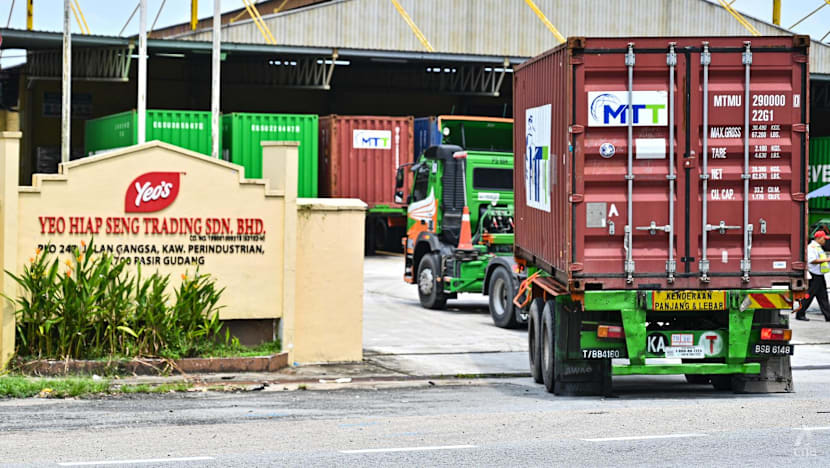
Outside Yeo’s factory in Pasir Gudang, one employee told CNA that similar manufacturing jobs in Johor typically pay RM3,000 to RM5,000 a month, compared with more than S$2,000 (US$1,566 or RM6,207) across the Causeway.
“The gap is still very big. There are few jobs in Johor that can match Singapore salaries,” said the employee, who declined to be named.
“But we also know these jobs in Singapore are becoming fewer, and you could lose them anytime.”
Lower labour costs remain one of Johor’s biggest advantages in attracting manufacturers, and this is unlikely to change anytime soon, Teh said.
Looking ahead, SMF’s Tan expects more Singapore firms to shift operations to Johor, particularly for food and beverage, consumer goods, packaging, light manufacturing and back-office functions.
High-value sectors such as semiconductors, biomedical sciences, aerospace and precision engineering are likely to remain anchored in Singapore, he said.
“These are exactly the industries the JS-SEZ was designed to support, so Singapore can focus on advanced manufacturing while Johor absorbs large-scale production,” he said.
“If your business is bulky, low-margin or commodity-driven, the future is likely in Johor or Batam, while headquarters and branding stay in Singapore. The question is no longer ‘Singapore or Malaysia’. It’s how companies can best use both.”