







Asian stocks pare losses as oil prices dip, Wall Street futures rise
Investors took some comfort from US President Donald Trump's decision to extend his ultimatum to strike Iranian power plants by 10 days.
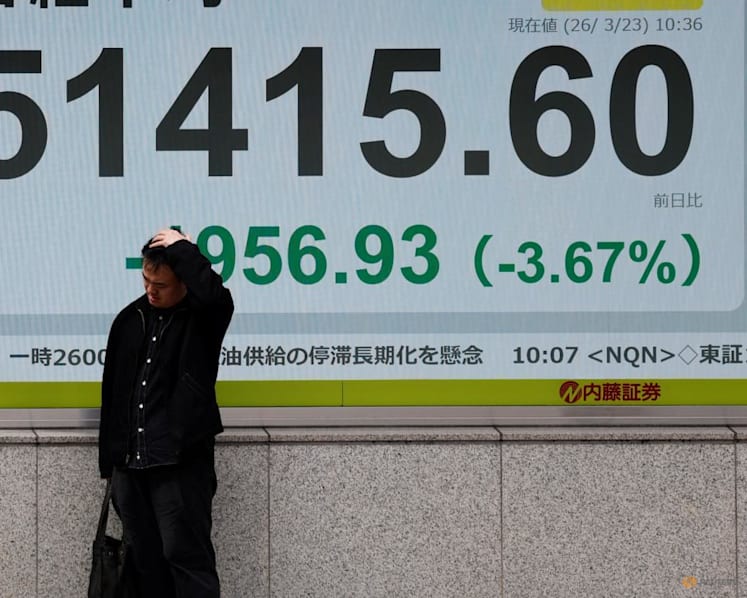
A man stands in front of a stock quotation board showing the exchange rates between the US dollar and Japanese yen, euro and Japanese yen and the Nikkei share average outside a brokerage in Tokyo, Japan, on Mar 23, 2026. (File photo: Reuters/Kim Kyung-hoon)
SYDNEY: Asian shares pared losses on Friday (Mar 27) as another delayed deadline in the Middle East war nudged oil prices lower, though there was still no end in sight to the unfolding energy crunch on the global economy.
Investors took some comfort from United States President Donald Trump's decision to extend his ultimatum to strike Iranian power plants by 10 days, after pushing back his initial 48-hour deadline by five days.
Brent crude futures slipped 0.7 per cent to US$107.23 a barrel, having jumped nearly 6 per cent overnight.
Wall Street futures rallied 0.6 per cent, after the Nasdaq Composite slumped 2.4 per cent overnight into correction territory.
Europe's EUROSTOXX 50 futures rose 0.7 per cent.
However, reports that Trump was considering sending more troops added to concern about the war escalating into a ground conflict, with no certainty that the Strait of Hormuz could be reopened to shipping soon.
Iran has dismissed a US proposal to end the conflict as "one-sided and unfair".
"It is in everyone's interests for this conflict to be short," said Diana Mousina, deputy chief economist at AMP.
"However, that’s not how wars often work as negotiations break down or there is a miscalculation. So it could still get worse from here."
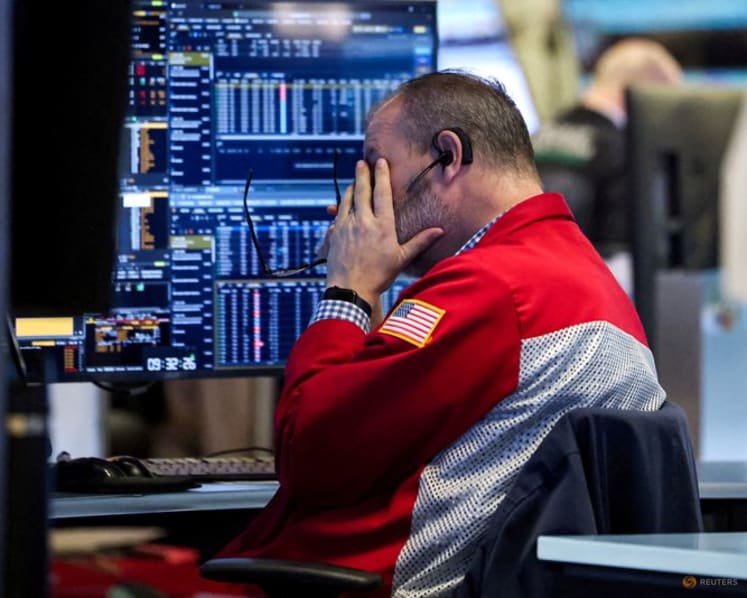
On Friday, MSCI's broadest index of Asia-Pacific shares outside Japan was last down 0.7 per cent, pulling back from earlier steep losses.
It was, however, still down 2.3 per cent for the week to mark the fourth straight week of declines.
Japan's Nikkei was last down 0.1 per cent, eking out a small 0.3 per cent rise for the week.
Chinese stocks bucked the trend, with the blue chips rising 0.7 per cent and Hong Kong's Hang Seng Index up 0.7 per cent.
Sources told Reuters that Beijing is considering easing shareholding restrictions for some major investors, in a move to broaden capital-raising options for commercial banks reeling from an economic slowdown.
.jpg?itok=hmZdPDJM)
GLOBAL BOND YIELDS SURGE
Norway's Norges Bank was the latest central bank to flag inflation risk and interest rate hikes ahead as the war rages on.
Having held policy steady on Thursday, the bank said it expected to raise rates this year, a stark contrast with its earlier forecast of three cuts by the end of 2028.
Global bond yields jumped anew after the climb in oil prices amplified inflation concerns.
Japan's 10-year yields rose 8.5 basis points to 2.36 per cent, while Australia's benchmark 10-year yields surged 11 basis points to 5.119 per cent.
The two-year US Treasury yield held steady at 3.9817 per cent on Friday, having jumped 10 basis points overnight as traders priced in more risk of a rate rise from the US Federal Reserve this year, which is about 50 per cent priced in.

In currencies, the US dollar slipped a little after three straight sessions of gains.
The risk-sensitive Australian dollar edged up 0.2 per cent to US$0.6905, having hit a two-month low of US$0.6872 earlier in the day.
The euro edged up 0.2 per cent at US$1.1544 after slipping 0.3 per cent overnight, while the yen hovered at 159.61 a dollar. Market watchers expect intervention should the yen hit 160.
Even gold prices climbed 2 per cent to US$4,468 an ounce.





