IATA warns replenishing jet fuel supplies could take months even if Hormuz reopened
The director general of IATA likened the situation to other shocks such as the downturns of 2008-09 or the aftermath of the Sep 11 attacks.
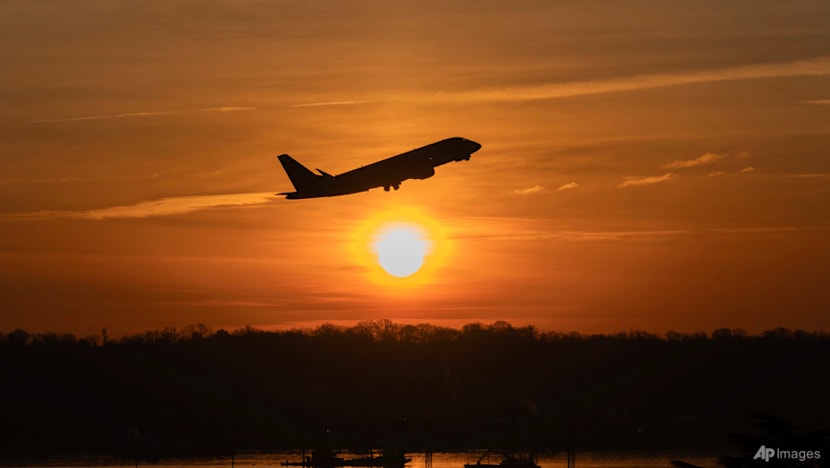
An airplane lifts off from Ronald Reagan Washington National Airport as the sun rises on Feb 3, 2025, in Arlington, Virginia. (File photo: AP/Jose Luis Magana)
SINGAPORE: The head of a body representing global airlines warned on Wednesday (Apr 8) it would take months for jet fuel supply to recover even if Iran reopened the Strait of Hormuz, given disruptions to Middle East refining capacity.
Fuel is the second-largest expense for air carriers after labour, typically accounting for about 27 per cent of operating expenses, according to the International Air Transport Association (IATA).
Iran's closure of the Strait of Hormuz as part of retaliatory moves in the war has choked supplies of jet fuel globally and news of a ceasefire and the possibility of safe passage through Hormuz sent airline stocks soaring.
Oil fell below US$100 per barrel after US President Donald Trump said he had agreed to a two-week ceasefire with Iran that was subject to the immediate and safe reopening of the Strait of Hormuz.





Willie Walsh, director general of IATA, told reporters in Singapore that while he expected crude oil prices to fall, jet fuel costs were likely to remain slightly elevated due to the impact on refineries.
"If it were to reopen and remain open, I think it will still take a period of months to get back to where supply needs to be given the disruption to the refining capacity in the Middle East," Walsh said.
He shrugged off comparisons to the COVID-19 pandemic, which crippled global travel.
"This is not similar to COVID. This is not a crisis anywhere close to what we experienced (in COVID)," he said. "In COVID, capacity reduced by 95 per cent because borders closed. We're nowhere near that."
The situation was more comparable to other shocks such as the downturns of 2008-09 or the aftermath of the Sep 11 attacks, he added.
"Post-9/11, the recovery took about four months. In 2008-2009 it was probably 10 to 12 months," he said.



AIRLINE SHARES SURGE
Airlines across Asia have been cutting flights, carrying extra fuel from home airports and adding refuelling stops as the Middle East conflict squeezes jet fuel supply, piling pressure on an industry already hit by a doubling of jet fuel prices.
Jet fuel prices normally move in tandem with oil prices, but they have more than doubled since the Iran conflict, far outpacing a 50 per cent rise in crude prices prior to the two-week ceasefire news.
The news and a possible safe passage through Hormuz lifted airline stocks across Asia. Shares of Australia's Qantas Airways jumped more than 9 per cent, Air New Zealand rose over 4 per cent, Hong Kong's Cathay Pacific climbed 5 per cent, while India's IndiGo soared as much as 10 per cent
Walsh said the hit to capacity for Gulf carriers, which last year accounted for 14.6 per cent of international capacity, would be temporary.
"Some of that capacity will be replaced by airlines outside of the region ... but there's no way they can replace the (entire) capacity that was provided by the Gulf carriers," he said, adding that data from April and May would provide a clearer picture of the scale of disruption.
"I fully expect the Gulf hubs to recover and recover quickly," he said.
On refining capacity, Walsh said the reopening of the strait, if sustained, would be positive not just for crude flows but for refined products, including jet fuel.
"It will take some time for refineries outside of the region to adapt and increase," he said, pointing to India and Nigeria as countries with capacity to increase refined product output in the interim.
Walsh added he "would like" to expect China and South Korea to resume exports of refined products once crude flows resumed.
"So there is (refining) capacity available once we get the crude oil flowing, but it'll take a little bit of time, and with the crack spread elevated the way it is, I think that provides an incentive for refineries to increase the production of jet fuel," Walsh said.
The crack spread refers to refinery margins.