Commentary: Japan's Takaichi needs more than her winning personality
A landslide election win sets Prime Minister Sanae Takaichi up to be one of the strongest, most consequential leaders Japan has known for years, says Gearoid Reidy for Bloomberg Opinion.
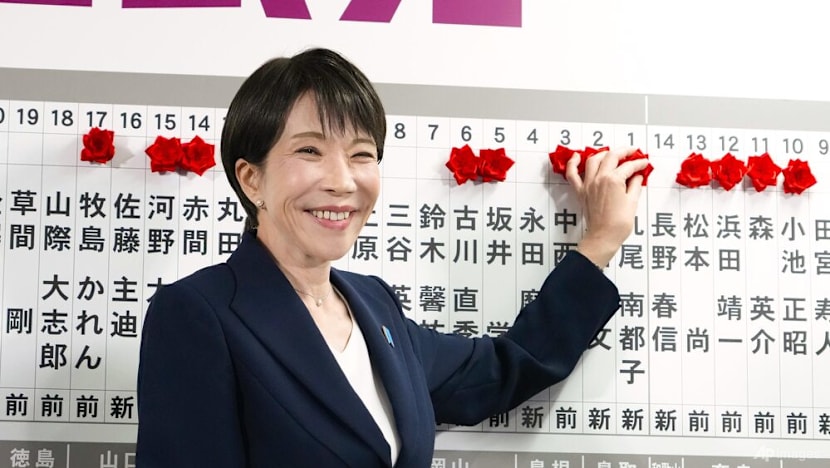
Sanae Takaichi, Japan's prime minister and president of the ruling Liberal Democratic Party (LDP), puts pins marking the names of candidates who won lower house elections at the LDP headquarters Sunday, Feb. 8, 2026 in Tokyo. (Keisuke Hosojima/Kyodo News via AP)
TOKYO: The streets of Tokyo were dusted with a rare snowfall as election day broke on Sunday (Feb 8), while other parts of the country were issuing emergency alerts as a blizzard gripped much of Japan.
It’s perhaps for this reason that a country with several of the snowiest regions hasn’t had a winter election for decades. But bad weather couldn’t deter the electorate, which turned out in greater numbers than in the last vote in 2024. They were given a simple question: whether or not to endorse Prime Minister Sanae Takaichi with a mandate to rule.
Past prime ministers have typically hung such votes on a policy issue. Takaichi made this an election about herself. In a gamble on her popularity, she called on the electorate to endorse her, personally.
“As a country with a parliamentary system, there is no means by which the citizens can choose their prime minister directly,” she said last month. “I want the Japanese people to make the decision directly on whether to entrust the management of the nation to Sanae Takaichi.”





RESOUNDING VICTORY
Management has been entrusted. Now, she must repay that trust.
The margin of victory is far more resounding than almost anyone could have expected. Her 316 seats exceeds the achievements of any leader of the Liberal Democratic Party (LDP). Even Shinzo Abe, her late mentor who became Japan’s longest-serving leader, did not realise this level of success.
A two-thirds majority in the lower house makes her minority position in the upper house largely an irrelevance, as bills rejected by the upper house can be forced through. And it sets her up to be one of the strongest, most consequential leaders the country has known for years.
Partly, she’s benefited from the quality of her opponents. The Centrist Reform Alliance, hastily formed from the traditional opposition party and the LDP’s former coalition partner, was a disaster, managing to be weaker than the sum of its parts. But perhaps any opponent would have struggled against a politician who is arguably the most naturally gifted of her generation.
The victory will show us the true Takaichi. With its precarious position in both houses of parliament, her government has so far been reactive. Now she has a mandate to enact her vision - but exactly what that is remains a little unclear. In making this election a referendum on the prime minister herself, policy has fallen a little to the wayside.

WHAT TAKAICHI STANDS FOR
Before asking what Takaichi stands for, let’s make clear what she’s not.
Many reports still brand her as an “ultraconservative” or “ultranationalist” - labels that confuse far more than they inform. She is a conservative, yes, but suggestions that she is a radical are wide of the mark. In most countries, her policies of a strong economy and healthy defensive posture would be firmly centrist.
There is one major change she might now pursue - the first revision of Japan’s constitution. The win gives her the potential to pursue that policy, a long-standing goal of the LDP that even Abe was never sufficiently emboldened to attempt.
Takaichi has already shown her appetite for risk, and spoke on the campaign trail of revising the US-imposed pacifist constitution to recognise the nation’s military. With a sufficient majority in the lower house, and enough parties that say they want revision in the upper, it’s an idea whose time might soon come.
That would prove extremely unpopular in Beijing. China was one of the big losers on Sunday, as its campaign to exert economic and political pressure on Takaichi over her comments on Taiwan backfired spectacularly. But ignore those who say she is “provoking” Japan’s neighbour.
The episode will only push her closer to Washington, where she’ll visit next month. US President Donald Trump likes a winner, particularly one he has backed - though Takaichi may not have appreciated his last-minute endorsement of her, the type of interference Tokyo usually deplores. The prime minister can leverage that to get further into Trump’s good books, perhaps securing better terms on tariffs or a more forceful backing of Tokyo’s position with Beijing.
It’s important to note also that Takaichi is not some advocate for irresponsible spending, despite so much market commentary to the contrary. She has not done the greatest job in outlining her economic policy. Rather than spend like crazy, she is seeking a change in the nation’s attitude to break free of austerity.
Admittedly, that is not what people immediately associate with Japan because of its historic debt levels. But the reality is that as a whole, the country saves far more than it should and spends less than it needs.
What this means in practical terms isn’t yet clear. Her proposal to temporarily cut the sales tax on food to zero disappeared during the election campaign, but reappeared immediately in media interviews as the scale of her triumph became clear. She’d have been best advised to drop it.
It’s one example of how Takaichi shouldn’t let success go to her head. First and foremost, she must be more careful with her remarks: Her comments on Taiwan and the weak yen, misinterpreted though they have been, sparked distractions she could do without.
But most importantly, a victory based on personal popularity requires her to maintain that appeal and connection with the electorate. That calls for swift action. Until now, she’s had the advantage of being seen as an outsider with the ruling party. Now, she owns it - warts and all.