







Commentary: Washington courts Manila, but the rest of Southeast Asia is watching
The region has a dilemma in engaging the US, as it faces the economic fallout of President Donald Trump’s actions in the Middle East, says Kevin Chen of the S Rajaratnam School of International Studies.
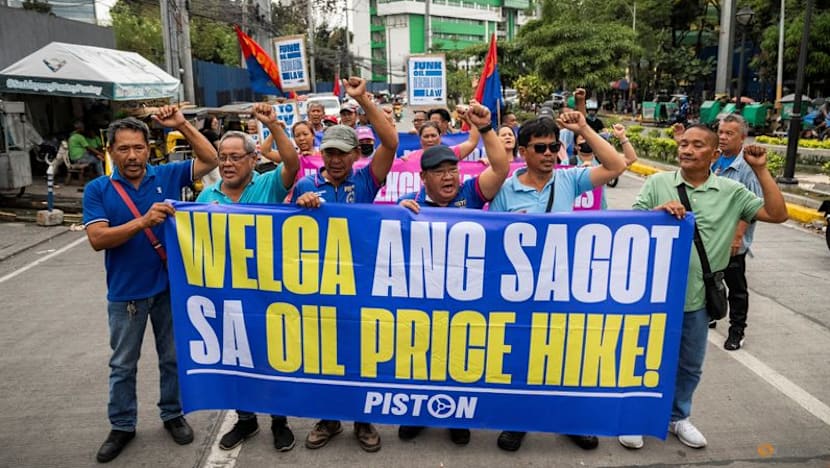
Members of a transport group, mostly jeepney drivers, raise their fist as they march during a protest against oil price hike amid the US-Israel conflict with Iran, near a gas station in Quezon City, Metro Manila, Philippines, on Mar 9, 2026. (Photo: Reuters/Lisa Marie David)

This audio is generated by an AI tool.


SINGAPORE: Much of the world’s attention is now focused on the fallout of the Iran war. Oil prices are spiking. Disrupted supply chains and energy concerns are weighing on economic prospects. And there are fears about the longer-term destabilising impact of US actions.
But a quieter display of American engagement is taking shape in Southeast Asia – on the Philippine island of Luzon.
When United States President Donald Trump returned to the White House in January 2025 and placed many of America’s aid mechanisms on the chopping block, there were dire predictions about what it meant for US influence in this region.
So it might come as a surprise that the Luzon Economic Corridor, a Biden-era initiative to invest in transportation, clean energy and semiconductor supply chains on the island, is alive and well.
US$60 million in foreign assistance funding was committed to the Philippines in July 2025, a quarter of which was dedicated to developing the economic corridor. In April, a 4,000-acre (about 1,620ha) high-tech industrial hub was announced in New Clark City, undergoing development north of Manila.
That same month, the Philippines joined Pax Silica, a US-led initiative to secure artificial intelligence supply chains, in which Singapore also participates. While meant to promote US economic security and reduce Chinese dependency, the coalition also promises to help countries climb the tech value chain and attract investments.
This is good news for Manila, and a welcome sign for the rest of the region. Washington’s approach to the Philippines shows a viable blueprint for how it intends to work with Southeast Asian partners. But whether it is a durable strategy under a volatile Washington is the bigger question.
A HEAVY DEFENCE FOCUS
The industrial hub and Manila’s membership in Pax Silica bears the hallmarks of US economic initiatives under Mr Trump. These initiatives are not guided by altruism, but business opportunities and economic security.
Such an economic focus would be a welcome change for the Philippines. The driving force behind US-Philippine ties over the past 16 years has been defence and security issues, with Manila seeking US support for its maritime claims and Washington wanting arrangements to aid it in the event of a Taiwan contingency. However, the concern has been that this defence focus came at the expense of economic engagement.
This defence focus has only intensified over the past year, with the US military unveiling a string of new military facilities and investments in the Philippines. These include plans for a naval repair facility on Palawan, an ammunition production facility, and a new depot for fuel and lubricants on Mindanao.
These projects are accompanied by a surge in financing, including an exemption from the US blanket security assistance freeze and the authorisation of up to US$1 billion in military sales to the Philippines under the 2026 National Defense Authorization Act.
But as Philippine Ambassador to the US Jose Romualdez remarked in 2024: “If we do not have economic security, we can have all these defence agreements, and it would mean nothing to us.”
NEW MODEL OF US ENGAGEMENT
In this light, the New Clark City hub and Filipino involvement in Pax Silica come as welcome developments.
Collectively, they provide an important opportunity for the Philippines to ingrain itself into multinational supply chains, increasing its attractiveness as an investment destination and supporting the growth of the domestic semiconductor industry. In return, US companies would be able to leverage mineral resources (including nickel, copper, chromite and cobalt) for operations in the hub and back in America.
While the hub may be confined to the US and Philippines, other partners such as Japan have been increasing their involvement in the Luzon Economic Corridor.
The US$3.2 billion Subic-Clark-Manila-Batangas railway is expected to break ground in 2027 with backing from both Tokyo and Washington, after an earlier plan funded by China fell through. The US and Japan have also jointly funded training programmes for telecommunications since 2022, when the Asia Open Radio Access Network (RAN) Academy was launched.
There are hopes that the New Clark City Hub will serve as Pax Silica’s first “Golden Node”, becoming a key manufacturing location and inspiration for future hubs in the Philippines and other partner countries.
PARTNER AND PROVOCATEUR
However, how closely Southeast Asian countries should integrate themselves into US-led initiatives is the bigger dilemma. Mr Trump’s Washington can be both partner and provocateur.
While there are economic benefits to be reaped, Mr Trump’s penchant for weaponising trade links to extract concessions is a known risk. He has not hesitated to slap tariffs on close partners like Canda, to wield them over non-trade issues like immigration, narcotic trafficking or to resolve diplomatic issues such as the Thai-Cambodian border conflict.

In addition, there are also political risks to partnering the US when Mr Trump’s disruptive actions are starting to hurt. The Philippines declared a one-year “national energy emergency” in March due to its high dependency on Middle East imports.
With little forthcoming aid from Washington beyond sanctions waivers so the Philippines can purchase oil from Russia, Philippine lawmakers have been outspoken in their frustration. Filipino Senator Panfilo Lacson accused Mr Trump of “brinkmanship” and “narcissistic arrogance” for dragging countries into the disruptive war. Even President Ferdinand Marcos Jr lamented that the Philippines is a “victim of a war we did not choose or desire”.
These sentiments encapsulate Manila’s dilemma. But the same will confront other Southeast Asian capitals deciding the limits of their engagement with Washington.
Efforts to cooperate with Washington will not evaporate overnight due to these tensions. US partners, however, will likely explore contingency measures, including working with China, to safeguard their own interests. Washington might be arriving at a new model of cooperation, but so too are its partners.
Kevin Chen is an Associate Research Fellow with the US Programme at the S Rajaratnam School of International Studies (RSIS), Nanyang Technological University (NTU), Singapore. He writes a monthly column for CNA, published every first Friday.





