analysis East Asia
‘New positioning’ in Sino-US ties: What does ‘constructive strategic stability’ really mean?
Chinese President Xi Jinping says he and US President Donald Trump have agreed on a relationship based on “constructive strategic stability”. Analysts weigh in on what the "new positioning" means.
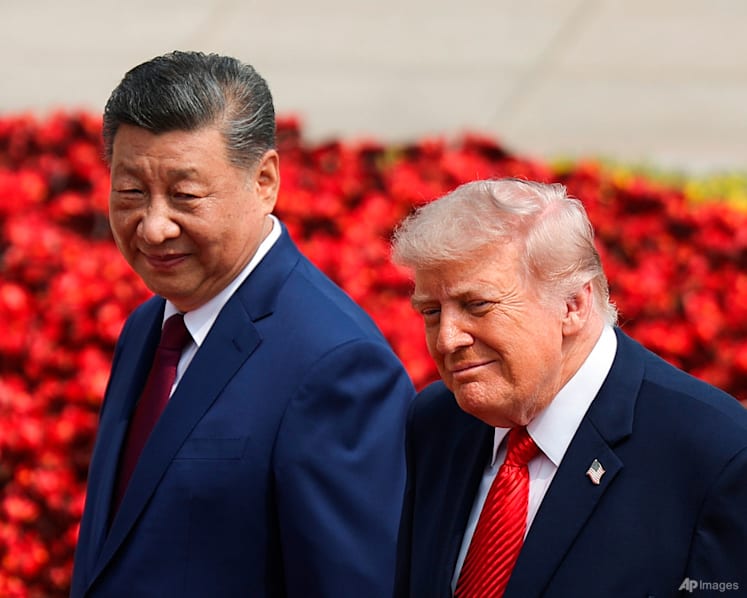
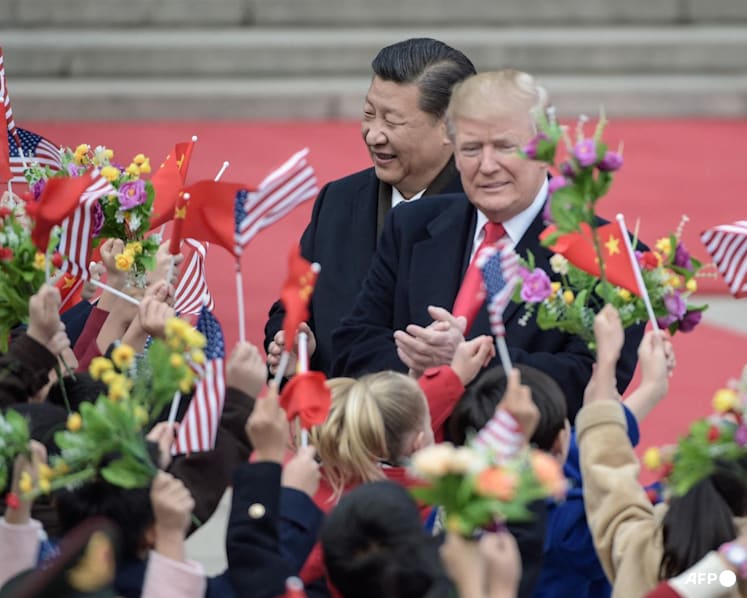
US President Donald Trump and Chinese President Xi Jinping attend a welcome ceremony at the Great Hall of the People in Beijing on May 14, 2026. (Photo: AP/Maxim Shemetov)

This audio is generated by an AI tool.


BEIJING: A Sino-US relationship based on “constructive strategic stability” - that was the new phrase introduced by Chinese President Xi Jinping on the first day of his high-stakes summit with United States counterpart Donald Trump.
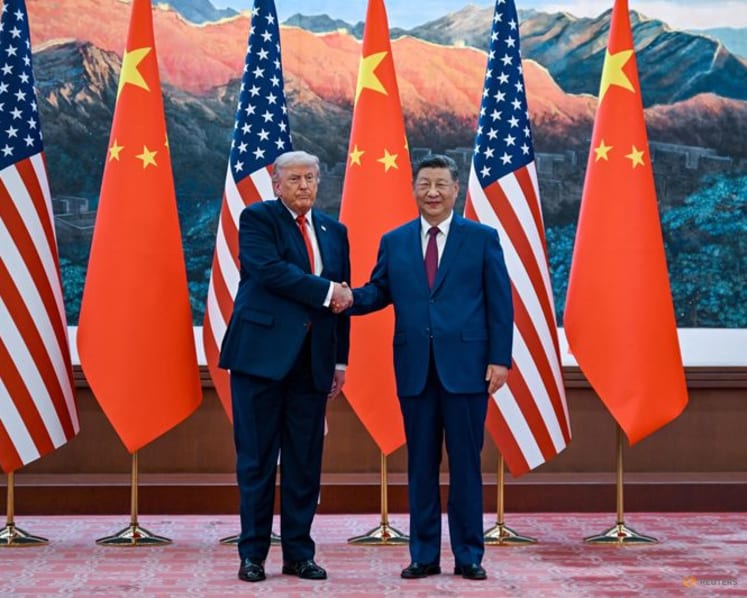
During their meeting on Thursday (May 14) at the Great Hall of the People in Beijing, Xi said he and Trump agreed to make such a relationship the “new positioning” of bilateral ties, according to the Chinese readout.
Centred on cooperation as the mainstay, measured competition, manageable differences and “lasting stability” where peace can be expected, this formulation would guide China-US ties for the next three years and beyond, the Chinese supremo added.
Analysts say Xi’s remarks reflect the clearest signal of how Beijing wants to frame the next phase of US-China relations - not as a reset, but as long-term competition managed within limits.





“The side that names the relationship is the side setting its terms … Beijing is making the first framing move,” said Li Yaqi, a research assistant specialising in international relations at the S Rajaratnam School of International Studies (RSIS) in Singapore, told CNA.
Analysts added that the formulation suggests Beijing is not trying to end strategic competition with Washington, but to define the boundaries within which that competition should unfold. In that reading, “stability” is less a concession than a way to keep rivalry controlled, sustained and less likely to spiral into crisis.
They also noted Xi’s broader message to Trump contained warnings about the risks of the so-called “Thucydides Trap” - the idea that conflict can arise when a rising power challenges an established one - while again emphasising the Taiwan issue as the “most important issue” in bilateral ties.
BEIJING COINS NEW FRAMEWORK
Analysts said the phrase “constructive strategic stability” goes beyond diplomatic packaging, reflecting Beijing’s attempt to shape the vocabulary of the next phase of US-China ties before other narratives emerge.
China does not introduce new diplomatic formulations casually, Li said, adding that Xi’s claim that both leaders agreed to make it the “new positioning” of the bilateral relationship puts China’s commitment on record first.
“It does not mean Washington has necessarily internalised the formulation in full, but it allows Beijing to shape the first interpretive layer of the summit before the US side reduces it to a list of deliverables for the domestic audience and announces ‘wins’,” he said.
The White House readout of the Trump-Xi talks did not refer to the “constructive strategic stability” formulation, nor did it describe it as a new framework for US-China ties.
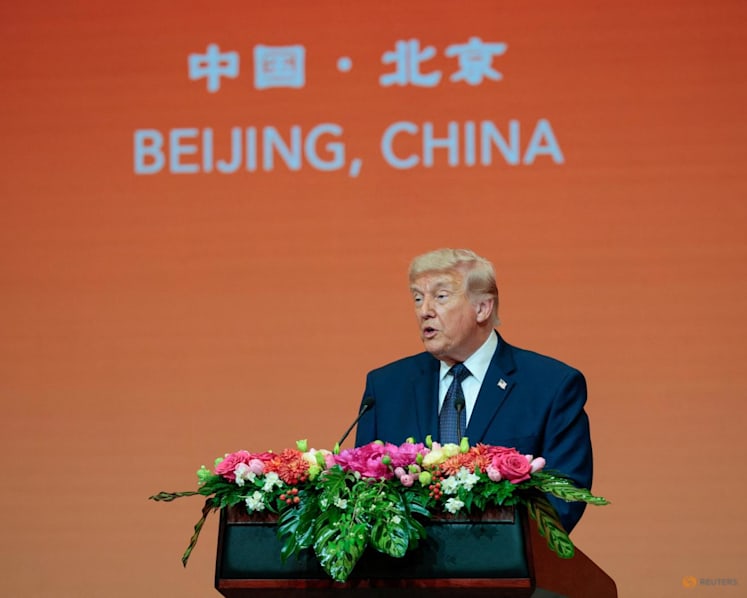
In his speech during the state banquet on Thursday evening, Trump did not mention or refer to the phrase, even though the Chinese leader repeated the phrase and again said both leaders have agreed to it.
Trump spoke instead about a longstanding “bond of commerce and respect”, describing it as the foundation for a future that benefits both the US and China.
“We value hard work. We value courage and achievement, we love our families and we love our countries. Together we have the chance to draw these values to create a future of greater prosperity, cooperation, happiness and peace for our children,” he said.
Referring to the “next three years and beyond” timeframe indicated by Xi, Li said it is significant because it appears designed to cover the rest of Trump’s term till January 2029 while extending into the early stage of the next US administration.
“Beijing is not only managing Trump personally; it is trying to create a durable reference point that outlasts this particular summit cycle,” he said.
Analysts said the latest formulation marks a notable adjustment in Beijing’s language.
"It's new language and I think it reflects China's desire to put more institutional guardrails around US-China relations, both competition and cooperation," Joe Mazur, a geopolitics analyst at Beijing-based consultancy Trivium China, was quoted as saying in a Reuters report.
James Chen, an assistant professor of diplomacy and international relations at Tamkang University, said the concept reflects Xi’s attempt to frame bilateral ties “not as mere rivalry, but as competition within a stabilised context”.
China, he said, is seeking to set boundaries for long-term competition and reduce the risks of destructive rivalry, particularly over Taiwan.
MANAGING RIVALRY WITHIN LIMITS
A similar tone ran through Xi’s opening remarks, which framed US-China ties through a broader lens of global order, historical choice and crisis management, analysts said.
That big-picture framing stood in contrast to Trump’s more personalised approach, as the two leaders struck markedly different notes at the start of their talks in Beijing.
Xi cast the relationship as one with global consequences, while Trump leaned on personal praise and ceremony, analysts said.
Ian Seow, a senior analyst in the China Programme at the S Rajaratnam School of International Studies, said Xi’s remarks were notable for situating the bilateral relationship in a wider global context.
“He underscored the importance of US-China relations for global stability,” he said.
That approach, he added, could reflect China’s attempt to project itself as a responsible major power in managing ties with Washington.
Tang Meng Kit, a Singaporean freelance analyst and commentator, said Xi’s reference to whether both sides can overcome the so-called “Thucydides Trap” was significant.
By invoking the term, Xi acknowledged the structural tension between a rising and established power, while reframing the question as whether both leaders could “write a different chapter”, Tang said.
“It brings a philosophical dimension and ambition, and it positions Xi as a statesman thinking in historical arcs, not just trade deals,” he said.
Analysts said the Taiwan issue - which featured prominently in the Chinese readout of the talks but not in the US readout - showed where the limits of that stability may be tested.
Describing it as “the most important issue” in China-US relations, Xi said that if the matter is handled properly, bilateral ties could remain generally stable.
But if mishandled, he warned, the two countries could “collide or even come into conflict”, pushing ties into a “very dangerous situation”.
Xi also said “Taiwan independence” was incompatible with peace in the Taiwan Strait and urged the US side to handle the issue with utmost caution.
According to the Chinese readout, he said maintaining peace and stability across the Taiwan Strait represented the greatest common ground between Beijing and Washington.
China regards Taiwan as its territory and has not ruled out the use of force to bring the island under its control.
The US is the island’s key international backer even as it does not formally recognise Taiwan diplomatically. Washington is also bound under the Taiwan Relations Act to provide Taipei with the means to defend itself.
Chen from Tamkang University said Xi’s emphasis on Taiwan made clear that Beijing views the issue as its top priority, with language that was sharper than during Trump’s 2017 visit.
He pointed in particular to Xi’s references to “collision”, “conflict” and a “very dangerous situation”, saying these were stronger and more serious than the wording Xi used nine years ago.
By explicitly linking “Taiwan independence” to peace in the Taiwan Strait, Xi is signalling that any stable US-China relationship will require Washington to move closer to Beijing’s position on the issue, Chen said.
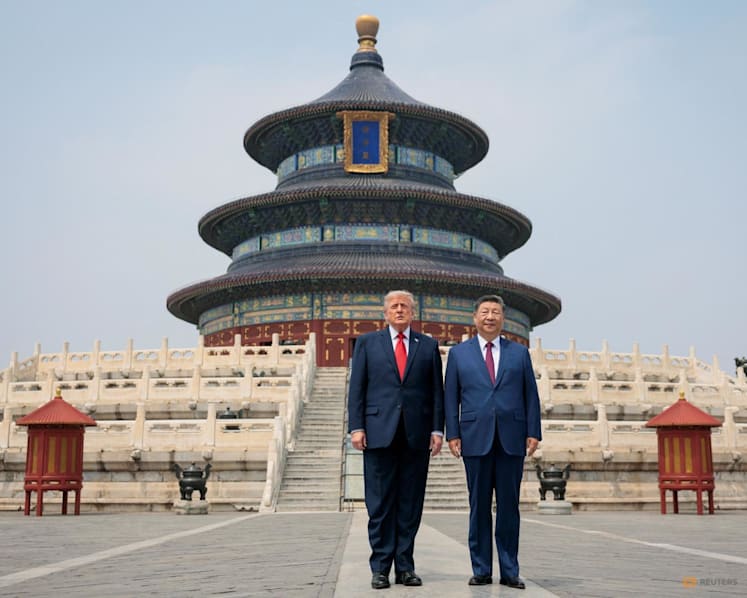
During a visit with Xi to the Temple of Heaven on Thursday afternoon, Trump did not answer when asked by reporters whether they discussed Taiwan.
FROM WORDS TO ACTION
The harder test now is whether the new formulation produces practical channels that can manage friction after the summit glow fades, analysts said.
The two-day summit is set to wrap up on Friday, when more detailed outcomes are expected to be released, which could offer a clearer picture of how both sides intend to manage a crowded agenda spanning trade, technology controls, Taiwan, Iran and broader crisis communication.
Li from RSIS said the new framework tries to set the “meaning, scope, and tempo” of the rivalry, but its value will depend on whether Beijing and Washington can build mechanisms around it.
That could include more regular diplomatic and working-level exchanges, clearer crisis-management channels, and discussions on areas where competition is already hardening, including export controls, sanctions, investment reviews and technology restrictions.
Beijing’s aim may be to develop its own set of strategic-economic tools while keeping enough room for cooperation to cushion the sharper edges of competition, said Li.
Such mechanisms would matter because the relationship is likely to remain competitive even if both sides want to avoid rupture, analysts said.
Zhao Minghao, an international relations expert at Shanghai's Fudan University, was quoted as saying in a Reuters report that frictions, such as those over the Iran conflict and recent US sanctions on Chinese firms may test the durability of the new framework and continue to "complicate US-China dynamics".
Jean-Pierre Cabestan, an emeritus professor of political science at Hong Kong Baptist University said there was a need for the US and China, as major economies and powers, to keep cooperation going.
“They don't want to see the relationship derail, leading to more uncertainty and more instability,” he told CNA in a TV interview.
In terms of concrete measures, there will likely be more trade, as well as more discussions on political issues ranging from Taiwan and the Middle East to the Indo-Pacific region, Cabestan said.
He added that the way forward would be to keep communication channels open and to “intensify” them so the relationship remains stable.
Chen from Tamkang University said China and the US are likely to establish working-level dialogues or groups “to reduce misjudgments and prevent escalation”.
“It’s a very significant first step to set the tone of Trump’s second term with China,” he said.
“But Trump may also change his mind after returning home. Who knows, right?”