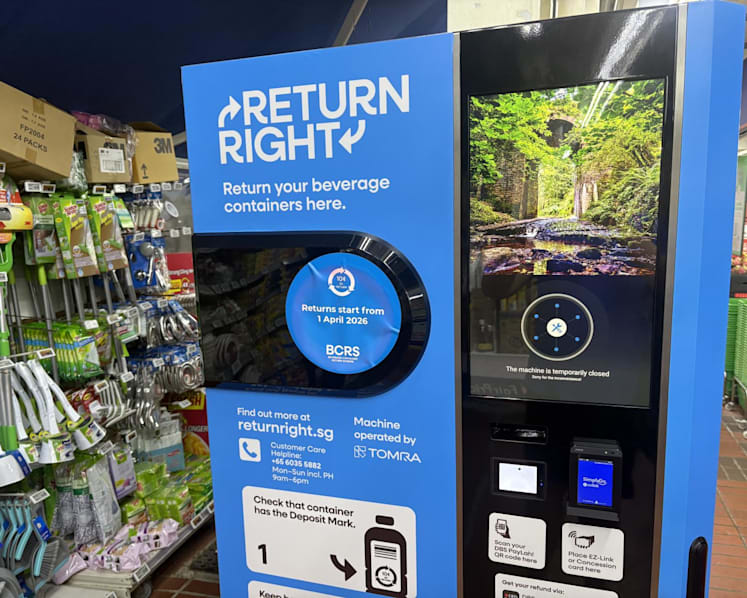
New search function launched for Singapore residents to find nearest beverage container return points
Supermarkets, retail outlets, hawker centres and institutes of higher learning are among key locations that will have Return Right machines.
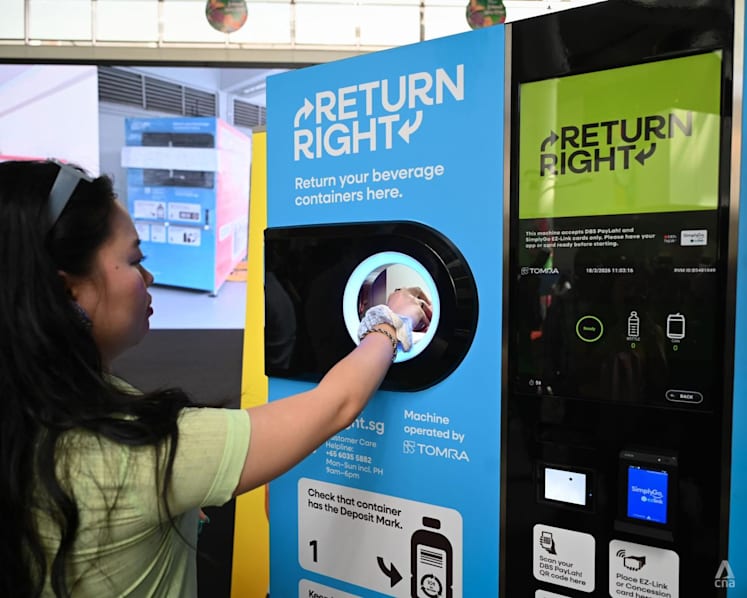
A consumer placing a beverage container into a Return Right machine on Mar 18, 2026. A total of 1,070 of these machines will be deployed across Singapore from Apr 1. (Photo: CNA/Syamil Sapari)

This audio is generated by an AI tool.


SINGAPORE: Singapore residents who want to find their nearest beverage container return machine can do so from Wednesday (Mar 18) with the launch of a search function on the website for the upcoming new national recycling scheme.
Ahead of the Beverage Container Return Scheme (BCRS) which is set to launch on Apr 1, residents can find locations of the Return Right machines and their operating hours via returnright.sg. It will also include the locations of about 160 upcoming machines that will be deployed progressively in the coming months.
A total of 1,070 machines will be deployed across Singapore during the launch, with over 90 per cent of Housing and Development Board (HDB) households within a five-minute walk of a machine. The number of return points is expected to double to 2,000 within the first year of implementation.
In addition to housing estates, more than 430 supermarkets and retail outlets will have Return Right machines in their premises, the National Environment Agency (NEA) and Beverage Container Return Scheme Limited (BCRS Ltd), the consortium appointed to operate the scheme, said in a joint media factsheet on Wednesday.





The machines will also be deployed at more than 610 Town Council-managed areas, as well as at 17 hawker centres that see high footfall, the agency and operator added.
Within the next few months, all hawker centres will have either an on-site machine or have access to a machine nearby.
Other key locations include institutes of higher learning, which will each have at least one machine. For industrial areas, 36 locations with high footfall areas will also have machines deployed in the coming months.
Additional locations will be identified based on the beverage container return rate and footfall patterns of workers in industrial areas, NEA and BCRS Ltd said.
Plans are also underway for the machines to be available at large migrant worker dormitories and all recreation centres, they added.
BCRS Ltd will monitor return patterns and gather feedback from the community to determine optimal placement for new return points.
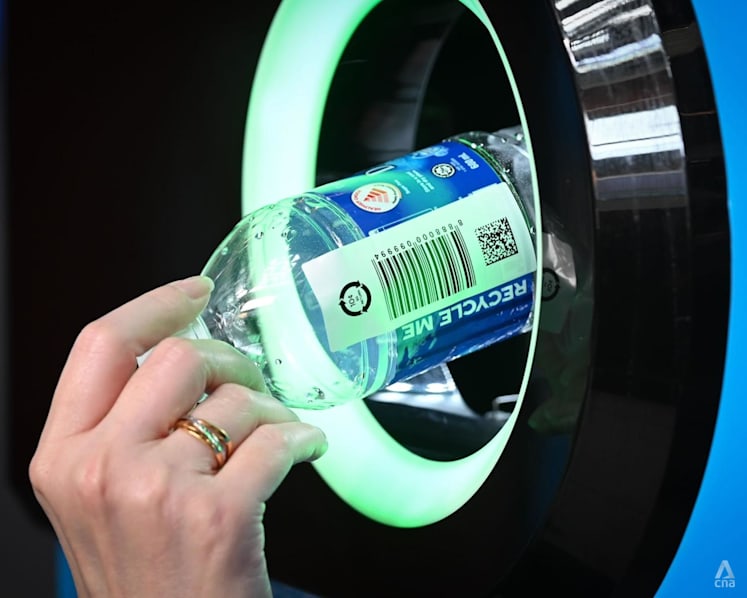
These updates were shared during a preview of the Return Right machines on Wednesday.
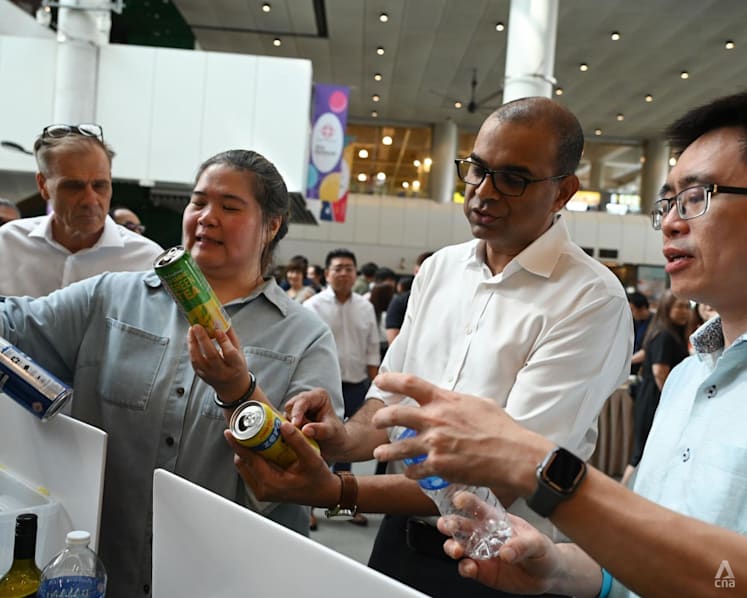
Senior Minister of State for Sustainability and the Environment Janil Puthucheary, who attended the event, was given a guided tour showing containers that are eligible and those that do not meet the requirement, as well as a map of the machine locations.
Dr Puthucheary also tried his hand at returning beverage containers, and was given a demonstration on how the machines will reject some bottles and cans such as those that are full or whose barcodes are no longer intact.
He told reporters that those involved in the scheme want to work with feedback as well as suggestions from consumers, retailers and producers on where they can further deploy the machines.
He earlier also mentioned during a talk with BCRS Ltd CEO Stephanie Yip that many assumptions are going to be challenged when the scheme launches.
"We've made assumptions about what are good locations for machines. We've made assumptions about how many times a day machines will have to be cleared, whether people will return them in the supermarkets or close to their homes," he said.
"So we're going to have to be quite agile, I think, over the first six months as Singaporeans shift their behaviour for recycling."
Under the beverage container return scheme, consumers will pay a S$0.10 (US$0.08) refundable deposit when purchasing pre-packaged beverages in plastic bottles or metal cans between 150ml to 3L.
Eligible containers will carry a new BCRS deposit mark, making it easy for consumers to identify which drinks come with the charge.
Refunds will be credited to EZ-Link cards, concession cards or DBS PayLah! wallets.
Three network operators - RVM Systems, SG Recycle and TOMRA - have been appointed to support the nationwide rollout of the scheme. These operators will supply and manage the entire network of Return Right machines across Singapore, handling end-to-end deployment and operations at supermarkets and community locations.
This includes installing and maintaining the machines, ensuring uptime and reliability, and managing the collection of returned containers.
HELPING MICRO PRODUCERS
NEA had earlier announced a grant of up to S$2,500 to producers who register with BCRS Ltd before Apr 1. This grant will help to offset costs such as product registration fees, producer fees, and the cost of scheme stickers.
To further support these businesses, BCRS Ltd is introducing a special registration concession for eligible micro producers, removing the requirement to register individual products for those supplying fewer than 50,000 units of beverage products annually.
For a start, the concession will apply to aluminium cans. Eligible micro producers can purchase up to 50,000 pre-serialised stickers each year under the beverage container return scheme as a substitute for individual product registration.
These stickers, which are unique to each micro producer, include the Deposit Mark and a 2D matrix to ensure consumers can successfully receive their deposit refunds.
NEA's Beverage Container Return Scheme Producer Transition Grant can be used to cover the cost of these stickers, the agency and BCRS Ltd said.
Between 50 and 100 companies are estimated to qualify for the special concession, based on engagements with micro producers, they added.
In line with the extended transition period of six months for producers to clear existing stocks not labelled with the deposit mark, the sticker quota for the first BCRS year - covering Oct 1, 2026 to Mar 31, 2027 - will be prorated. For example, the available quota for the six-month period will be 25,000 stickers.
"NEA and BCRS Ltd remain committed to engage producers of all sizes, offering practical support to facilitate their onboarding to the BCRS," the agency and operator said.
Dr Puthucheary added that the relevant agencies and operators have taken an adaptive approach in rolling out the scheme.
"We've adjusted some of the things that we've had to do in engaging with the industry, supporting small producers, supporting micro producers," he said adding that this approach will continue going forward even after the scheme is launched.
BCRS Ltd CEO Stephanie Yip said: "Our hope is that Return Right eventually becomes invisible, meaning it becomes a natural part of our daily routine that we don't even have to think about it.
"It’s about helping every Singaporean to know that their small individual action is directly contributing to a much larger recycling goal for Singapore."
Ms Yip had asked Dr Puthucheary what he was expecting from the operators. To this, he first noted that their effort has been worth it as people are talking about sustainability and what it will take for Singapore to shift its recycling rate.
He added that he hopes those involved are not thinking of the scheme going out on Apr 1 as a "functional outcome", but rather that they will be active partners in changing the conversation and shifting the mindset of Singapore and Singaporeans.
Ms Yip also said that one of the first challenges she expects to face is Singapore consumers getting excited about the scheme but not having the correct containers with the deposit mark.
Dr Puthucheary said there will be community volunteers using the machines as a focal point to guide residents who want to return their beverage containers.
He added that there are also community and non-profit groups who are excited about the opportunity to engage, refresh and energise people and that this was a starting point for another wave of education and engagement around sustainability and recycling.
"If we can do that, then we've achieved yet another level of success. And I'm hoping that I can see that type of activity."