







Budget 2026 debate: PAP MPs call for prudence, caution amid global uncertainties
Members of Parliament from the People's Action Party also urged for more social support for vulnerable groups in society.
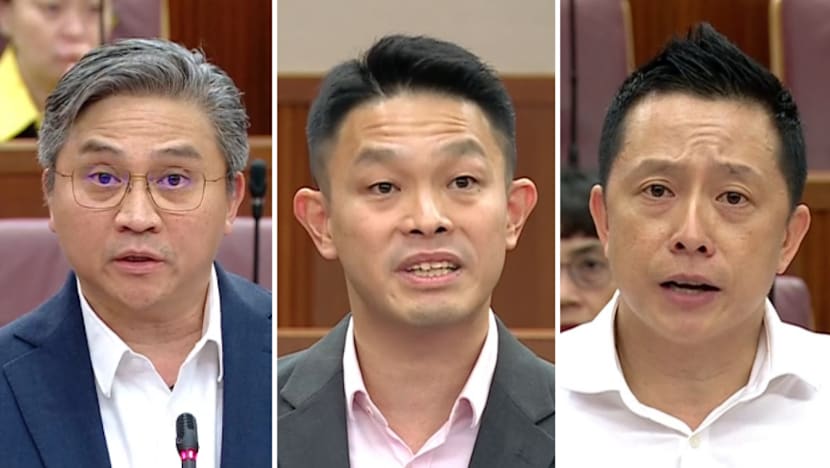
MPs Saktiandi Supaat, David Hoe and Yip Hon Weng speaking in parliament on Feb 24, 2026.

This audio is generated by an AI tool.


SINGAPORE: Members of Parliament from the ruling People’s Action Party (PAP) on Tuesday (Feb 24) called for prudence amid global uncertainties, as Singapore recorded a surplus of S$15 billion (US$11.8 billion) for the 2025 financial year.
More than 30 MPs spoke in parliament on the first day of the Budget 2026 debate, with some raising suggestions on how the most vulnerable in society can be better supported
The surplus for the current financial year is more than double the earlier estimate of S$6.8 billion.
A number of PAP MPs opened their speeches by noting heightened global uncertainty due to geopolitical tensions.





“The global environment is rapidly evolving. We are witnessing heightened geopolitical rivalry, economic fragmentation and a growing willingness by some states to prioritise what they believe to be national interests over collective commitments,” said MP Vikram Nair (PAP-Sembawang).
“While international law remains indispensable, we must also be realistic and prepare for a world in which non-compliance is going to be more common and where major powers may not always abide by either the letter or the spirit of international commitments.”
Prime Minister Lawrence Wong said in his Budget speech last Thursday that the stronger economic position was partly driven by better-than-expected economic performance, highlighting the increase in corporate income tax collections.
The financial year 2025 ends on Mar 31, 2026.

PRUDENCE AND CAUTION
Despite the fiscal surplus, MPs called for prudence and caution in spending.
MP Saktiandi Supaat (PAP-Bishan-Toa Payoh) noted that residents had asked him why there were not more "goodies" in light of the Budget surplus.
"This is an understandable question, but the surplus reflects, in part, the volatility of the global environment. Unexpected developments, whether geopolitical tensions or trade disruptions, can quickly affect growth and revenue.
"While we performed better than expected in 2025 as our economy grew 5 per cent, beyond our expectations ... we cannot assume that such conditions will persist," Mr Saktiandi said.
Likewise, MP Yip Hon Weng (PAP-Yio Chu Kang) said that Singapore's prudence was an asset as it gave the country options to act in times of uncertainty.
"In a more dangerous world, fiscal strength is national defence. Our buffers are not excesses. They are strategic insurance," he said.
Fiscal resilience is strategic capability as it preserves Singapore’s strategic autonomy, said MP Yip Hon Weng. Given its current surplus position, perhaps it can signal stability by avoiding further tax increases in the near term, he said in parliament on Tuesday (Feb 24). Mr Yip noted that the government may need to raise revenue but stressed that revenue adjustments should be designed with cost pressures firmly in mind. Where space exists, it should be used to cushion households and strengthen trust. Trust must also underpin Singapore’s AI transition, he said. If Singapore gets it right, it will not merely adopt AI but will guide, shape and humanise it.
SUPPORTING SINGAPOREANS
The PAP MPs noted that the surplus does not in itself ease the cost-of-living pressures faced by Singaporeans, with some turning to how resources can be better deployed to help individuals cope.
Some MPs raised tax-related suggestions.
Mr Saktiandi proposed raising the income tax threshold for tax exemptions from the current S$20,000 to S$25,000 or S$30,000, given that median incomes have increased.
The median monthly household income in Singapore rose to S$12,446 last year, up from S$11,558 the year before, an increase of 6.8 per cent after adjusting for inflation.
"More low and middle income earners enter the tax base not because they are significantly better off, but because the system has not been recalibrated," Mr Saktiandi said, adding that this would provide meaningful relief to low and middle income groups.
Parliament on Tuesday (Feb 24) began its debate on Budget 2026 delivered by Prime Minister Lawrence Wong. MP Saktiandi Supaat kicked off the debate by expressing support for the Budget and addressed the “life-cycle economic security” of Singaporeans. He also touched on the retirement adequacy of Singaporeans and wanted to know the government’s assessment on the success of the Central Provident Fund (CPF) Board's Matched Retirement Savings Scheme. He also wanted to know more about the new CPF life-cycle investment products, and asked the CPF Board to provide scenario-based projections to strengthen confidence among Singaporeans so that they can adequately provide for themselves after retirement.
Mr Yip proposed avoiding further tax increases in the near term, given the current surplus position.
Similarly, MP Shawn Loh (PAP-Jalan Besar) said the fiscal surplus should give the government more confidence to assure Singaporeans that it would not take "major revenue-raising moves" up to 2035, barring any material adverse circumstances.
Nominated MP Terence Ho said that a balance must be struck between setting aside funds for rainy days, investing in infrastructure capabilities and human capital, and strengthening social support.
He also suggested reframing the Community Development Council (CDC) vouchers scheme as part of a broader social support framework.
Vouchers and credits can be repositioned as a social dividend, an annual sum given to citizens that signifies that they have a stake in the country and its collective wealth, said Assoc Prof Ho.
"The government can determine the size of the dividend it declares each year, depending on prevailing fiscal and economic conditions," he said.
"The dividend should be universal and progressive, meaning that everyone receives something, or the less well off receive more. A social dividend would be a form of social support that complements the structural transfers, is flexible in size and sends a clear message of solidarity and inclusion."
Echoing his sentiments, Mr Loh suggested a surplus sharing mechanism in the form of more CDC vouchers if the surplus exceeds a threshold.

SOCIAL SUPPORT
Some of the MPs also urged stronger support for families and vulnerable groups.
MP David Hoe (PAP-Jurong East-Bukit Batok) asked for support for parents in the form of housing, reduced transport-related stress and childcare leave.
To support large families, the government should make it easier for those planning to have more children to secure homes of an adequate size, Mr Hoe said.
He suggested introducing larger “jumbo Build-to-Order” flats designed for modern families, including space for domestic helpers.
These flats could be priced similarly to smaller units through additional subsidies, but with conditions — such as requiring couples to commit to having two or more children within five to seven years of the minimum occupation period.
If they do not meet the condition, a clear downsizing pathway with subsidy clawbacks would apply, while allowing for reasonable exceptions such as medical fertility issues.
Singapore’s total fertility rate, which was at a historical low of 0.97 in 2024, suggests that Singapore has not been successful in shifting the needle on encouraging Singaporeans to have children, said MP David Hoe in parliament on Tuesday (Feb 24). He proposed a shift from “doing 'more' in an aggregate manner, to doing 'better'”, addressing the concerns of adequate space in HDB flats, mobility and commuting stress, paid childcare leave and accessibility to play areas for children. He also raised the issue of a widening opportunity gap and equitable access to opportunities among families with children.
He also suggested keeping childcare leave provision under periodic review.
Currently, parents get six days of paid childcare leave per child when their child is six years or younger. When the child is aged between seven and 12, the parent gets two days a year.
Mr Hoe said that when a child turned seven, the government could still keep the number of childcare leave to six days a year and taper off the number of leave days, so it is not a sharp drop.
MP Jackson Lam (PAP-Nee Soon) called for better support for seniors who are healthy and willing to continue working.
He proposed piloting structured second-career pathways in sectors with strong labour demand and combining modular training, job redesign and clear job placements for workers aged 55 and above.
Job-specific digital skills modules and a clearly identified senior skills track could lower barriers to participation, he added.
"Ultimately, supporting seniors is not just about financial adequacy. It is about dignity, contribution and about sustaining intergenerational trust, and that trust strengthens us, especially in uncertain times."




