







Budget 2026 debate: Pritam Singh calls for full disclosure of billions in public spending amid record surplus
The Workers’ Party chief says the public deserves detailed “report cards” on how taxpayer funds are used.
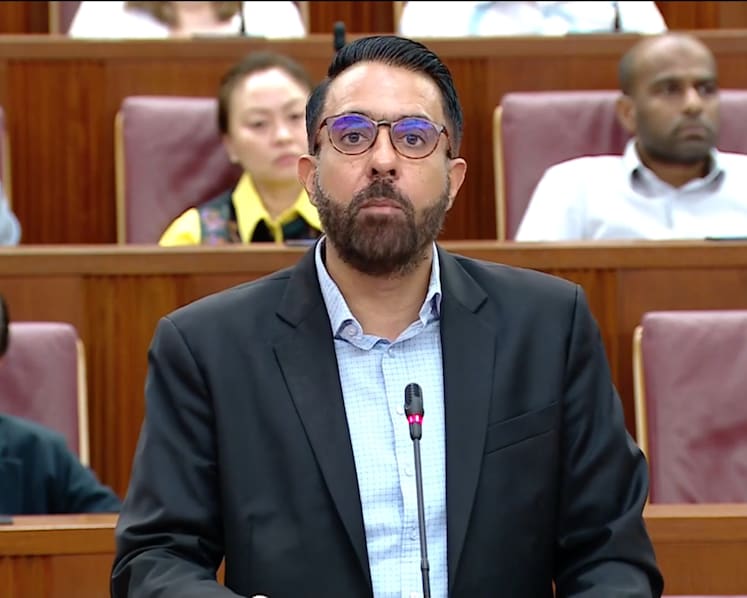
Workers' Party chief Pritam Singh speaking in parliament during the Budget debate on Feb 24, 2026.

This audio is generated by an AI tool.


SINGAPORE: Workers’ Party chief Pritam Singh has called for greater public disclosure of billions of dollars in government spending, pressing for clearer accountability at a time he described as “one of the largest fiscal surpluses in decades”.
Speaking in parliament on Tuesday (Feb 24) at the start of the Budget debate, Mr Singh also took aim at the timing of the last General Election, saying it was called shortly after global trade tensions flared.
“The PAP (People's Action Party) government dissolved parliament just days after the Trump administration's announcement,” he said, referring to the so-called Liberation Day tariffs unveiled by the United States last year.
“The political timing of the general elections was calculated to put the PAP in the most advantageous position, with tariff uncertainty serving as a rallying call for voters to back the tried and tested," he said.





“Since then, however, there has been remarkably little information on the sectoral tariffs and their actual impact on Singapore.”
Despite the “doom and gloom” surrounding the tariffs then, Mr Singh noted that the government now begins its new term “with what may be the greatest fiscal surplus any PAP government has seen in decades”.
Singapore recorded a surplus of S$15 billion (US$11.8 billion) for the 2025 financial year and expects an S$8 billion surplus for the 2026 financial year – figures Mr Singh said already far exceed the S$2 billion to S$3 billion in additional annual revenue that the Goods and Services Tax (GST) hikes of 2023 and 2024 were meant to generate.
Corporate tax collections are also expected to rise from the 2027 financial year, potentially widening the surplus further.
CALLS FOR ACCOUNTABILITY
Against this backdrop, Mr Singh said “significant” public interest surrounds how these surpluses get deployed, particularly as Singapore grapples with an ageing population and persistent inequality.
Pointing to the S$40 billion Forward Singapore package announced during Budget 2024, he said: “To my knowledge, there has been no well-publicised tracking of cumulative spending since then.”
On the Research, Innovation and Enterprise (RIE) 2030 plan – for which funding has increased to S$37 billion – Mr Singh said “no comprehensive report” existed on how previous allocations were used or what outcomes were achieved.
“There is much work still to be done in demonstrating how efficaciously taxpayer dollars have been spent. Across most Budgets, there is a lack of easy-to-track outcomes on the headlines that have been announced.”
He said the government should be mindful of the “public cynicism and detachment” that can grow when Singaporeans do not see a clear accounting of how public funds are used.
“That is not good for Singapore, and it sits in contradiction with the participatory spirit that Forward Singapore was meant to embody,” he said.
The time has come to refine the CDC Vouchers Scheme to better help Singaporean families, said MP Pritam Singh. He proposed a “simple and targeted adjustment” - retain the S$500 base for all households of three members or fewer. For owner-occupied households with more than three members, provide an additional S$150 per person. This is a modest and practical refinement that better reflects the actual cost-of-living burden that larger families carry, he said. It was among the suggestions he proposed in parliament on Tuesday (Feb 24), as he stressed that “taking care of our own” represents one standard by which all government policies will be unpacked, measured and scrutinised by the Workers’ Party.
SURPLUS FORECASTING
MP Gerald Giam (WP-Aljunied) pressed further on the government's fiscal projections, and what he described as a “recurring pattern of overly conservative” forecasts.
The revised FY2025 surplus of S$15.1 billion is more than double the original estimate of S$6.8 billion – a discrepancy Mr Giam said was not an isolated incident but part of a consistent trend in which "projected deficits regularly transform into healthy surpluses".
“While the government points to the volatility of tax revenue, this consistent underestimation raises fundamental questions of … whether the government is unnecessarily hoarding funds," he said.
“We need more accurate forecasting that ensures our nation's abundance benefits current generations as much as future generations.”
Mr Giam also questioned the necessity of the GST hike, which was supposed to fund increased healthcare costs, since surpluses had exceeded S$1 billion in all but one of the last five years, with a total of S$22 billion.
He pointed out that the Ministry of Health's revised operating expenditure for FY2025 came in S$305 million lower than estimated, due to lower-than-projected funding needs for public healthcare institutions, and asked whether the government would revise its projections for future healthcare expenditure growth.
He also flagged a sharp rise in revenue from licences and permits, which surged by 29 per cent to reach S$9.23 billion in revised FY2025 figures, and sought clarification on what drove the increase.
“True prudence is not just about amassing vast fiscal buffers. It's about balancing future security with the current needs of our people,” he said.
“Unnecessary taxation drains liquidity from households up front, creating a dependency on government handouts rather than fostering genuine financial independence.”
MINISTERIAL BONUSES AND GDP GROWTH
Mr Singh raised questions about whether the formula used to determine ministers’ bonuses remains appropriate, in light of Deputy Prime Minister Gan Kim Yong’s earlier remarks that GDP growth may no longer translate into jobs for Singaporeans.
During a mid-term update for the Economic Strategy Review last month, Mr Gan said that economic growth may not automatically lead to job creation given technological advancements, and Singapore needs to be "deliberate" about its policies and strategies.
Mr Singh said those remarks placed "every job-related policy, initiative and scheme" announced by the government into “sharper perspective than ever before”.
“For each – more so than before – Singaporeans deserve a well-publicised and detailed report card, one that distinguishes rhetoric about promises kept with measurable outcomes subject to parliamentary and public scrutiny,” he said.
He also questioned whether GDP growth should continue to factor into the national bonus for ministers. "If GDP growth will no longer reliably create good jobs for Singaporeans, should it remain in the ministerial bonus formula at all?" he asked.
He proposed anchoring the national bonus to a single objective outcome: "good jobs for Singaporeans in the age of artificial intelligence".
COST-OF-LIVING MEASURES
On Community Development Council (CDC) vouchers, Mr Singh noted the scheme's growth since its introduction at S$100 per household, but argued the current flat distribution model is inequitable.
“A household of two individuals receives the same as a household of five,” he said.
He proposed retaining the S$500 base for households of three or fewer, but providing an additional S$150 per person for larger owner-occupied households.
“This is a modest and practical refinement, one that better reflects the actual cost-of-living burden larger families carry,” he said.
He also welcomed the increase in the monthly household income threshold for student care subsidies to S$6,500, but urged a broader review of the subsidy calculation framework.
DEFENCE AND NEW CITIZENS
On defence spending, Mr Singh reiterated the WP’s support for the government’s priorities.
“As in previous Budgets, Singaporeans will know there is non-partisan support for the defence-related priorities in this Budget,” he said. “That consensus remains clear, and it holds.”
At the same time, he called for greater engagement with Singaporeans, new immigrants and citizens about the country’s national interests, amid a shifting geopolitical environment.
“Without that, the phrase national interest risks becoming a shorthand to shut down a conversation rather than to start one,” he said.
With Singapore's growing immigrant population, he said building psychological defence resilience has become "more urgent than ever".
Despite his concerns, Mr Singh ended his speech by expressing support for the Budget, while reiterating the Workers’ Party’s call for greater accountability.
“This Budget was delivered against a backdrop of genuine uncertainty, a shifting global order, the disruption of AI and the anxieties of working Singaporeans who worry about whether their wages, their savings and their children's future will keep up,” he said.
“In this context, taking care of our own represents one standard by which all government policies will be unpacked, measured and scrutinised by the Workers' Party in this term of government,” he said.
OTHER WP CONCERNS
MP Dennis Tan (WP-Hougang) and Non-Constituency MP Eileen Chong also spoke during Tuesday's debate.
Ms Chong focused on family support policies, calling for expanded childcare leave on a per-child basis, paid caregiving leave and "actual and enforceable" flexible work arrangement policies rather than guidelines – steps she said could support higher fertility and stronger family outcomes.
Mr Tan renewed his call for dental care to be integrated into Healthier SG, and urged the government to harmonise subsidies so seniors are not penalised financially when dental needs require hospital-based treatment.
"We must treat oral health as a basic pillar of well-being, not an optional extra," he said.
Mr Tan also raised concerns about integrated shield plan premiums rising when new rules take effect in April 2026, warning that higher costs could drive patients away from private healthcare and overwhelm the public system.




