LTA to launch real-time webpage to track MRT service disruptions
A colour-coded system will classify delays as minor or major, with advisories on alternative transport options.
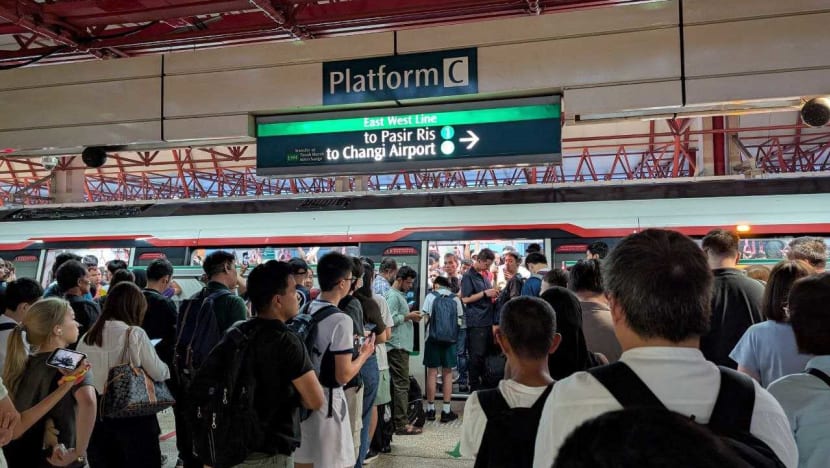
Morning commuters at Jurong East MRT station during a train service delay along the East-West Line on Aug 6, 2025. (Photo: Andrew Huang)

This audio is generated by an AI tool.


SINGAPORE: Commuters will soon have access to real-time updates on train service disruptions through a new webpage, the Land Transport Authority (LTA) announced on Friday (Dec 12).
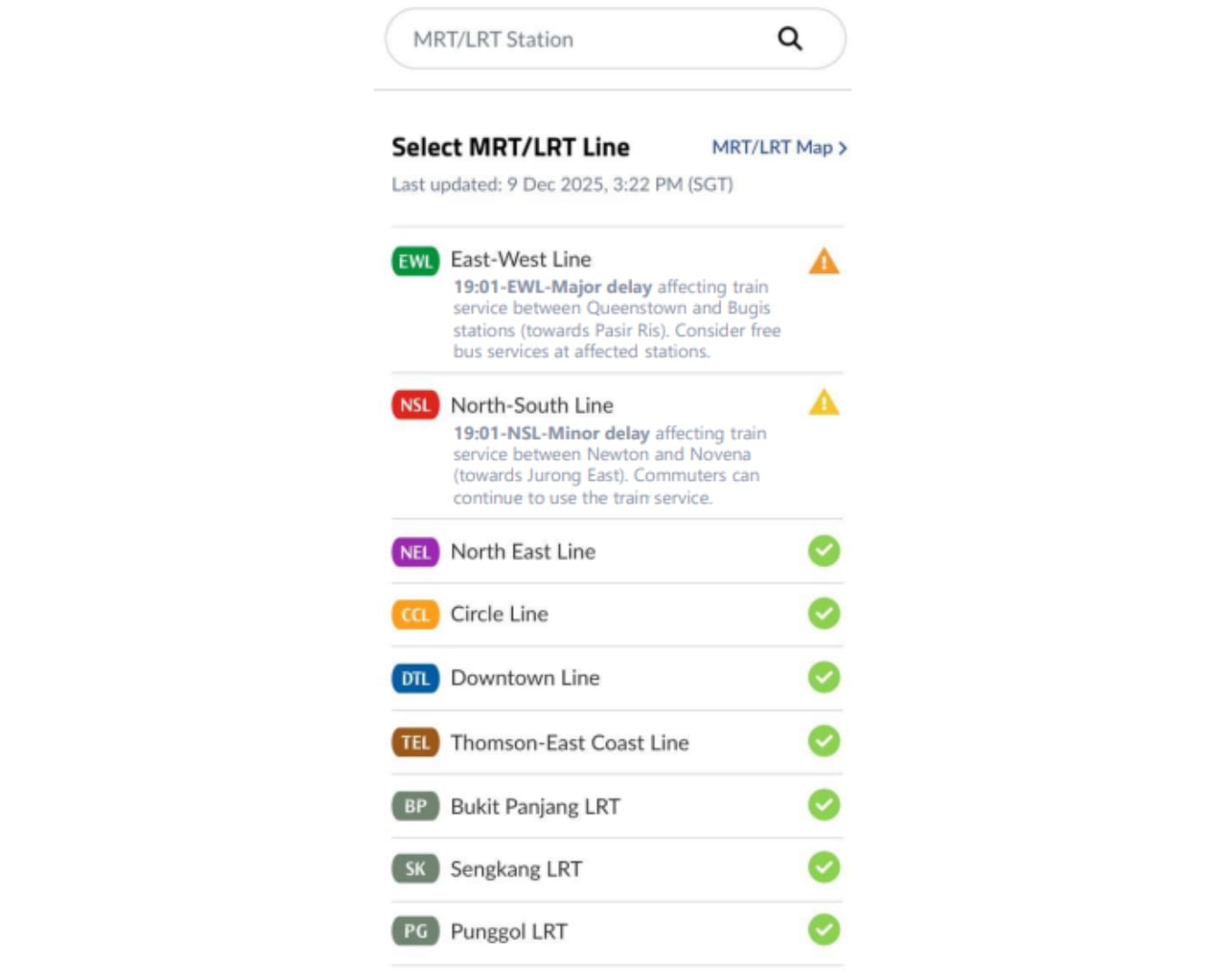
The webpage, mytransport.sg/trainstatus, goes live on Saturday at 6pm and will display colour-coded status updates for each MRT line.
Service delays will be classified into two broad categories: yellow for minor delays and orange for major delays.
Minor delays involve incidents expected to be resolved within 30 minutes, such as platform door faults. During these disruptions, updates will be communicated within stations and trains, with real-time information posted on the new webpage.





The authority will not make social media announcements for minor delays and commuters will be advised to continue using train services.
Major delays refer to incidents requiring more than 30 minutes to resolve. This will trigger communication across multiple channels – in stations and on trains, the real-time webpage and social media posts.
Commuters will be advised to consider alternative routes, including regular bus services, other MRT lines or bridging bus services.
When determining whether an incident is minor or major, LTA will consider factors such as the length of the track affected and whether the disruption occurred during peak or off-peak hours.
Other metro systems, such as those in London and Paris, also offer commuters a centralised website to check real-time operating statuses, LTA said. This is in addition to messages and announcements at affected stations during service delays.
The new webpage follows the establishment of a new rail reliability task force announced in September, comprising LTA and train operators SMRT and SBS Transit.
The initiative comes amid commuter frustrations over communication gaps during recent incidents. On Dec 2, a track point failure near Aljunied station on the East-West Line added 20 minutes to travel times, prompting complaints on social media about SMRT's lack of online communication about the delay.
The following day, LTA said train operators would prioritise “localised” announcements at affected stations during minor delays. But this was met with online criticism from commuters who said the emphasis on in-station announcements was insufficient.
LTA said on Friday that while social media remains important, posts may appear on users' feeds at different times, potentially after service has returned to normal.
The authority said the new webpage is a progression in providing real-time information to help commuters plan their journeys. It is also working with Google Maps to provide data to improve journey time estimates, with further details to be announced later.
RAIL RELIABILITY REMAINS HIGH
LTA's latest monthly report shows overall rail reliability remains high across all metrics.
The report now includes two new indicators alongside the existing mean kilometres between failure (MKBF) measure, the average distance trains travel before encountering a delay-causing fault. The MKBF has been used in Singapore to track reliability since 2016, with the target set at 1 million train-km.
The train service delivery indicator measures the actual distance travelled by trains compared to their scheduled distance, expressed as a percentage.
This remained above 99 per cent across the MRT network in October, apart from the Thomson East-Coast Line (TEL), which recorded a 98.21 per cent train service delivery.
Train punctuality measures the percentage of train trips that complete their trips “on time” at the end of each line or a scheduled turnaround point plus or minus two minutes within schedule.
Excluding TEL, train punctuality across the MRT network increased from 99.16 per cent in September to 99.32 per cent, based on October's provisional data.
As of end-October, the MRT network's 12-month moving average MKBF stood at 1,673,000 train-km, up slightly from the 1,671,000 train-km at end-September 2025.
All lines recorded MKBF improvements since end-September except the Circle Line, which saw a slight dip attributed to more passenger incidents causing minor delays.
October saw no delays exceeding 30 minutes on the MRT network, compared to two such delays in September.
The report now includes TEL data for the first time. Over the past 12 months, the line experienced three delays exceeding 30 minutes, estimated to affect an average of up to 5 per cent of daily passengers along the line.
TEL's train punctuality fell slightly from 99.36 per cent in September to 98.75 per cent in October.
LTA said it expects TEL performance to stabilise and improve after the line fully opens in 2026.