







Nurses beyond borders: How Singapore is holding on to its healthcare workers
Singapore saw record growth in the number of newly registered and enrolled nurses in 2024. In the final piece of a four-part series on the global nursing shortage, CNA looks at how Singapore is retaining its healthcare staff.

This audio is generated by an AI tool.


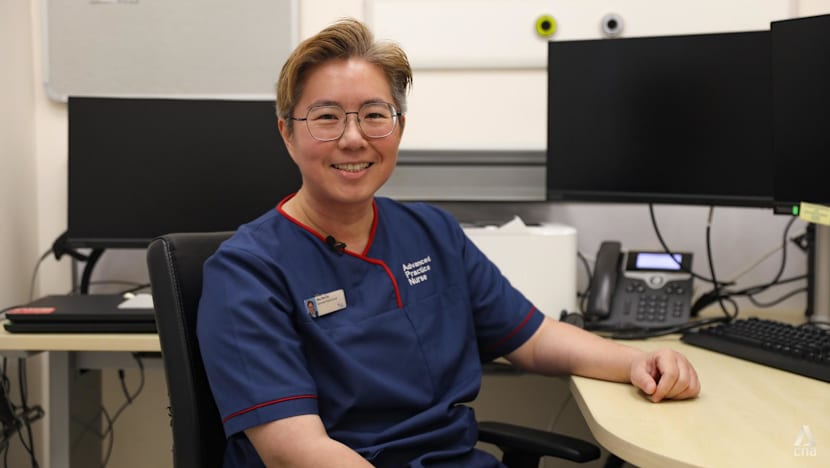
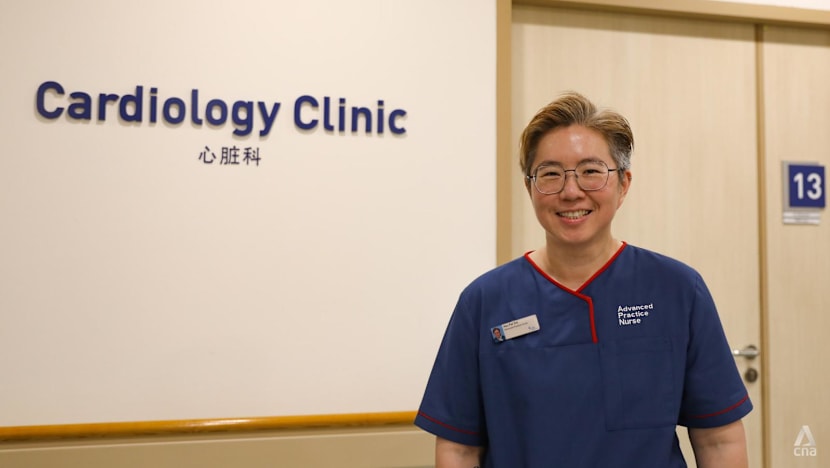
SINGAPORE: When Ms Hsu Pei Chi first started as a nurse 20 years ago, she followed doctors on their medical rounds and, in her words, blended into the wall.
Now 48, Ms Hsu is an advanced practice nurse at Khoo Teck Puat Hospital who has a masters’ degree, consults heart failure patients, teaches at one of Singapore’s medical schools, and still manages to find time to help out at the hospital’s intensive care unit.
After 26 years in the profession, the Taiwanese-turned-Singaporean has spent time studying and working overseas as a nurse.
Despite stints in Australia, the United Kingdom and the United States, she chose to return to Singapore and became a citizen in 2010.
Comparing Singapore to other healthcare systems, Ms Hsu said the country’s nurses are guided and protected by protocols, with intensive and robust training. “It is also very safe … Hospitals take staff abuse seriously,” she added.
With intensifying global demand for nursing, job opportunities are available around the world and some countries are fighting to keep hold of their healthcare staff.
Singapore is no different. It is expected to reach “super-aged” status by 2026 – when the proportion of its population aged 65 and above goes past 21 per cent.
But it is not just the ageing population. Singapore needs nurses due to the increasing complexity of health conditions.





In recent years, Singapore has rolled out several schemes to retain nurses.
According to the latest figures from the Singapore Nursing Board, the country saw record growth in the number of newly registered and enrolled nurses in 2024, with more than 6,000 joining the profession, bringing the total number of registered nurses to 50,389.
The number of Singaporean or permanent resident nurses reported the biggest growth from 2014 to 2024. In that same period, the number of foreign nurses rose from 7,696 to 11,156.
Foreign nurses form an essential part of Singapore’s healthcare workforce and complement its local core, said the Ministry of Health (MOH).
To help foreign nurses integrate, MOH supports them through acculturation programmes, language training, workplace induction with peer mentorship and collaboration with mental health support providers.
“Other targeted support such as onboarding, mentorship, housing assistance and family support are being strengthened to help foreign nurses settle and build long‑term careers in Singapore,” said the health ministry.
WHAT’S SINGAPORE DOING
In 2024, MOH announced a retention scheme that sees nurses receiving up to S$100,000 (US$78,600) over 20 years.
Under the Award for Nurses’ Grace, Excellence and Loyalty (ANGEL) initiative, new nurses and those aged below 46 receive S$20,000 to S$30,000 every four to six years.
Older nurses who have worked for at least five years will receive S$5,000 to S$15,000 upfront, and are then placed on an accelerated payout path.
The scheme is also open to foreign nurses after they have served for four years in Singapore’s public healthcare sector.
But it’s not just about pay.
Vacant buildings at five sites have been retrofitted to house 1,800 healthcare workers in hostel-type facilities, in an initiative rolled out by MOH Holdings, the company for Singapore's public healthcare institutions.
New foreign healthcare workers employed by public healthcare institutions – mainly nurses and allied health professionals – are eligible for thenew accommodation when they first arrive in Singapore.
In 2024, Health Minister Ong Ye Kung said the annual attrition rate in healthcare clusters had returned to pre-COVID levels of about 7 per cent, which he described as healthy.
Global nursing shortage
A global health challenge is intensifying.
Demand for nurses – the backbone of healthcare systems – is growing. While headline figures show supply is also expanding, a deeper look reveals widening gaps, uneven distribution and mounting pressure on poorer regions.
Nurses make up roughly more than 40 per cent of the global health workforce, according to numbers from the World Health Organization (WHO).
Any shortage doesn’t just affect hospitals – it weakens entire healthcare systems, from primary care clinics to emergency response networks.
The numbers: growth on paper
According to the State of the World’s Nursing 2025 report by the WHO and International Council of Nurses (ICN):
In 2023, there were about 29.8 million nurses worldwide.
By 2030, that number is projected to rise to 35.9 million.
At first glance, this appears to signal progress.
But by 2030, those nurses will need to serve a projected global population of 8.5 billion people, stretching systems that are already under pressure.
Not all regions are affected equally.
The African and Eastern Mediterranean regions are expected to face the most severe shortages in the coming years. These are also regions with some of the greatest healthcare needs.
On the move
Migration is now central to global healthcare staffing. According to the WHO and ICN report, about one in seven nurses works outside the country of their birth.
This reflects how heavily many healthcare systems depend on migrant labour. But the challenge is not simply about overall supply – it is about distribution.
About 78 per cent of the world’s nurses are concentrated in countries that account for less than half of the global population.
Across much of Asia, the outflow of nurses to wealthier economies is straining local healthcare systems.
WHY WORK IN SINGAPORE
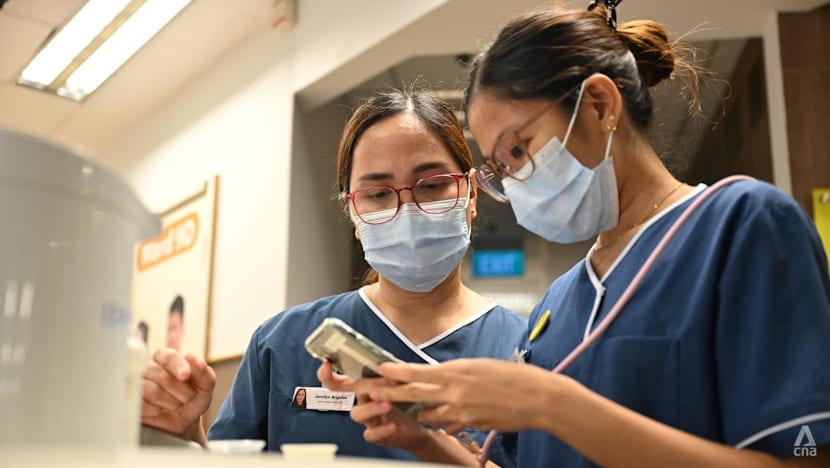
For assistant nurse clinician Jennilyn Flores Angeles, nursing is her second career. She switched paths after working as a physiotherapist in the Philippines, as she saw more potential in a nursing career.
After graduating from nursing school and training with no pay for a few months, she looked for work overseas through an employment agency and landed a job at Tan Tock Seng Hospital as a healthcare assistant, where she has worked ever since.
As an assistant nurse clinician, the 50-year-old now focuses on looking after the ward and guiding junior nurses.
When she was looking for work in 2005, she chose Singapore because it was more straightforward to get a job.
“All my classmates and batchmates were studying to really pass those exams, because once you are a registered nurse in the Philippines, your dream is to go overseas, which is the United States or the United Kingdom,” she said.
To work in Singapore as a nurse, Ms Angeles needed her degree, at least a year of hospital experience, and to pass the SNB exam.
Currently, foreign-trained nurses who want to work in Singapore must sit for a licensure examination, as well as undergo a competency assessment with SNB or be placed on provisional registration or enrollment.
Foreign nurses find Singapore peaceful and inclusive, which is why they feel welcome, said president of the Healthcare Services Employees' Union (HSEU) K Thanaletchimi.
The wages in Singapore are competitive compared to those of their home countries, she added.
“For work prospects, we do not discriminate against foreign or local. There are lots of opportunities for them to upskill and upgrade themselves.”
As a Malaysian, assistant nurse clinician Wong Kai Ying, 33, was familiar with Singapore since she crossed the border every year to visit relatives.
While studying nursing at a private institution in Malaysia, she saw most of her seniors find jobs with Singapore hospitals. She followed in their footsteps and started at National University Hospital (NUH) in 2016.
When asked why she decided to continue working in Singapore, she acknowledged that many of her peers hope to eventually work in other countries.
“But it didn’t really factor in my plans because I actually started my family here. My extended family is here.
“I have my work planned for now, probably for the next 20, 30 years, because my young kids are here,” said Ms Wong, who became a permanent resident in 2019 and a citizen in 2022.
Now married with a three-year-old, her husband recently became a Singapore citizen. Anecdotally, nurses know that it is easier and faster for those in their line to become permanent residents in Singapore, she added.
WHY STAY IN SINGAPORE
Foreign nurses who perform well, become valued members of Singapore’s healthcare community and demonstrate commitment to Singapore can apply to be considered for permanent residency, said MOH in response to CNA queries.
In 2023, about 1,200 foreign healthcare workers were granted PR status on average each year in the previous five years, MOH said.
More than six in 10 were nurses, while the remainder included doctors, allied health professionals and other healthcare workers.
Foreign nurses often come to the union to ask for support in their PR applications, said Ms Thanaletchimi, who is also president of the National Trades Union Congress (NTUC).
Adding that the union is careful in doing so, she stressed that it is important to be selective since PR or citizen status comes with more responsibility, which has to be weighed against the demand for nurses, she said.
If Singaporeans are not forthcoming in taking on nursing jobs or there aren’t enough of them, the country would inevitably rely on foreign nurses, she added.
“Good foreign nurses who want to make Singapore their home – we must embrace them.”
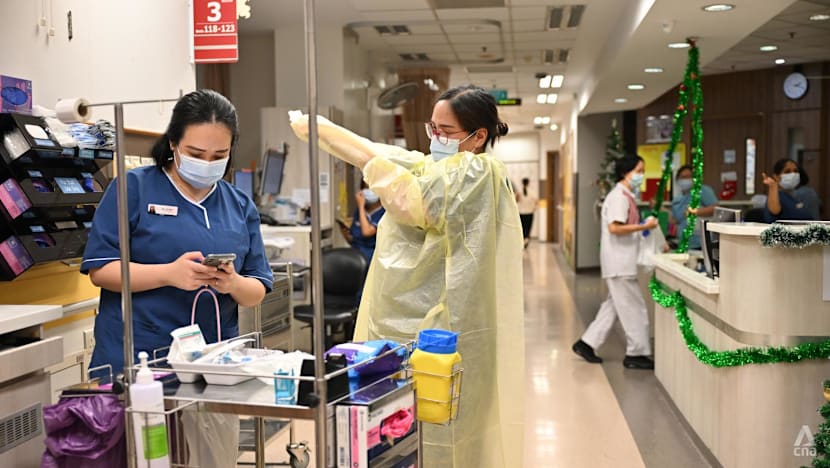
Ms Angeles cited Singapore’s multiculturalism as one of her reasons for staying put.
“Surprisingly, there are a lot of Filipinos. Whatever department, there are a lot of Filipinos, especially in this hospital,” she said.
“Because the Singapore healthcare (system) is on par with the US, so why not stay here?” she said, citing other benefits including hospitalisation leave and free vaccinations.
“It’s more comfortable going back home … rather than I go further overseas where I can see my loved ones maybe three, five years later? Here, I can go back any time I want.”
Senior enrolled nurse Syakirin Jeffreydin, who works in a high-dependency ward in Changi General Hospital (CGH), said nursing school students often discuss working overseas because their teachers often share their overseas experiences.
“In Singapore, the equipment is more advanced. The teaching here is all based on evidence-based materials, and the setup in the wards is friendly for teaching,” said the 28-year-old.
When she signed up for nursing school, she did not know about the extent of career progression available to nurses.
“But I take this as a challenge,” said Ms Syakirin, adding that her supervisors sign her up for courses because she can apply the knowledge at work. After those courses, she returns to the ward to share what she learnt with others.
She finds helping foreign nurses learn about nursing in Singapore particularly meaningful. Some of them may have trouble adapting to new protocols in local hospitals, she said.
For example, some nurses who work overseas do not change patients’ diapers, since family members usually do so, she shared.
“Some of them are really fresh graduates from school, some of them have three to five years of experience there. They cannot apply whatever they learnt there in Singapore because the system is different.”

CAREER GROWTH AND OPPORTUNITIES
Ms Hsu pursued her degree in Sydney, describing the experience as “seeing is believing”.
“After seeing the healthcare system there, I realised we might be better. And that made me come back to Singapore for good.”
Working in other countries exposes nurses to different types of patients that they otherwise might not see in Singapore, she said.
“Frankly speaking, I wouldn’t stop nurses if they say they want to go overseas and take a look because I’m pretty sure they may return,” she added.
Ms Hsu has also gone on overseas attachments with coronary care units in the United States and a team in London that deals with heart failure patients in the community.
“We thought the grass was always greener on the other side, but when I went there, I realised actually we might be way better,” she added.
She observed that Singapore was ahead in its use of technology, especially for documentation. Its infection control is also “really top notch”, said Ms Hsu.
“That made me realise Singapore is really a good place for upskilling, and in terms of competencies and clinical standards.”
But Singapore still has some way to go in giving nurses more autonomy, which is important so they do not feel like they are just taking orders, said Ms Hsu.
This way, nurses can ask more questions about a patient’s condition and why certain tests are ordered. Nurses can then update patients about their conditions as well as doctors, she said, adding that this would also help with retention.
After 15 years in nursing, she decided to try to become an advanced practice nurse, inspired by a senior nurse. As an advanced practice nurse, she can manage patients, decide on their treatment and prescribe medication.
“They don't just take orders from the doctors. They manage, they decide, they explain. And I thought ‘wow, this is what I want’,” said Ms Hsu.
For Ms Wong, her pay has increased consistently and she can focus on career progression, having pursued a specialist diploma in palliative care. The hospital has also incorporated technology into its day-to-day work, she said.
“All this is actually contributing to why I’m still staying in a nursing career. I can see that the future can be more different,” said Ms Wong.
Health Minister Ong Ye Kung announced in February that about 23,000 community care organisation staff members could see at least a 7 per cent pay increment as part of new salary guidelines.
To retain both local and foreign nurses, Singapore should pay attention to job redesign, especially using technology, said Ms Thanaletchmi, adding that union leaders cited concerns about artificial intelligence, and whether it would make their jobs obsolete.
This would not be the first time technology has replaced roles in a hospital. Humans used to collect payment and register patients behind the counter, but machines have since taken over, she said.
Sponsorships and scholarships play a big part in retaining nurses, said Professor Liaw Sok Ying, who heads the Alice Lee Centre for Nursing Studies at the National University of Singapore.
Since most of these opportunities are bonded, the school sees a consistently high employability rate of 90 per cent each year, she added.
Research showed that the turnover rate of those who leave the profession after a few years of service is “relatively high”, she added.
Like Ms Thanaletchimi, she highlighted diversity in career paths, empowerment at work through pursuing higher education, as well as acknowledgement from healthcare authorities and the public, as some of the factors that would encourage nurses to stay on.
Younger nurses are interested in hybrid roles, said Prof Liaw. This could mean working three days as a frontliner and doing two days of research, or taking on jobs that have other responsibilities.
For example, a nurse communicator – a nurse who also works in the communications department in the hospital.
Interdisciplinary roles like nurse informatics – individuals who serve as a moderator between frontline nurses and the team implementing technology in the hospitals – are also on the rise.

WHAT’S NEXT
While Singapore’s retention of nurses is “pretty good” now after rolling out multiple measures, the country cannot rest on its laurels, said Ms Thanaletchimi.
One important area to pay attention to is their workload, she added.
“What are the areas that can be improved using technology? What are the areas we can shift to some other job roles and right site the task so that the nurses can practise on top of their licence and do much more value-added jobs?”
Another common concern is that when nurses take on projects or research work, they typically do not have protected time and have to pitch in outside work hours.
While nurses are happy to take on these projects because it enhances their profession and abilities, employers should recognise that this is eating into their time and see whether they can be given protected time, said Ms Thanaletchimi.
“That means that we may need more nurses, or we need to automate some of the stuff.”
Generally, advanced practice nurses are in their late-20s, said Ms Hsu, adding that it is no longer perceived as a very senior nursing role.
When she first started seeing patients in the clinic five years ago, they would ask her: “Why am I seeing a nurse and not a doctor? What do you do? What do I need to pay to see you?”
As the years went by, patients evidently became more familiar with the evolving role of nurses.
The sky is the limit for the training available, which in turn leads to career opportunities, said Ms Thanaletchimi, pointing out that Alexandra Hospital’s new CEO is a nurse.
“Never would we have thought 20, 30 years ago, a nurse could be a CEO of a healthcare institution.”
While Singapore has done a “very decent job” in promoting nursing as a respectable job, nurses’ welfare can still be improved, she added.
“We need a mindset change in society. Many (patients) are very good, very respectful, but there are pockets of them that can be pretty rude, and that will spoil the day of many nurses in the entire institution,” said Ms Thanaletchimi.
Like the nurses CNA spoke to, she hopes people can understand that nursing is a profession on its own and that they do more than assist doctors.
“We urge that we keep on promoting, campaigning for the prevention of abuse and harassment, and if we continue to do that, I’m sure that society’s mindset will be more enlightened towards nurses.”




