Bondi attack highlights blind spots in Australia’s tough gun laws: Analysts
Nearly three decades after landmark reforms in the aftermath of the 1996 Port Arthur massacre, private gun ownership has increased by almost 30 per cent to 4 million, says a think tank.

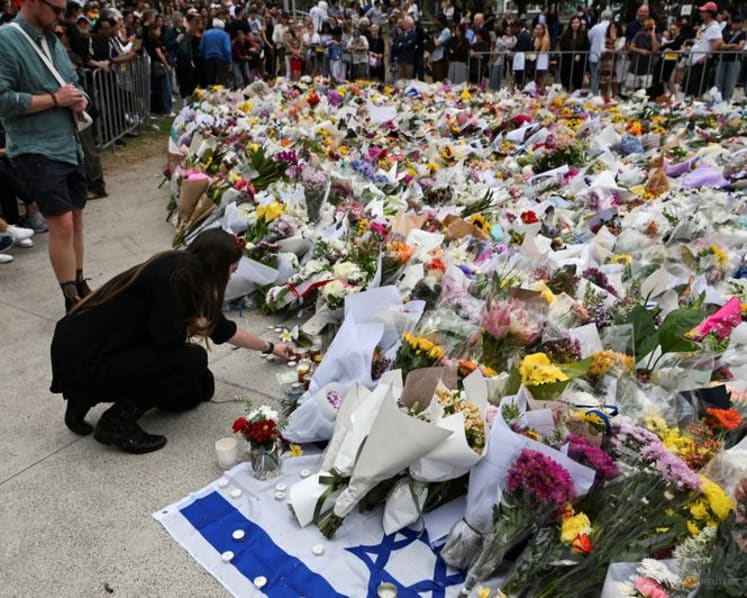
Mourners embrace at the Bondi Pavillion following the Bondi Beach shootings in Sydney on Dec 15, 2025. (Photo: AFP/Saeed Khan)

This audio is generated by an AI tool.
A recent mass shooting at Sydney’s Bondi Beach that killed 15 people has reignited a national debate on whether Australia’s gun laws – already among the toughest in the world – are strong enough.
In an emergency meeting on Monday (Dec 15), Australia’s National Cabinet vowed to overhaul gun regulations. Its proposed reforms include a long-delayed national firearms register, limits on how many guns an individual can own, and a ban on foreign nationals holding gun licences.
The announcement came as investigators continued to examine how a father-and-son pair were able to carry out the attack on Sunday targeting a Hanukkah gathering at one of Australia’s most iconic public spaces.
Experts say the tragedy underscores both the strengths and weaknesses of Australia’s firearms regime, nearly three decades after landmark changes that followed the 1996 Port Arthur massacre.





That attack, in which a lone gunman killed 35 people in the Tasmanian tourist town, led to sweeping new laws including a national gun buyback scheme and restrictions on semi-automatic weapons.
Political sociologist Josh Roose said the Bondi attack could have been far deadlier had the perpetrators been able to access the types of weapons once available before the reforms.
“(The attackers had to) reload. The fact that they couldn't access semi-automatic firearms … prevented many more deaths,” said the associate professor at Deakin University.
But last weekend’s shootings have raised fresh questions on how the gunmen – whom police said appeared to be inspired by Islamic State – operated under the radar and obtained the weapons.
BLIND SPOTS IN EXISTING GUN LAWS
Some experts have voiced concerns that Australia's current gun system looks strict on paper, but is lacking in practice.
Canberra-based think tank The Australia Institute noted the country now has more guns in circulation than it did before the Port Arthur reforms.
Its report estimates that Australia, with a population of 27 million, currently has more than 4 million registered privately-owned firearms – nearly 1 million more than in 1996. This estimate excludes illegal firearms.
The report stated that while the number of licensed guns per capita has fallen – adjusted for population growth, licensed owners now possess a greater number of firearms per person.
“In the last decade, we've steadily seen gun numbers increase. The Australian government, (both) federal and state … have been complacent about gun laws,” said Rod Campbell, a research director at the institute.
A major gap is Australia’s failure to complete a national firearms registry, despite commitments nearly 30 years ago, he added. Each state and territory still operates its own registry with limited data-sharing, creating gaps in oversight when firearms move across borders.
Advocates say a centralised system would prevent prohibited individuals from obtaining guns in other states, improve coordination among law enforcement agencies, and ultimately strengthen public safety.
Other measures – such as restrictions on firearm use by those under 18 – have been applied inconsistently across Australia, undermining their effectiveness.
Gun theft is another persistent issue. According to the institute, more than 2,000 firearms are stolen nationwide each year.
"That's a gun every four hours … ending up in the hands of criminals. Australia’s state borders are also completely porous – anyone can go across any border at any time,” Campbell told CNA’s Asia First programme on Tuesday.
"That lack of consistency in our gun laws is part of the problem.”
STRONG PUBLIC SUPPORT FOR REFORMS
A January poll by The Australia Institute found that 70 per cent of respondents believe it should be harder to access a gun, signalling strong public appetite for stricter controls.
Even so, some analysts caution that further tightening may be challenging, as Australia’s current system is already considered comprehensive.
“The gun laws are quite sturdy and have been fit for purpose for a prolonged period of time,” said Roose. “There are tens of thousands of Australians – such as hunters, farmers and sport shooting associations – who use weapons. It's critical that we don't rush into any new gun laws without adequate evidence to inform their future direction.”
He said gun reforms alone cannot address extremism, adding that the Bondi attack was intentionally designed to inflame divisions.
“It was about driving a wedge, about polarising society, dividing one Australian against another, seeking to effectively create a binary us-versus-them mentality, between our Muslim communities and wider Australia,” said Roose.
He added that Australia needs a more open national conversation about antisemitism and underlying societal rifts that extremists seek to exploit.