Internet-fuelled extremism behind rise in 'lone wolf' terrorism, experts say after Bondi shooting
The two gunmen behind Australia’s worst mass shooting in nearly three decades appeared to have acted alone and were likely inspired by Islamic State ideology, said authorities.
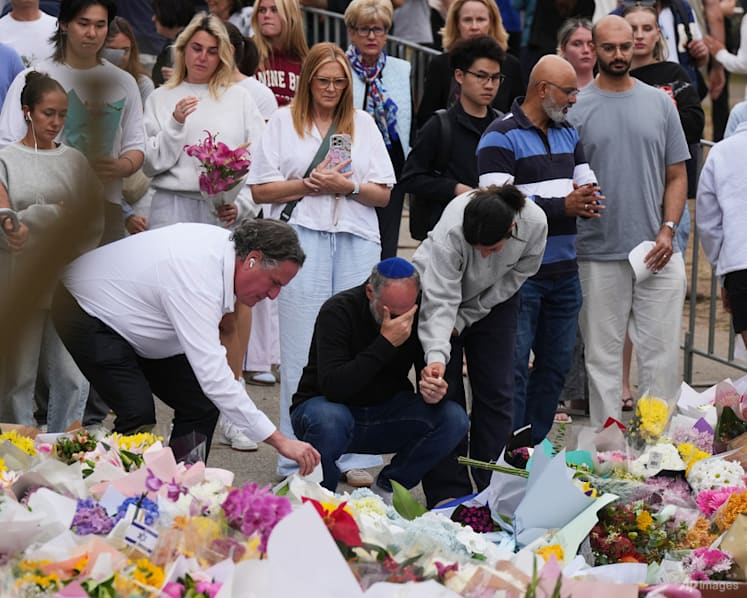
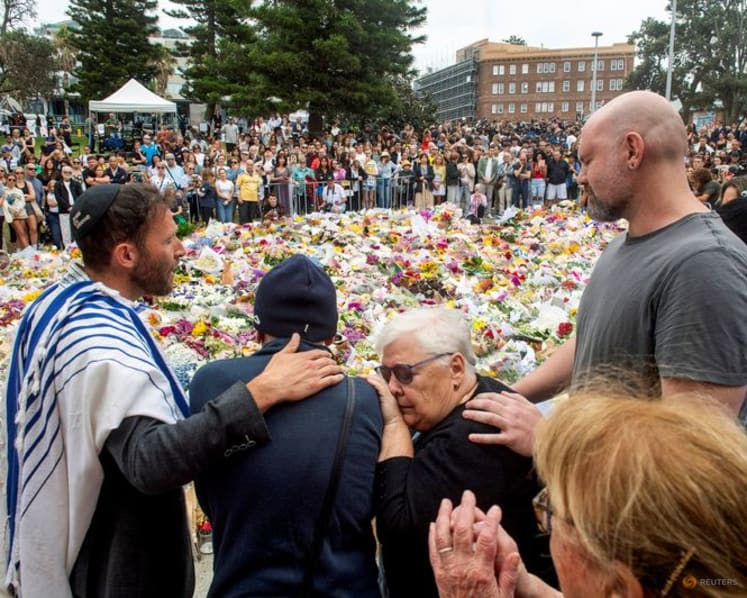
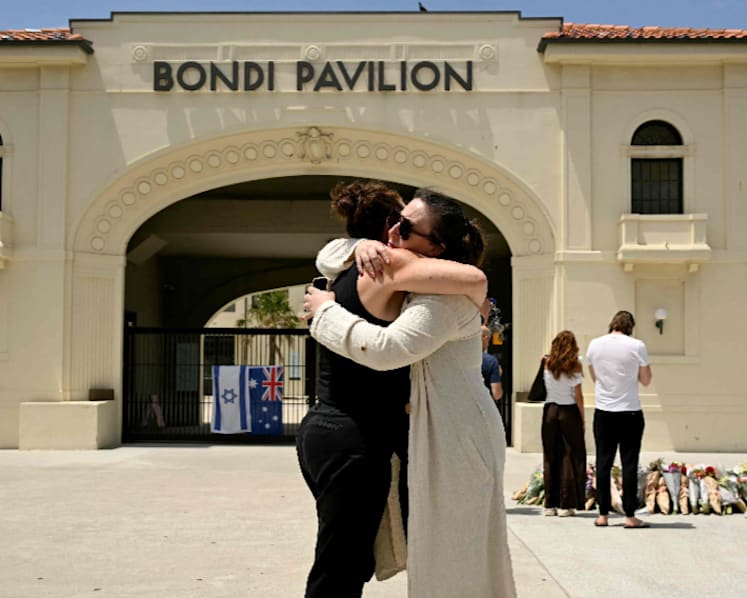
People weep and offer flowers at a floral memorial for victims of Sunday's shooting at the Bondi Pavilion at Bondi Beach on Tuesday, Dec. 16, 2025, in Sydney, Australia. (AP Photo/Mark Baker)

This audio is generated by an AI tool.


A mass shooting at Sydney’s iconic Bondi Beach last weekend has sparked fears of a rise in lone wolf terrorism, with authorities saying the two gunmen appeared to have acted alone.
Lone wolf actors, or those who carry out political violence without direct support or instruction from an established terrorist network, are typically more difficult to identify – and the internet has played a big part in their rise, experts told CNA.
The attack on Sunday (Dec 14) was Australia’s worst mass shooting in nearly three decades.
Police allege it was carried out by Sajid Akram, 50, and his 24-year-old son Naveed. The pair opened fire at a Jewish holiday event, killing 15 people in an attack that shocked the nation and led to concerns over growing antisemitism.
Sajid was shot dead by police at the scene, while his son was charged with 59 offences on Wednesday after waking from a coma, including murder and terror charges.
Australian Prime Minister Anthony Albanese said the gunmen were likely inspired by Islamic State ideology after investigators found homemade ISIS flags in the trunk of the gunmen's car.
“Every (terrorism) group has a lot of threat signatures – that is, where they went and trained, where they work together, who are the members,” noted Rohan Gunaratna, professor of security studies at Nanyang Technological University’s S Rajaratnam School of International Studies.
Such groups are “much easier to detect” compared with individuals and splinter cells, he noted, which makes the task of identifying lone wolves significantly more difficult for security and intelligence agencies.





CHALLENGES FACED BY GOVERNMENTS
Such lone wolf attacks have been on the rise over the past two decades, said Levi West, a research fellow at Australian National University’s Research School of Social Sciences.
“It's reasonable to say that since about the mid-2000s, most jihadist terrorist plots – in the West, at least – have looked more like what we would call lone actor terrorist attacks (rather) than any kind of large-scale mass casualty, centrally organised terrorist plots,” added the terrorism and counterterrorism expert.
Rohan told CNA938 that while lone actors do not have a structure for weapons procurement or training, they can stage significant attacks and seriously damage a country’s national security, as evident in the Bondi shooting.
“Governments must develop the capabilities to detect, disrupt, prevent and pre-empt group attacks and also attacks by cells and individuals,” added the founding head of Singapore's International Centre for Political Violence and Terrorism Research.
However, observers said there are several challenges to this.
West raised the issue of funding and resources, where governments may not have enough money or manpower to efficiently monitor threats.
In terms of civil liberties and citizens’ rights, it is also “very, very challenging” for liberal democracies to act against those who might commit violence in the future, he added.
Australia's intelligence agency had examined Naveed Akram for alleged Islamic State links in 2019 when he was aged 17, though he was not deemed a threat.
West said that while it was likely true at the time, circumstances have drastically changed since then.
“It’s very easy for everyone to go back and say: ‘We should have done something in 2019’ – except in 2019, he wasn't presenting with the (evidence) necessary to charge him with an offence or to put him onto an intervention programme or a diversion programme,” West pointed out.
“So, there's substantial challenges in that regard.”

APPARENT LACK OF FOLLOW-UP ACTION
Rohan concurred that the Australian authorities should have reassessed Naveed after the Oct 7, 2023 Hamas attack on Israel, which sparked the ongoing war in Gaza.
He said the attack triggered many Islamic State and Al-Qaeda supporters and inspired them to act.
“There’s huge radicalisation that has taken place after the Oct 7 attack and Israel's overwhelming response … and the protests and the demonstrations that instigated people to go and do attacks,” Rohan added.
Greg Barton, rector and professor of global Islamic politics at Deakin University Lancaster University Indonesia, similarly noted that it is unclear if Australian authorities carried out follow-up visits after investigating Naveed six years ago.
“It’s not clear that anyone knew that his father had been radicalised,” he told CNA’s Asia Tonight.
“That's a reminder that these sorts of deep ideological convictions don't fade away overnight, unless there's some concerted effort to rehabilitate people.”
RADICALISED BY THE INTERNET
Meanwhile, experts pointed out that the digital space has made it much easier for lone wolves to be inspired by terrorism groups.
An organisation’s preachers or leaders can be neutralised, but governments will “always struggle to defeat and eradicate … the ideas that animate it”, said West.
“As long as everyone has access to the internet, people can go online and they can access content that is Islamic State or Al-Qaeda or generally jihadist in nature, and it might happen to resonate with them. And if it does, then … that can lead to what we would call self-radicalisation,” he told CNA.
West noted it is unclear how much content and propaganda Naveed was consuming.
Additionally, Rohan said social media has been a “game changer” in terrorism.
“Whatever happens today inspires, instigates other actors to take action. There will certainly be groups that will emulate the attack in Bondi Beach, and that is what governments should prepare for,” he added.
CAUSE FOR CONCERN IN SOUTHEAST ASIA
As to whether a similar threat could emerge in Southeast Asia, Barton warned there is “certainly a cause for concern”.
Sajid and Naveed had spent nearly a month in the Philippines before the attack. The southern city of Davao on Mindanao Island – which has previously been linked to Islamist militancy – was reportedly their final destination.
Australian authorities have not confirmed claims by some media reports that the suspects visited the Philippines to receive military-style training, while a spokesperson for the Philippines’ presidential office said there is no validated report that the gunmen received any form of terrorist training in the country.
Officials added there have been no recorded terrorist training activities, recruitment efforts or large-scale attacks by domestic groups since 2016, and that terrorism threat levels in several parts of Mindanao have shifted from high to low.
The Philippine army also released data showing a sharp decline in local terrorist groups from more than 1,200 members in 2016 to 50 this year.
However, Barton pointed out that firearms are widespread in the country.
“Those guns could come across the sea border to Malaysia, to Indonesia. They could even penetrate Singapore,” he added.
“We need to be realistic about the threat that's posed … and the copycat effect of two amateur gunmen causing such lethality so tragically in Bondi is likely to have others thinking ‘If they could do it, I could do it.’”