Trump’s ambitions in the Middle East – peace broker or dealmaker?
As US President Trump enters his second year in office, the Middle East is emerging as both a proving ground and a pressure point for his foreign policy ambitions.

This audio is generated by an AI tool.
On the campaign trail ahead of his return to the White House, United States President Donald Trump cast himself as a dealmaker capable of achieving lasting peace in the Middle East.
A year into his second term, that pledge is being tested.
Lingering conflicts and rising regional tensions are expected to keep his administration heavily entangled in one of the world’s most volatile regions.
FRAGILE CEASEFIRE IN GAZA
Trump’s most notable diplomatic achievement in the region so far has been brokering a ceasefire in Gaza last October, two years into a devastating war in the Palestinian enclave.
Last Thursday (Jan 15), Washington announced the fragile truce would advance to its second phase. But on the ground, progress appears to have stalled at the first stage.
Major fighting has ceased in the war-torn strip. Hamas has released hostages in exchange for Palestinian detainees and prisoners. Israel partially withdrew its troops from parts of Gaza.
But key elements of the agreement remain unfulfilled. These include a complete cessation of bloodshed, the recovery of the remains of one last Israeli hostage, and Israeli delays in the reopening of Gaza’s border crossing with Egypt.
The humanitarian situation remains dire. More than two million people – virtually Gaza’s entire population – are confined to roughly a third of the territory, living mostly in makeshift tents and damaged buildings.
Israel and Hamas have accused each other of ceasefire violations and remain divided on the more difficult steps planned for the next phase.
DIFFICULT ROAD TO LASTING PEACE
Observers said that convincing both sides to move forward in the wider Gaza peace plan will pose a major challenge for the Trump administration.
Hamas must disarm and Israel's military must withdraw from more territory. Major questions also remain over the deployment of international forces and the rebuilding of the battered enclave.
Former Israeli diplomat Alon Pinkas questioned whether Trump has the patience to see the peace process through.
“Everything now is all about details, and (Trump) is not a man of details,” he said. “There's a good chance that at some point along the road, Trump is going to give up (as he is) no longer interested.”
Some are more optimistic, believing Trump’s personal ambitions could help sustain momentum.
“The desire for prestige is definitely motivating the Gaza ceasefire push,” said historian Theo Zenou, adding that Trump wants to position himself as a global peacemaker and potentially secure a Nobel Peace Prize.
TRUMP’S BROADER AMBITIONS
In the latest turn of events, Trump last week announced the formation of a "board of peace” aimed at resolving conflicts. Originally conceived to oversee the reconstruction of Gaza, its mandate now appears broader.
Dozens of world leaders have been invited to join and membership reportedly comes with a billion-dollar price tag.
Beyond Gaza, flashpoints continue to simmer across the Middle East, including in Syria, Lebanon and Yemen. Maritime security is also a pressing concern, particularly along the Red Sea, a vital global shipping route.
Iran presents another major challenge, as nationwide protests and calls for regime change raise questions about the future of the Islamic republic’s clerical rule and its nuclear programme.
SECURITY MEETS ECONOMICS
Analysts say security and stability in the Middle East remain central to American economic interests.
While the US is now less dependent on the region for oil and gas, the Trump administration is still keen on securing Gulf energy supplies, protecting shipping routes and countering the influence of rival powers such as China and Russia.
Under Trump, Washington has signed major investment deals in the region, including with the United Arab Emirates, Qatar and Saudi Arabia, spanning sectors from artificial intelligence and defence to nuclear energy.
In November, Trump hosted Saudi Crown Prince Mohammed bin Salman at the White House, where the Saudi ruler pledged to raise planned investments in the US from US$600 billion to US$1 trillion. Trump described it as an “honour” to be the crown prince’s friend.
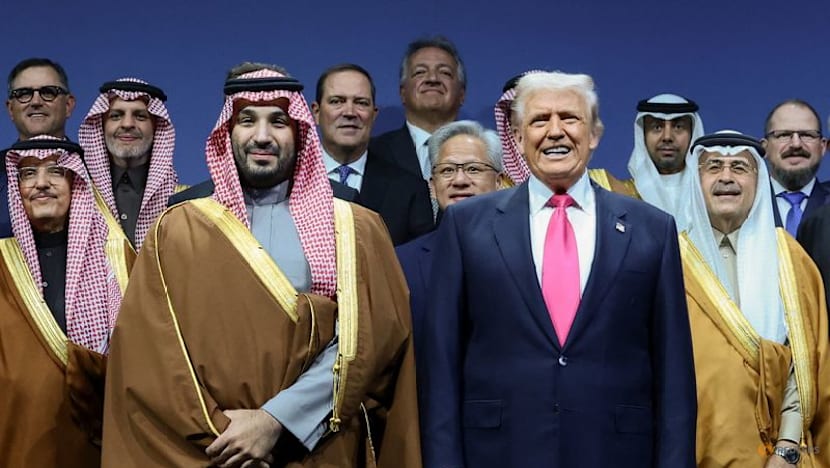
Observers say Trump’s transactional approach to diplomacy resonates with many Middle Eastern leaders.
“They're personality driven, just like Trump, and are ready to make transactions. They have the power as well, which Trump likes because he can deal directly (with them) … in one-on-one business dealings,” said Zenou, who is a visiting fellow at the Australian National University.
BLURRED LINES
However, the president’s business interests in the region continue to draw scrutiny.
The Trump Organization, run by his sons, has signed major real estate and licensing deals across the Middle East. Gulf money has also reportedly flowed into a cryptocurrency venture backed by the Trump family and a private equity firm run by his son-in-law Jared Kushner, blurring the line between public policy and personal profit.
“Trump does not really distinguish between the financial interests of his family and the financial interests of the US,” said Giorgio Cafiero, CEO of Washington-based geopolitical risk consultancy Gulf State Analytics.
“Clearly, he has his own interests in terms of his personal and family business pursuits in the Middle East, especially in the Gulf states. (Still,) I think he is genuinely trying to grow the US economy.”
Looking ahead, Trump faces no shortage of challenges in the Middle East. Analysts say how he confronts them may ultimately depend on whether they align with America’s security and economic priorities – and with his own political ambitions.