Money and might: How Trump’s second term is reshaping US-China relations
Over the past year, relations between the world’s two largest superpowers have been marked by trade wars, military signalling and uneasy truces.
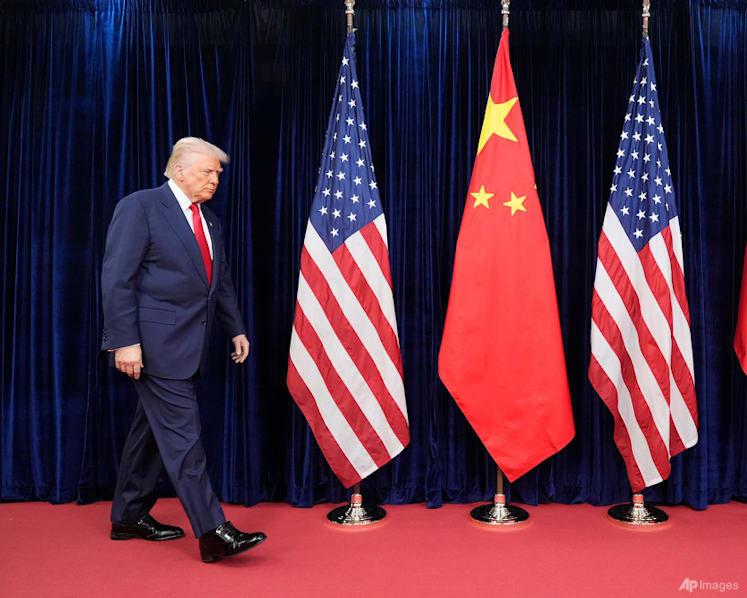
US President Donald Trump walks in for his meeting with and Chinese President Xi Jinping at Gimhae International Airport in Busan, South Korea, Oct 30, 2025. (File photo: AP/Mark Schiefelbein)

This audio is generated by an AI tool.
WASHINGTON: Ties between the United States and China have been on a rollercoaster ride, a year into US President Donald Trump’s second term.
The relationship has become a volatile mix of economic confrontation and military posturing, underscoring how deeply intertwined money and security have become in Washington’s China policy.
On the economic front, ties have lurched from an all-out trade war to a fragile truce, punctuated by disputes over semiconductors, artificial intelligence, rare earth exports and the future of Chinese-owned social media giant TikTok.
At the same time, security tensions have intensified, driven by US efforts to bolster military deterrence in East Asia and deepen alliances with Japan, South Korea and the Philippines to counter Beijing’s growing regional influence.





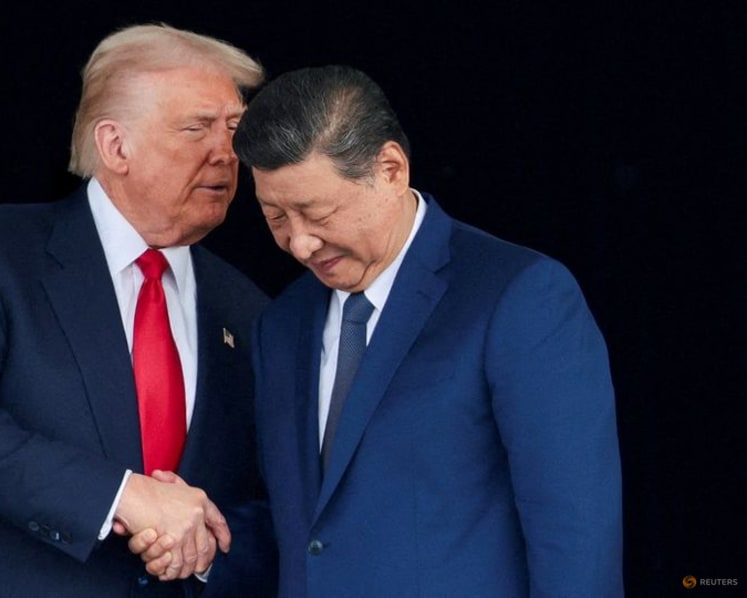
Last October, Trump met Chinese President Xi Jinping on the sidelines of the Asia-Pacific Economic Cooperation (APEC) summit in South Korea, capping months of heightened tensions.
The meeting yielded several trade- and economic-related agreements, de-escalating their trade war after months of turbulence, including US tariff reductions and a pause in Beijing’s new restrictions on rare earth minerals and magnets.
TRUMP’S SECOND TERM & TARIFF SHOCK
Tensions between the world’s two largest economies began soon after Trump returned to the White House in January last year.
Within weeks, his administration imposed fresh tariffs on Chinese goods. It escalated these levies until early April, when the president declared what he called “Liberation Day” – a sweeping move imposing tariffs on imports from nearly every nation.
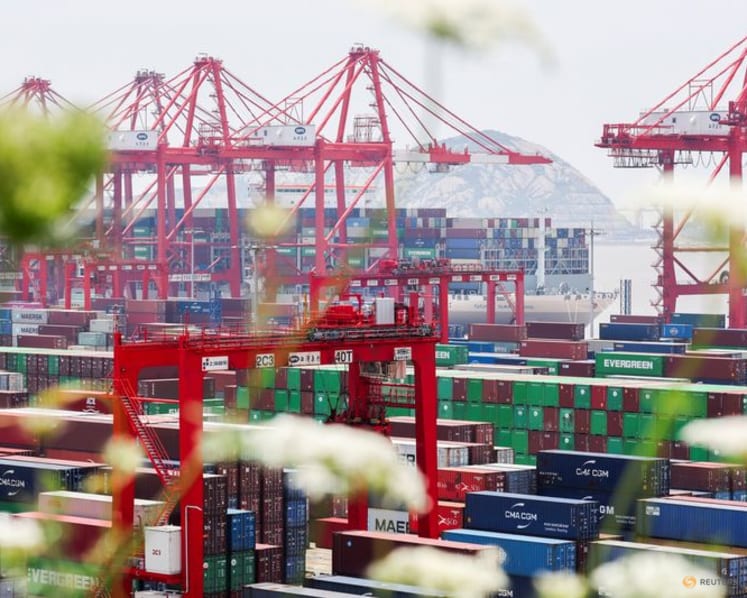
For China, the impact was especially severe. Within days, US tariff rates on Chinese goods surged to as high as 145 per cent, effectively grinding bilateral trade to a halt.
Former US Assistant Secretary of State for East Asian Affairs Danny Russell said the scale of escalation exposed the risks of weaponising an interdependent relationship.
“We saw so much escalation to try to gain leverage over the other (in the form of) sharp tariff hikes (and) retaliatory measures,” said Russell, now a distinguished fellow at Washington-based think tank Asia Society Policy Institute.
“But the interdependence meant there was a very substantial amount of pain (as well) for the party that was administering it.”
RARE EARTHS: CHINA’S STRATEGIC LEVERAGE
That pain became clear when Beijing wielded what many see as its trump card: Dominance over rare earth minerals.
China twice tightened export controls, choking off supplies that account for nearly 80 per cent of America’s imported critical minerals.
“It was really a visible gut punch to Trump and (his) team because they just hadn’t done their homework,” said Russell, describing the move as a strategic shock to Washington.
“(Beijing) showed … that’s something that could cripple US industrial production, that had very severe potential impacts on the US military.”
While talks helped bring about a pause in tariff escalation, friction continued beneath the surface. Washington and Beijing remain locked in disputes over chips and AI technology, even as Trump pushed for greater US industrial self-sufficiency.
Todd Belt, a political management professor at George Washington University, said he does not expect those tensions to fade anytime soon.
“Trump thinks he can do this himself with US companies, by taking some of the stock and propping it up in order for them to do more manufacturing. But this doesn’t happen overnight. There’s going to be a big point of contention,” he added.
FOREIGN POLICIES COSTS AT HOME
Domestically, the political costs of Trump’s China-focused agenda may be mounting.
Some analysts believe his trade policies could hurt the Republicans in November’s midterm elections, with Democrats poised to argue that the president has neglected domestic priorities while driving up costs for ordinary Americans.
Hans Noel, associate professor of government at Georgetown University, said cost-of-living pressures usually weigh heavily on voters during election seasons, regardless of the underlying causes.
“Midterm elections often appear to be like a referendum on the president,” he told CNA.
“Concerns about affordability, the price of gas and groceries – how much is directly attributable to tariffs versus (other factors)? Most voters are just going to say, ‘I’m paying those prices’, and that’s not going to be good for their assessment of the president.”
US NATIONAL SECURITY STRATEGY
The White House’s National Security Strategy, released last November, underscored how closely economics and security have become linked in US thinking on China.
Its language on Taiwan was stronger than in Trump’s first-term strategy, drawing Beijing’s ire. The document said there was “rightly, much focus on Taiwan” because of its strategic location along major trade routes and its dominance in global semiconductor manufacturing.
Beijing views Taiwan as its own and has never renounced the use of force to bring the democratic, self-governed island under its control. China also lays claim to vast areas of the South China Sea – claims disputed by numerous smaller neighbours.
The updated strategy signals Trump’s intent to deter conflict by building up US and allied military power across the region.
However, some analysts warn that Washington’s actions elsewhere may undermine its credibility.
They point to US involvement in Venezuela, which has raised questions about America’s commitment to sovereignty, potentially weakening its moral authority when confronting China over Taiwan.
Earlier this month, Trump ordered a military strike in Caracas, capturing Venezuelan leader Nicolas Maduro and his wife Cilia Flores, and brought them to New York to stand trial on drug trafficking and other charges.
“The US going into Venezuela … trying to conduct some sort of regime change … this sort of gives the green light to China in some ways because the US has lost the moral high ground when it comes to respect for sovereignty,” said Belt.
For many younger Americans, however, the most tangible US-China flashpoint of the past year was TikTok.
The Chinese-owned social media platform briefly went dark for its 170 million US users before last-minute dealmaking – and promises of a majority US control – saved the popular app.
Looking ahead, April could mark another pivotal moment. Trump is expected to travel to Beijing, potentially to finalise a long-delayed US-China trade deal.
Observers hope the visit will, at the very least, stabilise the uneasy truce between the world’s two largest superpowers.