What’s on the agenda at the ASEAN Foreign Ministers’ Retreat in Cebu?
On their plate are unresolved challenges including the Myanmar crisis, alongside new uncertainties reshaping the global order.
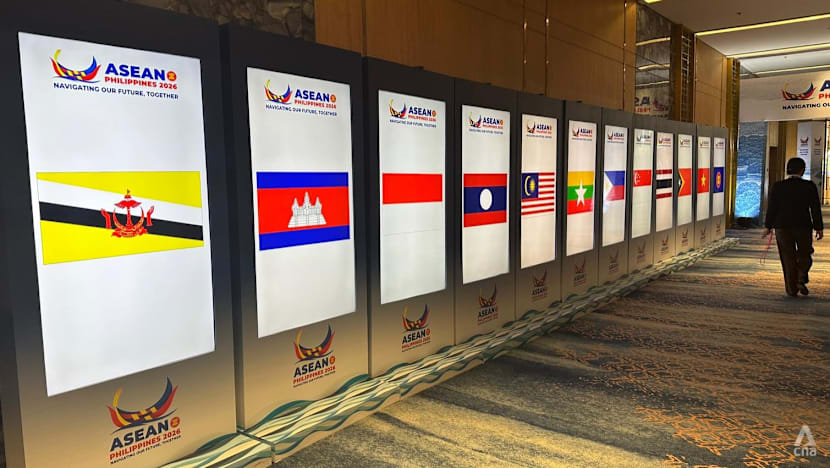
A man walks past flags of the 11 ASEAN member countries during the bloc's foreign ministers' retreat in Cebu, Philippines, Jan 28, 2026. (Photo: CNA/Leong Wai Kit)

This audio is generated by an AI tool.


SINGAPORE: Southeast Asia’s top diplomats are gathering in Cebu this week for their annual foreign ministers’ retreat, marking the first major ASEAN meeting of the year.
The talks come at a time of mounting uncertainty, as the bloc grapples with long-standing regional challenges alongside new global developments reshaping the landscape.
The retreat will be the Philippines’ first major test after taking over the rotating chairmanship of the Association of Southeast Asian Nations (ASEAN) this year.
As the new chair, Manila inherits a growing list of issues demanding collective attention.
Here are some of the key topics expected to be discussed in Cebu.
A TOUGHER GLOBAL ENVIRONMENT
ASEAN is facing profound changes in the global order, said Sharon Seah, a senior fellow at the ISEAS–Yusof Ishak Institute.
“We are seeing now the rise of populism, the rise of right-wing authoritarianism across many parts of the world. We are also seeing (global) economic changes and challenges,” she said.
At the start of the year, the United States took unilateral military action against Venezuela, with US President Donald Trump ordering the arrest of Venezuelan President Nicolas Maduro on narco-terrorism conspiracy and other charges.
The move has raised concerns over the erosion of multilateral norms and the growing unpredictability of great-power behaviour.
Seah said such acts highlight a harsher global reality.
“The recent actions show that we've now really moved into the law of the jungle,” she told CNA.
“The best thing for ASEAN to do is to maintain a neutral convening ground – be friendly and inclusive of everyone, which is in the DNA of ASEAN. Bring everyone on board. Be as non-threatening to major powers as we can.”
US STRATEGIC FOCUS
Further uncertainty stems from the US National Security Strategy released in November last year, which emphasised Washington’s intention to regain its pre-eminent role in the Western Hemisphere.
Seah said the shift could, in the short term, ease pressure on Southeast Asia, which lies in the Eastern Hemisphere.
“The (document) tells us where the US' attention will be, at least in the remaining (three) years of Trump's administration,” she said.
“In that regard, I think it's not a bad thing – it gives Southeast Asia some breathing room to regroup, reconsider and re-strategise, and to see what more can be done to mitigate risks.”
SOUTH CHINA SEA TENSIONS
Closer to home, the Philippines will have to manage persistent tensions in the South China Sea, a key issue in ASEAN’s own backyard.
The disputed waters have been a constant sore point for Manila, amid repeated confrontations between Philippine and Chinese vessels.
Philippine officials have accused Beijing of encroaching on areas well within the country’s exclusive economic zone, raising concerns over sovereignty, maritime security, freedom of navigation and the safety of Filipino fishermen.
Manila is especially uneasy about developments near the Luzon Strait, a vital international waterway between the Philippines and Taiwan that connects the South China Sea to the Western Pacific.
“Manila is concerned that China could occupy Philippine territory in the Luzon Strait,” said Rahman Yaacob, an academic advisor to the Australian National University’s ASEAN-Australia Defence Postgraduate Scholarship Programme.
“If the Chinese navy needs to safely move out from the South China Sea into the Western Pacific, they would need to secure the Luzon Strait to make sure that the Americans and the Filipinos could not attack Chinese warships.”
These concerns are driving ASEAN to push for progress with Beijing on a long-delayed Code of Conduct for the South China Sea, which Manila is keen to advance during its chairmanship.

REGIONAL FLASHPOINTS
Beyond maritime tensions, border clashes between ASEAN members Cambodia and Thailand remain a concern for regional stability.
A fragile month-long truce has held since both sides ended weeks of deadly fighting last month. However, the ceasefire remains shaky, with both countries trading accusations of actions “inconsistent with de-escalation measures”.
Another major challenge is Myanmar. The country ended its three-phase election process last Sunday (Jan 25) with a junta-backed party claiming a landslide victory.
The United Nations, democracy watchdogs and rights groups have called the polls illegitimate. Malaysia's Foreign Minister Mohamad Hasan said ASEAN will not endorse the results, citing the lack of inclusive and free participation. Malaysia was the bloc's chair last year.
ASEAN has maintained its position that Myanmar must fully implement the Five-Point Consensus aimed at restoring peace. The country has been gripped by bloody civil war and a worsening humanitarian crisis since a military coup in 2021 ousted an elected government.
Political representatives from Myanmar remain barred from the regional grouping's meetings, and the country will not be allowed to chair the bloc until ASEAN decides otherwise.
As the Philippines settles into its role as ASEAN chair, a key question remains: how the bloc will engage a post-election Myanmar – a country that has, on paper, moved from military rule to what the junta describes as a democratically elected government.
Manila will also have to manage risks arising from disputes within the region, while maintaining unity among member states with differing strategic interests.
The ASEAN foreign ministers’ retreat will take place in Cebu on Wednesday and Thursday.