analysis Asia
Who is in line to take over Muhyiddin’s chairmanship of Malaysia opposition pact PN?
Islamist party PAS says it is ready to lead Perikatan Nasional, but some analysts question if it has a candidate with “bridge-building” credentials that can steer the bloc into the next general election.
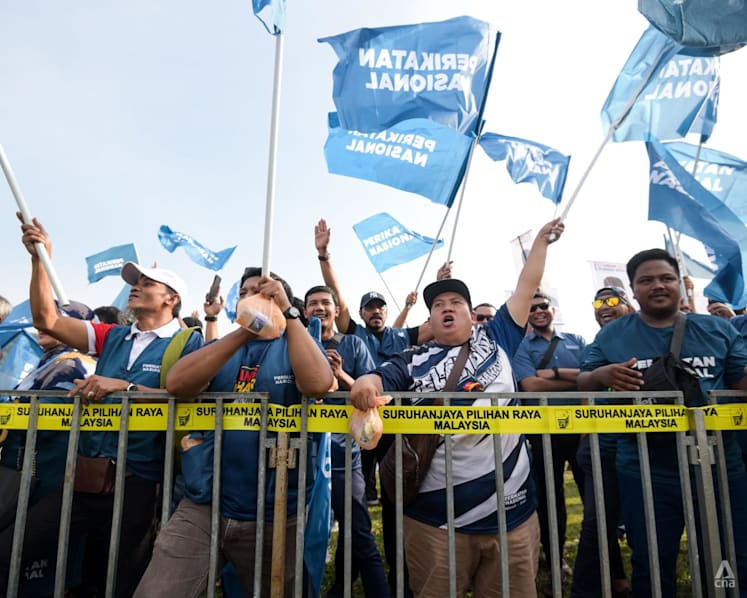
Malaysia’s Perikatan Nasional (PN) supporters outside a nomination centre in Sungai Pusu, Selangor, on Jul 29, 2023, ahead of the state election. (Photo: CNA/Fadza Ishak)

This audio is generated by an AI tool.


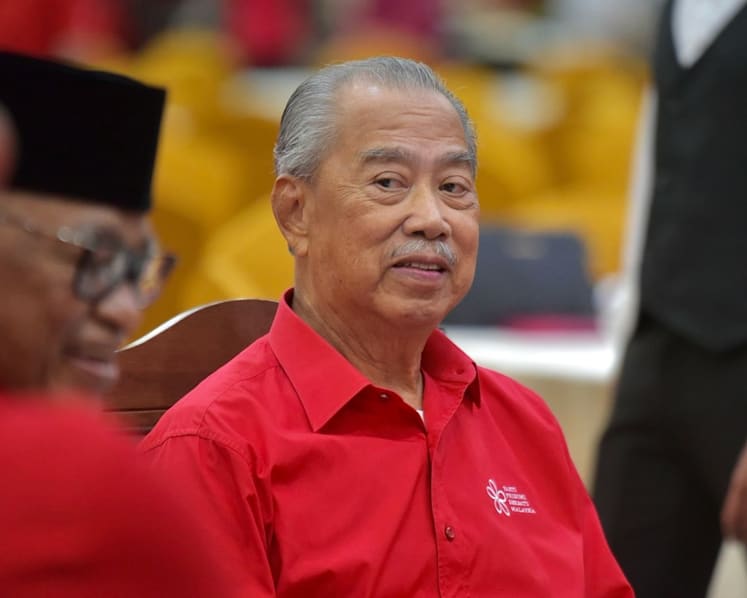
KUALA LUMPUR: A leadership vacuum has opened within Perikatan Nasional following Muhyiddin Yassin’s upcoming resignation as its chairperson, leaving Malaysia’s opposition coalition to grapple with the question of his successor.
Parti Islam Se-Malaysia (PAS) promptly signalled its readiness to lead the coalition, with party leaders saying that they will nominate a candidate to replace Muhyiddin.
However, political observers question whether any potential replacement from PAS possesses the necessary “bridge-building” credentials to lead the bloc into the country’s 16th general election (GE16) that must be held by February 2028.
The Islamist party, while popular in the Malay heartlands, has often been criticised for failing to appeal to the non-Malay population or address non-Muslim fears of an Islamic theocracy, in part due to its leaders’ comments on race and religion.





Muhyiddin, who was Malaysia’s eighth prime minister and held office from March 2020 to August 2021, said on Tuesday (Dec 30) that he will resign as PN chairman, effective Jan 1.
Hours later, former international trade and industry minister Mohamed Azmin Ali also announced his resignation as the coalition’s secretary-general as well as from his post as the chairman of the Selangor State PN Liaison Committee.
This was followed by the resignation of several other state leaders from Bersatu such as Faizal Azumu as Perak PN chairman, Sahruddin Jamal as Johor PN chairman and Hanifah Abu Baker as Negeri Sembilan PN chairman.
Political analyst Awang Azman Awang Pawi of Universiti Malaya (UM) told CNA that Muhyiddin's exit raised critical questions over who will inherit a position that serves as the coalition’s de facto prime minister candidate for GE16.
Awang Azman questioned who would be acceptable to both parties, especially as some PAS leaders have said that the party should take the position.
“In a multi-racial society like Malaysia, the optics of a PAS prime minister (candidate) would not help the coalition gain more votes in constituencies where there are many non-Malay voters,” said Awang Azman.
“There is a very big question mark now. This is a situation that can spark a long conflict and result in the collapse of PN.”
PN was formed in February 2020 and is currently made up of four component parties: Bersatu, PAS, Parti Gerakan Rakyat Malaysia and the Malaysian Indian People’s Party. The latter two are largely considered to be minor players in the coalition.
Muhyiddin, 78, is the president of Bersatu while Azmin is its party secretary-general.
Bersatu supreme council member Saifuddin Abdullah, who has been critical of Muhyiddin, however told CNA that he did not see any issue with PAS taking over the chairman position given its role in PN.
“PAS heads PN in many states, including Pahang where I come from. Current Bersatu MPs and assemblymen from Kelantan and Terengganu ran for the last elections under the PAS logo. So? PAS has more MPs than Bersatu,” he said when asked if a PN chairperson would be acceptable to him.
Muhyiddin’s resignation follows a political crisis in the northeastern state of Perlis, whose state assembly is controlled by PN.
The upheaval saw PAS’ Sanglang assemblyman Mohd Shukri Ramli resigning as chief minister and Bersatu’s Kuala Perlis assemblyman Abu Bakar Hamzah replacing him in the post.
Shukri’s resignation came after eight statutory declarations were signed by state assemblymen – three from PAS and five from Bersatu – retracting their support for him.
The three PAS assemblymen have since been sacked by the Islamist party.
There are 15 seats in Perlis’ state assembly. PAS holds six of the remaining seats, Bersatu holds five, and Prime Minister Anwar Ibrahim’s Parti Keadilan Rakyat (PKR) holds one.
Some PAS members have criticised Bersatu’s move against Mohd Shukri as a “backstabbing” betrayal, and gone as far as to call on the party’s leadership to sever all ties with Bersatu at every level.
Perlis ruler Tuanku Syed Sirajuddin Jamalullail on Sunday called on all parties to end speculation and allegations “for the good of the state”.
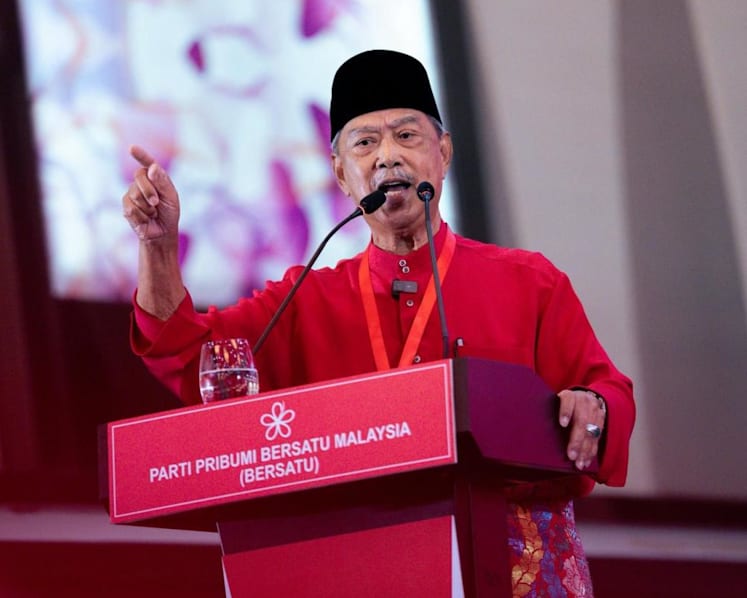
IS BERSATU DEPUTY PRESIDENT HAMZAH A LIKELY REPLACEMENT?
While PAS has signalled its intention to lead PN, most observers however opined that PN deputy chairman and current leader of the opposition Hamzah Zainudin is the most natural candidate to take over Muhyiddin.
Hamzah, 68, is also deputy president of Bersatu.
Political scientist Syaza Shukri of the International Islamic University Malaysia (IIUM) said that Hamzah - who was formerly Home Minister - is the most likely candidate from Bersatu as he has the support of PAS leaders.
“PAS may say they want their own leader which is fair but if PAS truly does that then PN is really PAS-dominated and PAS-led. So is PAS ready for that perception?” she told CNA, adding that Bersatu acts as PN’s bridge to moderate and non-Malay voters.
ISEAS-Yusof Ishak Institute’s visiting fellow Amrita Malhi wrote in a commentary in April that PAS’ “exclusionary narratives” and its leaders’ consistently “chauvinistic statements” have alienated non-Muslims.
“Its leaders’ statements cast these minorities as threats to Malay and Muslim power, arguing for their rights and freedoms to be stripped on the one hand; while, on the other, seeking to reassure them that they would be safe under PAS rule,” she wrote.
This fails to reassure the minorities, leaving many Malaysians concerned that PAS is seeking co-option into an “Islamic unity” government, she added.
James Chin, a professor of Asian studies from the University of Tasmania, said that whether PAS leads the coalition is an open question.
“There are several people in PAS who want the position but the problem is if PAS takes over PN, this is not good for them because the Chinese community has totally rejected PAS. This means it will be much harder for them to win the next general election,” he told CNA.
However some analysts believe that the PAS grassroots would prefer that the party lead the coalition, rather than Bersatu.
Political analyst Azmi Hassan of the Nusantara Academy for Strategic Research said that although PAS leaders are comfortable with Hamzah as a choice for chairman, its members would not be particularly happy with this.
“The main reason Muhyiddin stepped down was due to pressure from PAS and the Perlis fiasco. If Hamzah is agreed upon by PAS and Bersatu, it would show that PAS has no capable leaders to take over PN and PAS doesn’t want to portray that. Most likely, PAS will take over,” he said.
Awang Azman of UM concurred and said: “I don’t think the PAS grassroots will want anyone from Bersatu as there will be questions (over) how the minority can rule the majority.”
PN enjoyed surprise success in the 2022 general election that was characterised by the "Green Wave" featuring significant electoral gains largely propelled by PAS.
PN won 74 seats in the 222-seat parliament, establishing itself as the second-largest bloc behind Pakatan Harapan (PH), which won 82 seats.
PAS was the driving force behind PN's success, securing 43 parliamentary seats — a substantial gain of 25 seats — while Bersatu secured 31 seats, representing a gain of 17 seats.
PN's success came largely at the expense of Barisan Nasional, which won just 30 seats, and is now part of Anwar’s unity government.
However, Bersatu’s share of seats has since dropped to 25, after six members of parliament unhappy with Muhyiddin’s leadership switched allegiance to Anwar’s government in 2023.
Bersatu has been divided into at least two main camps: One that is with Muhyiddin, and another with Hamzah.
News reports also point to a Bersatu faction loyal to secretary-general Azmin that is aligned with Muhyiddin.
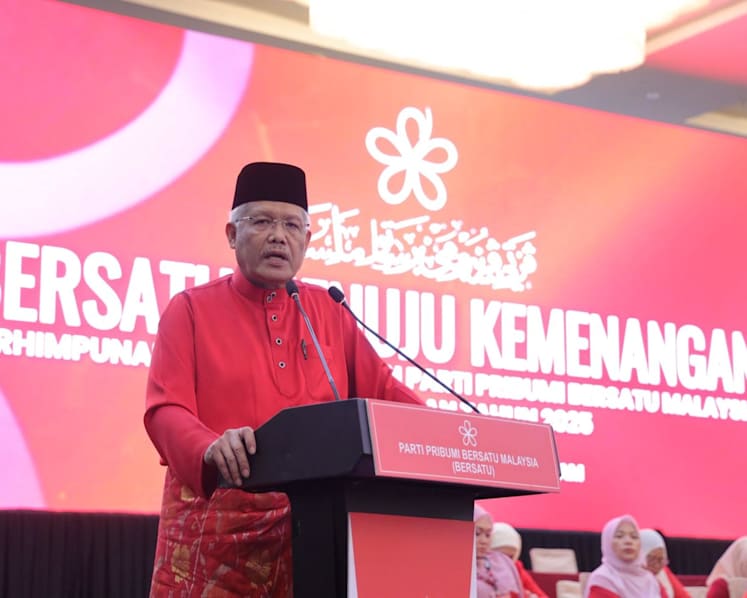
WHO FROM PAS CAN TAKE THE TOP POSITION?
The youth wing of PAS has been vocal about the party leading PN.
PAS youth chief Afnan Hamimi Azamudden said on Monday after the swearing in of the new Perlis chief minister that it should take over the chairmanship of PN.
"An ally unable to keep their own men in line is a weak ally. But an ally who stabs a friend in the back is a traitor. After what has transpired in Perlis, PAS is more than justified in taking over the helm of Perikatan Nasional," he said in a Facebook post.
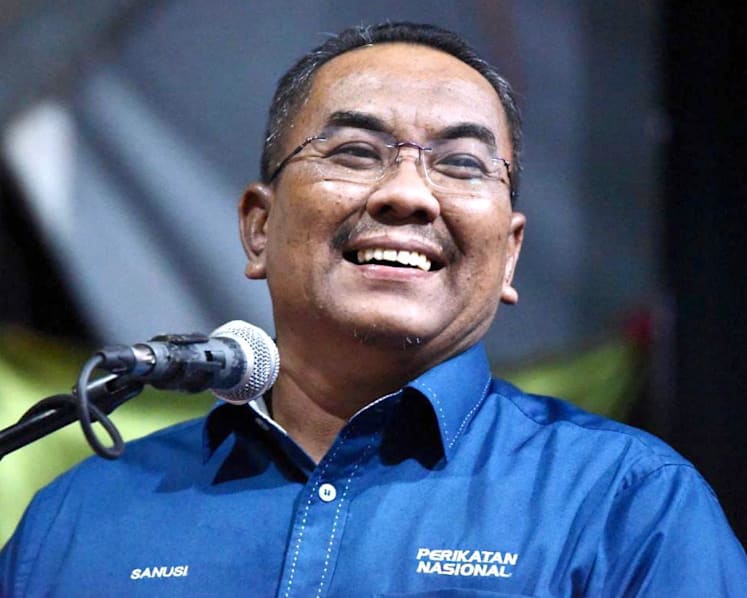
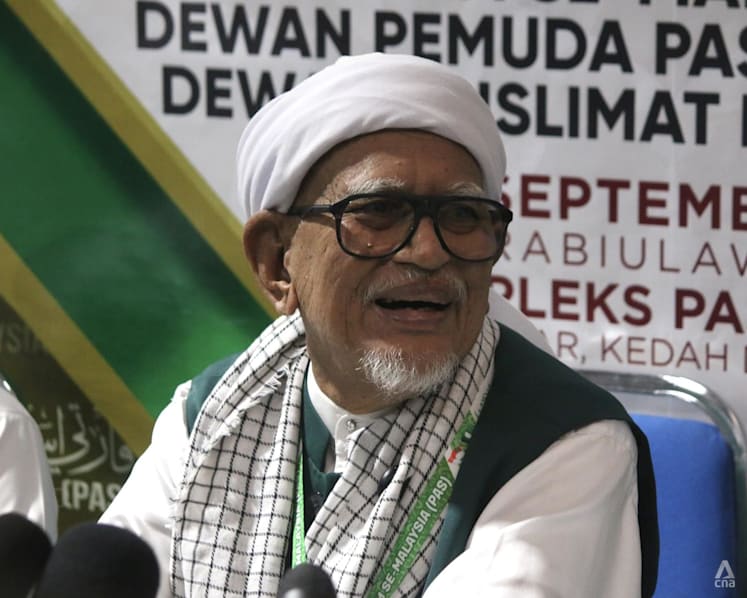
A few of the names that have been bandied about by observers include its deputy president Tuan Ibrahim Tuan Man, its secretary-general Takiyuddin Hassan, Terengganu chief minister Ahmad Samsuri Mokhtar and Kedah chief minister Muhammad Sanusi Md Nor.
Its president Hadi Awang, 78, is however unlikely to be in the mix for the position because of his poor health.
PAS information chief Ahmad Fadhli Shaari said in a statement on Tuesday that the party would nominate a candidate from the party to be the chairman of the coalition.
“It does not necessarily have to be the party president, but an individual who is believed to be able to galvanise the collective strength of the component parties under PN," he said.
Tuan Ibrahim has said that the matter of who would replace Muhyiddin would be brought to the coalition’s supreme council for deliberation by the presidents of its component parties.
“What is important is that everybody works together to strengthen PN,” he was quoted as saying by news outlet FMT.
Azmi Hassan believed that Tuan Ibrahim, 65, is most likely to be PAS’ candidate because of his seniority. While Syaza agreed with this assessment, she was not sure if he had the support from all parties.
“Some within PAS want their own leader but I’m not sure if PAS has any good candidate, including Tuan Ibrahim. He may not have broad support, especially from Bersatu,” she said.
While Azmi Hassan regarded Ahmad Samsuri as the most “intellectual” candidate from PAS, Syaza was skeptical, questioning whether he possesses the necessary stature for national leadership.
Fifty-four-year-old Ahmad Samsuri - a popular technocrat and an incumbent PAS vice-president - is the only member in the party's top five positions not seen as part of the powerful ulama (religious scholar) faction.
As for Sanusi, Syaza believed that there are those within Bersatu who are not that happy with him.
“They don’t see him as a stabilising factor and a good leader. But that’s a while back. Sanusi has been relatively quiet now. It would make sense since he is part of the leadership circle,” she said.
Sanusi, 51, had previously made headlines for his controversial remarks on the royalty and opposing politicians.
MUHYIDDIN ‘MAGNANIMOUS’, SAYS BERSATU MEMBER
Meanwhile, Bersatu information chief Tun Faisal Ismail Aziz claimed that Muhyiddin’s resignation as PN chair showed that he was someone who did not pursue positions.
Tun Faisal Ismail said that after the 15th general election, Muhyiddin had offered the posts of PN chairman and opposition leader to PAS, but the party declined.
However, the Perlis political upheaval has led to disharmony, exacerbated by the overly forceful stance of PAS leaders, said Tun Faisal Ismail.
“As a magnanimous leader, Muhyiddin chose to relinquish his position to make way for PAS and other component parties within PN. His intention was to restore harmony in Perlis as well as at the federal level,” he told CNA.
But Muhyiddin has long faced pressure to step down, said observers.
In 2023, Muhyiddin had caused a stir when he backpedalled on his decision not to defend his presidency at Bersatu’s internal polls that year.
He had said then that what his wife had told him had made him reconsider his earlier decision.
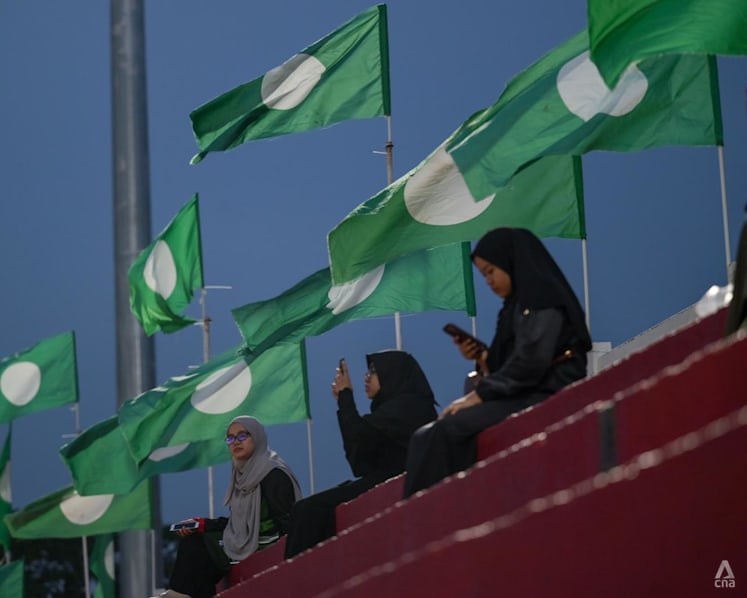
In September this year, the Bersatu annual general meeting was rocked by a public display of dissent against Muhyiddin, with some delegates heckling him to step down as president.
Speaking earlier at the meeting, Muhyiddin had criticised plans to "topple the president" via the collection of statutory declarations from party members, saying that this was against Bersatu's constitution.
Still, the meeting unanimously endorsed him as the party’s prime minister candidate ahead of the next general election.
Analysts had said that the tensions between warring factions in Bersatu could undermine such a pick by the party, adding the internal unrest could also be exploited by PAS to assert more control in PN.
Muhyiddin is facing charges of abuse of power and soliciting bribes amounting to RM232.5 million (US$57.4 million) during his 17-month premiership.
Earlier in November, a Malaysian High Court declared that his corruption trial would begin in early March 2026.
Chin believed that the Perlis fiasco was tied to the larger plot to push Muhyiddin out of PN, adding that it was quite clear that he had lost support in the coalition.
“There has been a lot of pressure on him in the past year to step down,” he said.