Commentary: India-EU’s ‘mother of all deals’ is much more than just a trade pact
The sprawling trade deal sends a positive message in support of rules-based global trade at a time when that appears to be increasingly under strain, says Amitendu Palit from the National University of Singapore.

This audio is generated by an AI tool.


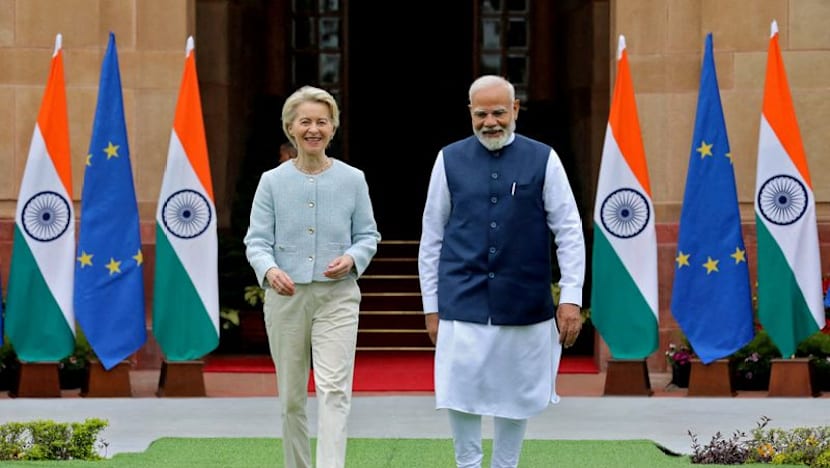
SINGAPORE: After nearly two decades of stop-start negotiations, India and the European Union (EU) have sealed a free trade agreement (FTA), lavishly described by both sides as the “mother of all deals”.
Formally announced at the India-EU Summit in New Delhi on Tuesday (Jan 27), the trade pact has far-reaching significance – not only for its economic potential as one of the world’s largest common markets, but also the positive message it sends in support of rules-based global trade at a time when that appears to be increasingly under strain.
The sprawling deal also marks a transformative high in India’s once-conservative free trade strategy.
LARGE ECONOMIC SCALE
Work on the FTA first started in 2007 but stalled repeatedly over issues such as automobiles, agriculture, wine and spirits, and data rules.
Negotiations picked up momentum from 2022, backed by strong political will on both sides. The last year witnessed sharp progress following the visit of European Commission President Ursula von der Leyen and her team of commissioners to New Delhi in February 2025, as both sides recognise that stronger bilateral ties may no longer be optional amid the return of United States President Donald Trump to the White House and geopolitical uncertainties around the world.
One of the trade pact’s significance lies in its sheer scale. It brings together some of the world’s largest economies, including India – the fifth biggest globally – and major EU members such as Germany, France and Italy, which are ranked third, seventh and eighth, respectively.
Together, India and the EU make up a combined market worth around US$25 trillion encompassing nearly two billion people. These figures represent close to a quarter of both the world economy and population.
The FTA will be India’s largest to date and the EU’s second biggest after the US.
MORE THAN JUST A TRADE PACT
Easier market access and economic gains aside, the deal is more than just about trade. It can be seen as a strategy for risk diversification and supply chain resilience, given an unpredictable United States and economic overreliance on China.
For India, 2025 highlighted tendencies of both the US and China to use their economic power as leverage – through unilateral tariffs and export controls, respectively.
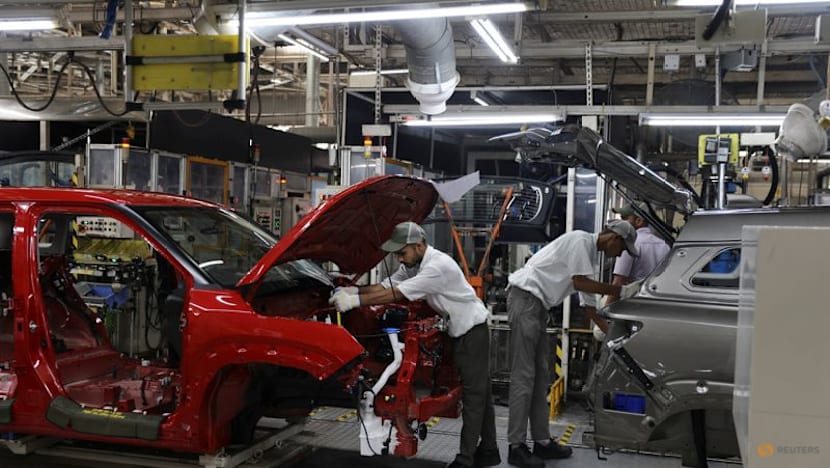
The US is India’s biggest export market, while India remains a major importer of Chinese products. Indian exporters are currently grappling with steep 50 per cent tariffs from the US. The country’s importers, particularly automakers and component makers, also faced a scare when China briefly tightened its rare earths export controls last year.
Partnerships with more major world economies in the form of FTAs with modern trade rules and generous market conditions will allow Indian exporters greater preferential access to global markets. They also enable domestic export-oriented industries to source inputs from multiple countries, enabling resilience of various supply chains.
High dependence on one or two markets for imports and exports naturally increases risks of economic coercion. India’s latest trade pact with the EU aims to provide a safeguard by enabling greater diversification.
HIGH POINT IN INDIA’S TRADE STRATEGY
It is worth noting that the trade deal with the EU marked India’s ninth such agreement in four years.
This marked a U-turn from nearly a decade’s hesitation and reticence on engaging in FTAs. Since 2022, India has signed several trade pacts, beginning with the United Arab Emirates and Australia, followed by the European Free Trade Association consisting of Iceland, Liechtenstein, Norway and Switzerland. The sprint picked up pace last year as India entered into FTAs with Oman, New Zealand and the United Kingdom.
India’s latest FTAs are more exhaustive in scope and market access ambitions than its earlier ones. These include rules on modern 21st-century trade issues, such as digital trade, government procurement, competition policy, as well as labour and environment standards.
While still protecting sensitive sectors like agriculture and dairy, India is reducing tariffs on several items, including food, beverages and automobiles. It is also allowing foreign suppliers in previously protected domestic services like accounting, and liberalising rules for intellectual property.
The deal with the EU again incorporates all the above features. By having trade rules that are closely aligned to global standards, it marks India’s coming of age as a global trade actor ready to contribute to rule-making on 21st-century trade issues.
A POSITIVE MESSAGE FOR RULES-BASED TRADE
India and the EU have traditionally disagreed on various trade issues. These differences, such as those on investment facilitation, taxing e-commerce transactions, agriculture subsidies and intellectual property rules, continue to prevail.
Yet, the fact that they have been able to finalise a bilateral FTA notwithstanding these differences sends a positive message for shoring up global rules-based trade.
The message is in two major global actors with contrasting views on trade putting faith in their abilities to thrash out framework rules. It means that more countries with conflicting views on trade, especially from the Global North and Global South, can hope to work out mutually agreeable trade rules among themselves.
This is especially critical at a time when global trade rules are being upended by trade-restrictive policies from major powers. Such moves by the major powers may motivate other global actors to collaborate deeper on global trade in their own strategic interests. The EU-India FTA can serve as an important example of how this can be done.
Amitendu Palit is Senior Research Fellow and Research Lead (trade and economics) at the Institute of South Asian Studies, National University of Singapore. The opinions expressed are those of the writer and do not represent the views and opinions of NUS.