







Commentary: Helping SMEs sustain, not just adopt, AI will be key for Singapore
As Singapore pursues AI at the leading edge, it must ensure small- and medium-sized enterprises do not fall too far behind, say Singapore Business Federation CEO Kok Ping Soon and PwC Singapore Executive Chairman Marcus Lam.
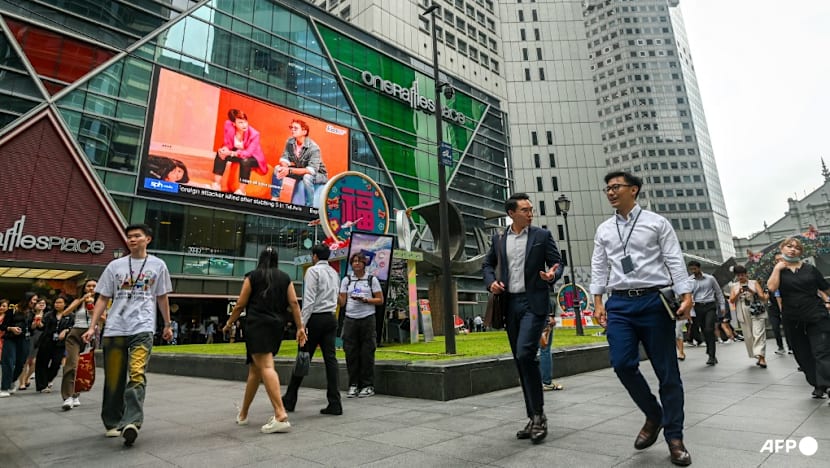
People walk on the street during lunch break at Raffles Place in Singapore on Jan 22, 2025. (File photo: AFP/Roslan Rahman)

This audio is generated by an AI tool.




SINGAPORE: Singapore should boldly establish itself as an AI leader and a “location of choice” for global AI innovation, recommended the Economic Strategy Review (ESR) committees in a mid‑term update on Jan 30. Crucially, the review emphasised that AI adoption must extend across the economy, including helping small‑ and medium‑sized enterprises (SME) reap the technology’s full benefits.
However, in our day-to-day engagements with SME leaders, a stubborn reality keeps surfacing.
While many start with optimism, technical hurdles, competing priorities and limited resources soon get in the way. Initial AI efforts then end up fragmented and difficult to scale.
The numbers reveal this frustration. In Singapore, only 14.5 per cent of SMEs adopted AI in 2024, sharply lower than 62.5 per cent of larger businesses, according to the Infocomm Media Development Authority’s most recent Singapore Digital Economy Report.
The gap is striking, but it should not be mistaken for a lack of readiness from smaller companies.
SAME PROBLEMS, DIFFERENT RESOURCES
The difference is that SMEs have far fewer resources and buffers than multinational companies to confront remarkably similar barriers to AI adoption.
In the Singapore Business Federation’s National Business Survey 2025, companies cited barriers such as a lack of in‑house expertise, uncertainty over where to begin and difficulty in demonstrating return on investment. A SME is more likely to experiment with AI in fits and starts, often relying on a single champion juggling multiple roles. When daily operations demand attention, progress stalls.
This highlights the first structural gap: moving from individual productivity gains to enterprise-level productivity.
Many SME employees already use off-the-shelf AI tools to draft emails, analyse spreadsheets or generate content, but these are typically used informally, outside company systems. Individuals become more productive, and benefits are lost when they leave.
For there to be lasting value for the organisation, AI must be embedded into core business functions – such as customer relationship management, invoicing, procurement, communications and marketing – and must be set up to support specific roles and used consistently.


This tilts the ecosystem toward bigger players.
National conversation often centres on frontier technologies, advanced use cases and innovation‑driven firms, with underlying assumptions about integration timelines, data readiness and in-house expertise. Larger organisations can afford to invest in digital infrastructure, sustain long pilots, and hire technical leads to ensure AI is fit for purpose.
Take Mr Tan, the finance director of a Singapore-Batam shipping agency providing door-to-door logistic service that employs about 50 people. Business has picked up in light of recent interest in Indonesia’s Batam–Bintan–Karimun (BBK) free trade zone, but this comes with an increase in manual tasks, such as the processing of invoices, supporting documents, bank statements and customer replies.
Mr Tan knows that AI can help ease his workload and remove a bottleneck to the company’s growth. But designing new processes and workflows requires technical capability and the workload leaves him little time and capacity to get resources, test and evaluate solutions, or train the AI tools to meet his business needs.
The Association of Small and Medium Enterprises’ (ASME) recent announcement of a S$10 million grant is an important step toward lowering the financial barriers of entry. But effective AI adoption also requires organisational transformation, which in turn needs strong advisory support, sector-specific guidance and practical implementation pathways.
FROM ENTERPRISE ADOPTION TO ECONOMY-WIDE PRODUCTIVITY
Another structural gap is the challenge of moving from enterprise-level productivity to economy-wide gains.
Singapore already has useful precedents. The Monetary Authority of Singapore has a sectoral pathfinder programme for regulators, industry players and technology partners to share use cases and resources, for more practical insights to AI adoption.
A similar sectoral approach would be useful in sectors such as logistics and wholesale trade, advanced manufacturing and marine services, where supply chains are tightly integrated.
As AI systems become more interconnected and agentic, productivity gains will increasingly depend on raising the baseline capability of SMEs alongside larger firms.
LOWERING BARRIERS OF ENTRY
For many SMEs, AI adoption remains daunting. Not knowing how or where to start is a common concern.
Should limited budgets go toward AI tools in marketing, accounting or operations? Who should lead this internally? What skills are required and how can impact be measured?


While SMEs are aware of the growing suite of national initiatives to support their AI adoption, our day-to-day engagements suggest that many leaders struggle to turn them into concrete action.
Going back to finance director Mr Tan, he had considered the Enterprise Development Grant, but found the application and claim process tedious and added further load to his overworked staff. The organisation was also rejected for another grant, and appealing the decision will mean more administrative work. While individual experiences vary, similar concerns surface frequently in our conversations with SMEs.
One suggestion to lower entry barriers would be to enhance the Productivity Solutions Grant with an AI booster add-on to reduce upfront costs and encourage experimentation.
Most support initiatives provide general support without deep industry-specific guidance. Industry leaders, trade associations, chambers and tech partners could offer tested or pre-vetted solutions and practical advice in the form of industry roadmaps and collaborative opportunities.


UPGRADING THE WORKFORCE IN PARALLEL
Keeping momentum beyond initial adoption is just as hard and matters as much. Many SMEs conveyed to both SBF and PwC Singapore that while AI tools are easy to trial, sustaining their use is harder once real costs and capability gaps surface.
One such case is Mr Lim, the second-generation owner of a leading product tanker operator and physical marine supplier with about 30 employees. They explored AI tools and digitalisation, but recurring operating costs such as the cost of tokens or licenses to use cloud and AI services soon outweighed perceived benefits. In addition, as staff lacked confidence in embedding these tools into daily workflows, the company eventually stopped using them and returned to manual processes.
This highlights the importance of upskilling the workforce in step with AI usage. SMEs gain far more from role‑based and workflow‑based training that is tightly aligned to how AI is used in daily tasks, whether in operations, finance, logistics or customer support.
Flexible training wallets, such as SkillsFuture Enterprise Credit‑type mechanisms, can play a critical role by allowing firms to draw down support progressively as needs emerge, instead of committing to large, one‑off programmes.
A NATIONAL IMPERATIVE
With Budget 2026 around the corner, there is no better moment to confront the structural gaps in SME AI adoption.
SMEs sit at the centre of Singapore’s economy and employ 90 per cent of our workforce. Their AI adoption is a core economic priority.
If they are empowered to harness AI effectively, the productivity gains, innovation spillovers, competitive resilience and skills upgrade will be felt far beyond the individual firms.
Kok Ping Soon is Chief Executive Officer of the Singapore Business Federation.
Marcus Lam is Executive Chairman of PwC Singapore.





