China’s robot ambitions dazzle on stage, but real-world challenges remain
Embodied intelligence – the integration of AI into physical forms such as robots, cars and smart devices – has emerged as a strategic priority for Beijing.
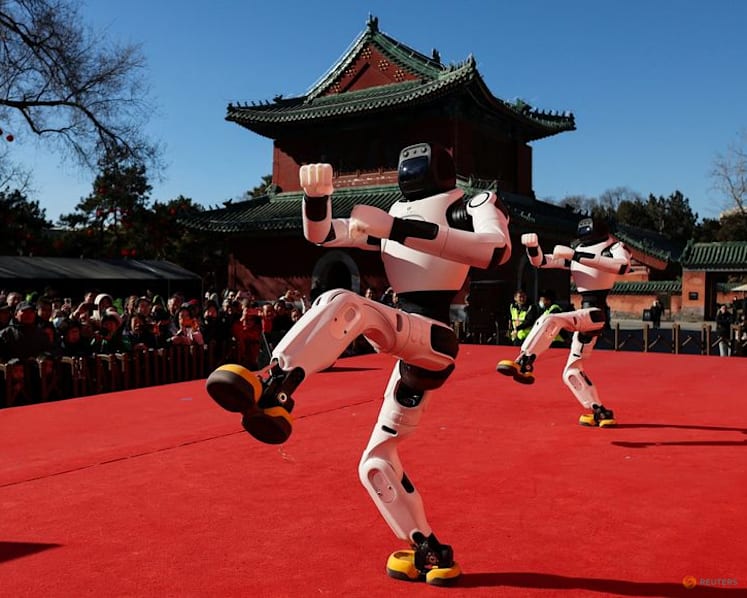
People watch as robots perform a dance during Lunar New Year celebrations in Beijing, China, Feb 18, 2026. (File photo: Reuters/Maxim Shemetov)

This audio is generated by an AI tool.




HANGZHOU, Zhejiang: China’s robots grabbed global attention at this year’s Spring Festival Gala with martial arts moves, backflips and a full-blown spectacle that blurred the line between science fiction and state ambition.
Videos of humanoids performing fully synchronised wushu routines with nunchucks and swords quickly went viral online. In one segment, the machines sparred in choreographed sequences alongside children.
The show has become a point of pride for Hangzhou, where homegrown firm Unitree Robotics’ G1 humanoids performed the kungfu segment at the nationally televised gala.
Known for its picturesque West Lake and as the birthplace of e-commerce giant Alibaba, the eastern Chinese city is positioning itself at the forefront of what Beijing calls its “industries of the future”.





Among them: embodied intelligence.
FROM STAGE TO STRATEGY
Embodied intelligence – the integration of artificial intelligence into physical forms such as robots, cars and smart devices – has emerged as a strategic priority for Beijing.
The push has been written into China’s latest Five-Year Plan, signalling policymakers’ determination to move AI beyond software and into the real world.
At this year’s National People’s Congress that concluded last Thursday (Mar 12), officials made clear they want intelligent machines to move beyond controlled demonstrations and into everyday life.
The vision is ambitious: humanoid robots working in factories, assisting in logistics, supporting healthcare, and helping with household chores.
But how close is that reality?
ROBOTS STILL “GROWING UP”
Industry insiders say the technology is advancing rapidly, but true general-purpose humanoid robots remain some distance away.
Yolanda Xie, marketing manager at Unitree Robotics, said today’s machines are still far from fully autonomous.
“Right now, robots are still like children or teenagers. They need more time to grow,” she told CNA, adding that cognition remains the biggest bottleneck.
“Robots still can’t really think or make decisions – like fetching a glass of water, or cleaning a room, that’s still hard for today’s humanoids,” she added.
“But that’s our ultimate goal: to develop a more general-purpose robot.”
GOOD ENOUGH FOR NOW
Even so, progress is tangible. Advances in machine learning mean robots can now mimic human movement far more naturally.
In many industrial settings, that level of capability is sufficient for now.
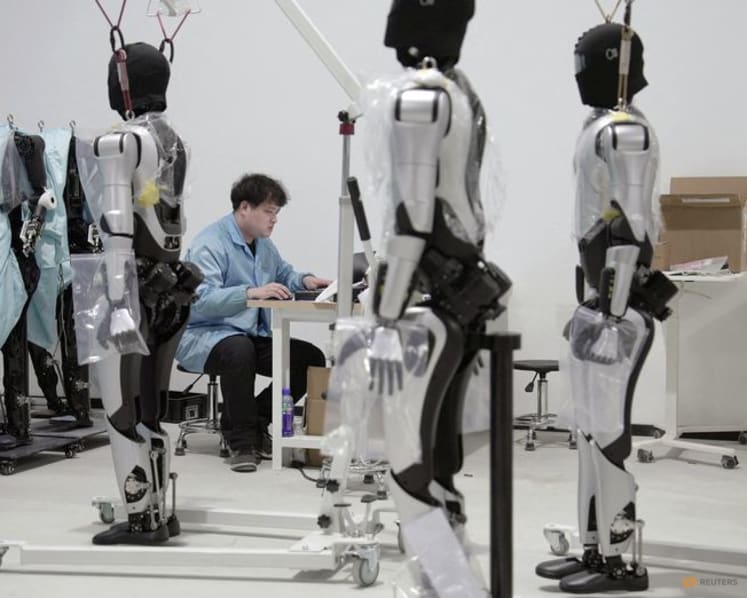
From its headquarters and 10,000-sqm factory in one of Hangzhou’s sprawling tech parks, Unitree provides the hardware platform while clients customise the software.
SPIKE IN DEMAND
At Wuhan Fengke Robot Technology, demand for humanoid robot rentals has more than doubled in recent weeks compared with the same period last year.
THE CONSUMER FRONTIER