Budget 2026 debate: MPs propose higher salary cap for Jobseeker Support Scheme
Advance retrenchment notifications, stronger support for the unemployed and rethinking entry-level jobs were among the MPs' suggestions during the debate.

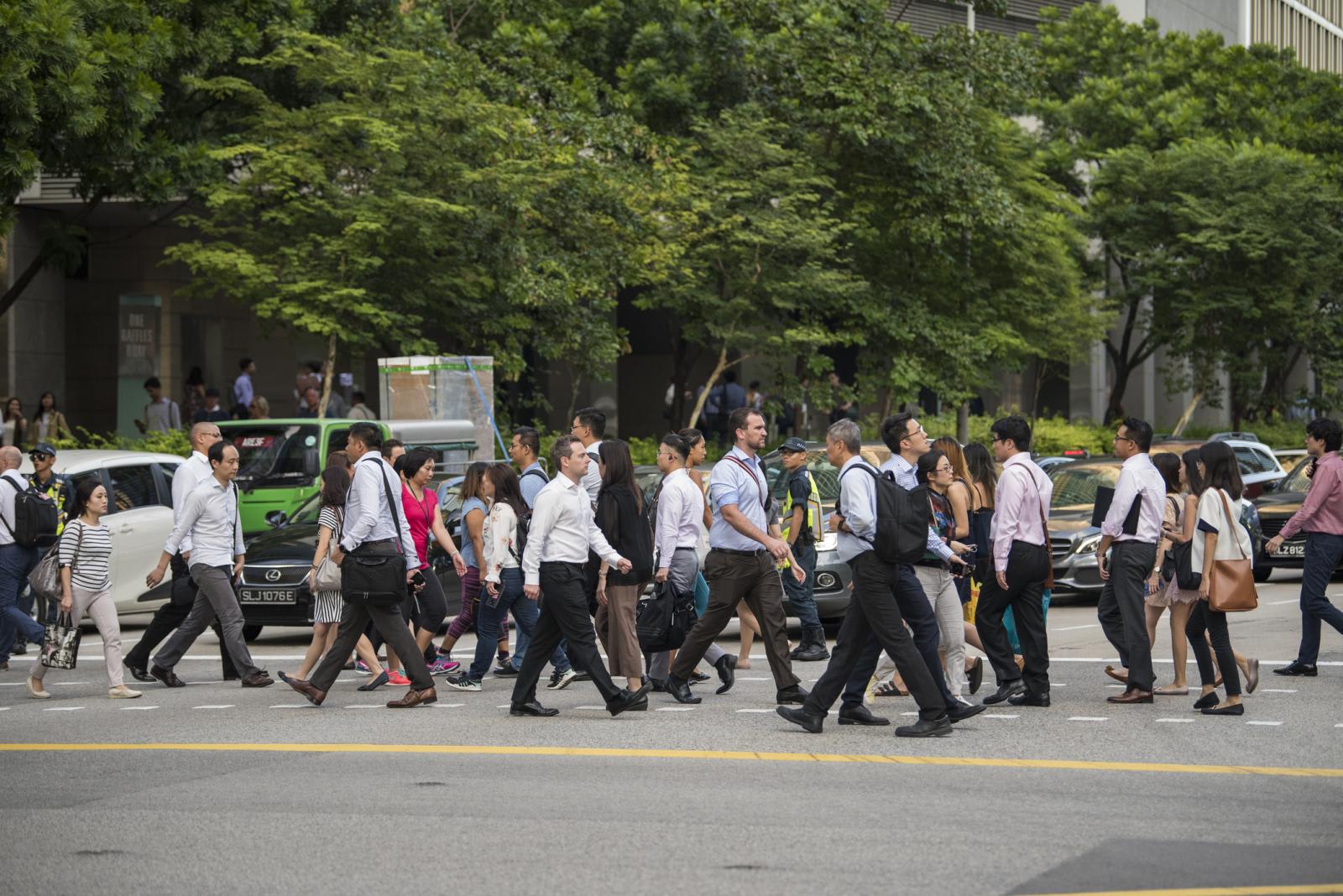
People walk on the street during lunch break at Raffles Place in Singapore on Jan 22, 2025. (File photo: AFP/Roslan Rahman)

This audio is generated by an AI tool.




SINGAPORE: Proposals to raise the salary cap for receiving unemployment benefits under the Jobseeker Support Scheme were among the measures Members of Parliament (MPs) called for on Wednesday (Feb 25) to support workers.
Better protections for contract workers, as well as a rethinking of entry-level jobs, were also on the agenda as parliament debated the 2026 Budget.
Eight lawmakers from the labour movement were among the 26 MPs who spoke on the second day of debate.
They called on the government to raise the income ceiling for the Jobseeker Support Scheme from S$5,000 (US$3,950) to S$7,600.





This is to match the median gross monthly income of professionals, managers, executives and technicians (PMETs), labour chief Ng Chee Meng said.
“As more PMEs may experience churn, it is timely for the government to review this income threshold,” said the National Trades Union Congress (NTUC) secretary-general.
The Jobseeker Support Scheme provides up to S$6,000 for people who have lost their jobs involuntarily. They must participate in job search activities to receive payouts.
The first-of-its-kind scheme in Singapore was introduced in April 2025 and had received over 7,200 applications as of the end of August 2025.
Budget 2026 must reassure Singaporean workers who are anxious about their place in a changing economy, said MP Patrick Tay. Speaking in parliament on Wednesday (Feb 25), he pointed out that in this era of AI, ageing and global uncertainty, Singaporeans are not asking for guarantees but want fairness and opportunity, as well as see their effort rewarded. He outlined the various ways the Budget must work for the “five U's” - the unemployed, underemployed, under-represented, untrained and underserved.
About 60 per cent of the applications were rejected, and one of the top three reasons was applicants exceeding the monthly income threshold of S$5,000.
“I therefore opine that more can be done to support the broad middle of involuntarily unemployed workers,” said MP Patrick Tay (PAP-Pioneer), who is also NTUC assistant secretary-general.
Easing financial pressure helps unemployed workers avoid rushing into poor job matches that lead to underemployment, he added.
The Manpower Ministry previously said that the S$5,000 threshold slightly exceeds the median income of full-time employed residents in 2024, which was about S$4,900 (excluding employers' Central Provident Fund contributions).
RETRENCHMENT NOTICES
Labour MPs also called for companies carrying out retrenchments to notify the government before they do so, and not after.
Currently, companies with at least 10 employees must notify the Ministry of Manpower of any retrenchment within five working days after the affected employee is informed.
An administrative penalty of S$1,000 can be imposed if the employer fails to do so.
Mr Tay said there should be stronger penalties and “not just a slap on the wrist”.
He also asked the government to consider sharing information with unions on sectors and companies that might be disrupted due to economic restructuring, including expected scale of impact and timeline, past retrenchment incidence and past retrenchment benefit level.
Seeking clarification, Workers’ Party chief Pritam Singh noted that NTUC had already made known its intention to seek advance mandatory retrenchment notification before the Budget debate.
He also noted that the CEO of the Singapore National Employers Federation (SNEF) had expressed strong reservations against the proposal in a forum letter in the Straits Times on Feb 13.
“In view of the tripartite framework, has there been agreement with SNEF on this particular point?” Mr Singh asked.
Mr Tay replied that tripartite partners were in the midst of negotiations on the matter in the tripartite work group to review the Employment Act.
“We are looking at this carefully to balance the interests of the respective tripartite partners. But what I’ve shared earlier is our NTUC standpoint,” he said.
According to advance estimates, there were 14,400 retrenchments in Singapore in 2025, up from 13,020 in 2024.
Employers should set organisational norms around after-hours responsiveness, escalation rules and protected focus time, NMP Sanjeev Kumar Tiwari said in parliament on Wednesday (Feb 25). He noted that rest is not about doing less, but about sustaining effort over longer careers. Without sustainable norms, he added, even the best upskilling will under-deliver as burnout erodes adaptability and retention. Mr Tiwari also spoke against fixed-term contracts, especially annual renewals, where older workers are disproportionately represented. He said these give rise to uncertainty which makes long-term planning and upskilling harder.
Nominated MP Sanjeev Kumar Tiwari, who sits on NTUC’s central committee, said that early notification to unions is the difference between “proactive help and reactive damage control”.
“We should institutionalise advance retrenchment notifications across all firms, including for PMEs, so that affected workers can be rendered meaningful assistance early and with dignity,” he said.
YOUNG WORKERS
Several MPs also spoke about how young adults entering the workforce can be better supported, especially in the age of artificial intelligence.
NTUC deputy secretary-general Desmond Choo highlighted how a new industrial policy is needed for entry-level jobs.
“We must fundamentally redefine what it means to be entry-level in the Singaporean economy of the future,” he added.
He said that while a worker’s value in the past lay in production, entry-level roles in the future must increasingly be defined by supervision, integration and judgment.
“Audit AI's output for truth and bias, integrate systems securely, provide context, empathy … that machines cannot replicate.
“Now this is a higher value role, but it’s also a harder role because it assumes a level of maturity and skill earlier in one’s career.”
He suggested that some traditional execution roles can be converted into structured apprenticeships with core elements of AI oversight or AI integration.
Industry leaders must also be identified to lead AI transformation in the workforce.
Mr Choo also suggested that students be equipped with semi-senior entry responsibilities from the start of their careers.
“AI literacy cannot be optional. It must be foundational. Every graduate should be proficient, not only in theory, but in practical AI usage.”
He also proposed accelerating reskilling timelines, suggesting the government assess whether earlier access to training support may be needed in this new environment.
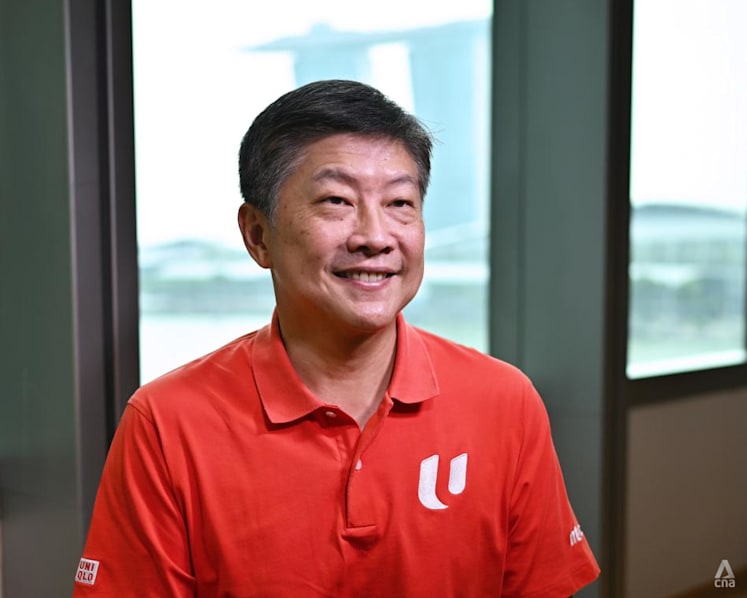

Mr Tay also spoke on the Graduate Industry Traineeships (GRIT) scheme that was launched last October.
He suggested launching an enhanced version of the scheme in high-growth and high-demand sectors, with opportunities ranging from one to two years and with monthly traineeship allowances on-par with starting salaries.
The scheme is intended for fresh graduates from universities, polytechnics, the Institute of Technical Education and other educational institutions who have no prior work experience. It is also open to graduates with master's degrees or doctorates.
“Host organisations must convert trainees into permanent full-time employees unless a valid reason and supporting evidence are submitted.
“The government can also set aside more resources to groom early-career professionals by sending them for overseas work postings,” Mr Tay said.
MP Jamus Lim (WP-Sengkang) spoke about how AI is upending Singapore's approach to educating its future workers.
"The advent of AI will mean an erosion of the edge in knowledge and ability that our schooling system had previously been able to confer," he said.
"We must not be now lulled into a false sense of security by our nation's current unemployment rate, which has yet to capture the potential displacements of jobs that could result when AI and robotics become more entrenched in the economy," he added.
"The future is much better inferred from the unemployment rate of new workers," he said.
CONTRACT WORKERS
MPs also raised concerns about the challenges faced by workers on fixed-term contracts as well as PMEs.
NMP Mr Tiwari said the continued use of fixed-term contracts, particularly annual renewals, places pressure on workers.
He noted that the share fell slightly in 2025, with over 90 per cent of resident employees now in permanent roles. However, about 7 per cent remain on fixed-term contracts, with older workers disproportionately represented along one-year contracts
“For them, renewal uncertainty makes long-term planning and upskilling harder, which puts them at risk of falling behind.
“This issue is felt acutely by mature workers who already face longer job searches. Their reality should push us beyond administratively convenient renewals towards clearer pathways to permanency where work is ongoing.”
Mr Tiwari called for greater transparency on contract terms, renewal patterns and pathways to permanency.
Echoing these concerns, Mr Tay asked the government to encourage employers to place fixed-term contract workers in permanent roles after two cycles of contract renewals.
Singapore is moving towards becoming an AI-enabled economy, but it is also becoming a super-aged society. A major priority is to ensure that AI strengthens workers rather than displaces them and senior workers can have a big role to play. Senior Minister of State and NTUC Deputy Secretary-General Desmond Tan said this in parliament on Wednesday (Feb 25). He said Singapore aims to build a cross-generational workforce, where older workers bring experience as mentors and coaches while younger workers bring digital confidence and new technological capabilities. "AI playbooks" have been launched to guide companies on business transformation and supporting workers’ upskilling. A tripartite workgroup is also studying if more support can be given to long-term unemployed seniors looking to re-enter the workforce.
SENIOR WORKERS AND FLEXIBLE WORK
As Singapore becomes a super-aged society, supporting seniors who want to work was the focus for NTUC deputy secretary-general Desmond Tan.
Singapore’s ageing population is a primary reason for the steady decline in the country's labour force participation rate.
A tripartite work group on senior employment is studying whether additional and more dedicated support can be given to long-term unemployed seniors who want to return to the workforce, said Mr Tan.
He noted that many seniors still face barriers to employment through hiring filters and reduced benefits at re-employment. They also worry about keeping up with technology.
“Employers have also cited difficulties such as mismatched salary expectations, skills gaps and concerns about higher wages,” said the senior minister of state in the Prime Minister’s Office.
He stressed the importance of giving seniors the choice and flexibility to contribute meaningfully, and called on employers to continue developing flexible career options.
NTUC assistant secretary-general Yeo Wan Ling, who spoke about making workplaces more inclusive for women, noted it has been over a year since employers had to put in place a process for considering flexible work arrangement requests.
“Awareness is high, yet in our NTUC Women and Family surveys, more than half of workers have never made a request. Not because they do not need flexibility, but because they fear being seen as less committed,” she said.
“They fear slower progression. They fear subtle discrimination. Indeed, we have created permission. But we have not fully created safety.”