IN FOCUS: Why the stigma over flexible work persists in Singapore
Micromanaging, unhelpful colleagues and the threat of job loss – workers tell CNA about the costs of flexibility in the workplace.
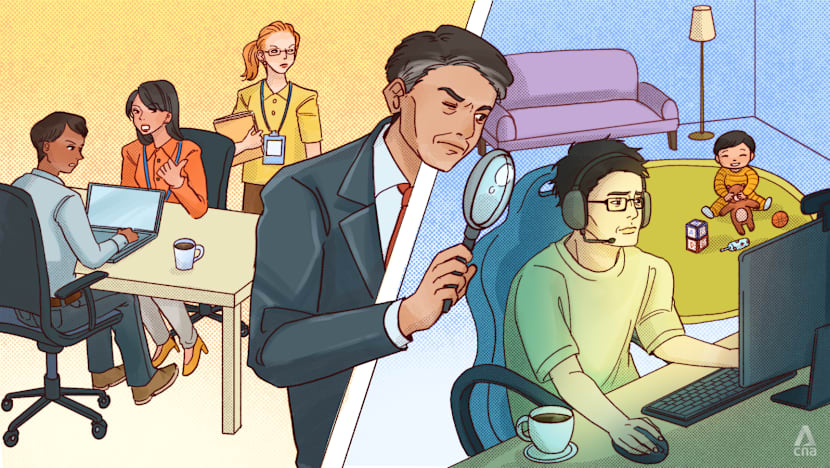
(Illustration: CNA/Clara Ho)

This audio is generated by an AI tool.


SINGAPORE: R, a father in his 30s, worries that he is on thin ice at his job because he is the only person in his department who works from home two days a week.
He felt encouraged when his head of department easily greenlit his flexible work arrangement request so that he could care for his two-year-old toddler. But he soon discovered a different reality on the ground.
Ever since his organisation reinstated working in the office as the default policy in late 2025, remote work became a workplace faux pas among his colleagues, leaving him singled out as an outlier.
“There have been indirect comments from colleagues and even from the head of department saying that it’s not always a good thing to be working from home, even though it’s just twice a week, and even though you are 100 per cent responsive to work,” said R, who works in a corporate department in the education industry.





It is now more than a year into Singapore’s push to normalise flexible work arrangements. Since late 2024, employers have been required to properly consider workers’ requests for flexible work arrangements under tripartite guidelines.
On the surface, the availability of such work arrangements allows for better talent retention and access to a larger hiring pool, with the request process meant to ensure a harmonious norm where workers can feel comfortable asking for workplace flexibility.
Around seven in 10 firms now offer flexible work arrangements, according to the Ministry of Manpower (MOM).
A 2025 survey by the women’s advocacy wings of the People’s Action Party (PAP) and National Trades Union Congress (NTUC) also found that out of those who applied for these arrangements, nine out of 10 requests were fully approved or approved with some modifications.
Yet employees who have made such requests told CNA that stigma and mistrust persist in some workplaces, and that flexibility still comes at a cost.
“Colleagues will choose weird ways of showing their unhappiness to you,” said R, who declined to be named because he was not authorised to speak to the media.
“For example, when you’re working from home, they will not respond to you on Teams message, they will not reply to you on emails, just because they prefer to speak to you face-to-face in the office,” he said, adding that this delays his work.
Speaking to CNA, R said his wife works in healthcare and does not have flexible work options. His mother, who works part-time, chips in to care for his child.
For him, working from home twice a week helps to keep him “sane” by giving him one more hour of sleep and letting him keep an eye on his toddler while working without the distractions of the office.
Far from being a liability, he said this arrangement has made him a more effective and productive worker, and contributed to him being one of the top performers in his team.
Yet because of the emphasis the organisation’s leadership places on working from the office, he worries he is testing their patience.
“I’m not sure if one day they will tell me, if you still need continued hybrid work, then this might not be a suitable job for you. You might need to find another job,” he said.
Stigma is the primary concern stopping one-third of workers from asking for flexible arrangements, according to the PAP Women’s Wing survey.
Although most respondents who asked their employers for flexible work arrangements got them, they stressed a pressing need for a wider range of flexibility options, visible support from leadership, and clearer policies and processes.
Those who spoke to CNA about their experiences reported that it was not always smooth-going, especially when it came to navigating office politics.
Several others said that they considered how flexible arrangements would improve their work-life balance and make them more productive, but finally decided not to request them as they were discouraged by their employers.
Six of the eight employees CNA spoke to asked not to be named as they were concerned about repercussions.

MICROMANAGERS
Jolie (not her real name), who works in a museum, requested and was given flexible hours and additional work-from-home days so she could care for her sick parent for about half a year between 2024 and 2025.
Her immediate manager was empathetic, trusting and understanding as long as she completed her work before the deadlines, she said.
But a more senior manager felt differently, and asked her to slowly transition from working in the office to working from home over the weeks.
This manager did not want other employees to think that work-from-home “can be granted as and when they wanted to”, said Jolie, who is in her 30s.
After Jolie’s parent died, this manager then felt she should return to work as soon as possible, she said.
On days when she asked to work from home, the manager would text her to check her responsiveness, and to make sure she was actually working and not taking the arrangement for granted.
“I would say certain perceptions with this manager have definitely impacted the working relationship and maybe career progression,” said Jolie.
She felt that more trust should be given to employees who need flexibility because they are in a difficult situation.
“I was mentally prepared to quit my job should my flexible work arrangement be rejected,” she said, adding that caregiving took a toll on her mental and physical health.
Managers’ capabilities and mindsets pose a key challenge to implementing the guidelines on flexible work arrangement requests, according to the Institute for Human Resource Professionals (IHRP).
“Some managers are still adjusting, particularly in moving away from presenteeism,” said IHRP CEO Aslam Sardar.
Presenteeism refers to a culture of performative work that is less productive, such as working through illness or staying at work longer than necessary.
Managers can tend towards micromanagement or concerns around trust and productivity when employees use flexible work arrangements, said Mr Sardar.
Experiences can vary – some employers are ahead of the curve.
Ms Arveen Kaur, 39, spent over a year trying to return to the workforce after she had a child, and did not raise remote work for childcare in her job interviews.
But she was proactively offered a “part-time permanent role” at an international boutique consultancy – a job she was told was designed for returning mothers.
In that role, she works 24 hours over four days, with overtime pay if she does more, and has all the benefits of a full-time permanent employee with pro-rated leave.
After starting the job in November 2024, Ms Kaur initially went to the office every day to get acquainted with her team and build trust. Her manager, based in Germany, is now comfortable letting her work from home when she needs to.

CLASHES OVER FLEXIBILITY
In some cases, disagreements over flexibility have put workers’ livelihoods in danger and led to acrimony between employer and employee.
MW, 40, works in a real estate consultancy and is a father of two. His 10-year-old son has complex special needs, difficulties with mobility and feeding, and is non-verbal.
In early 2024, the family went through a crisis period when MW’s son was hospitalised and their maid, the boy’s main caregiver, was diagnosed with an end-stage illness.
With his son fully reliant on him, MW had to ask his then-employer to let him work from the hospital so he could look after the boy.
The employer was unhappy as this went on for two months, and warned MW he could be terminated if this continued.
He managed to change jobs before that, and now works for a company that gives him more flexibility to work from home. His son is out of the hospital and doing better.
But MW said he is not open with his new employer about his son’s health conditions, and would hesitate to apply for flexible work arrangements even if he needed them.
“If my work is really strictly asking me to come to the office ... I might be reluctant to apply (for flexible work arrangements),” he said.
“My former experience was pretty traumatising. I almost lost my job and I was the sole breadwinner. So if I lose my job, it’s really not easy.”
CNA also spoke to a working mother who made a report with the Tripartite Alliance for Fair and Progressive Employment Practices (TAFEP) about issues including flexible work.
She wanted flexibility in her work location and timing to fulfil her maternity-related and infant caregiving responsibilities.
Her request was turned down by her employer citing the operational requirements of her role, said the woman, who is a senior leader in her firm.
The disagreement with her employer has not been resolved.
Such disputes are why TAFEP provides a channel to investigate complaints.
If companies do not comply with having a process to evaluate flexible work requests, the agency can advise and educate employers on how to follow the guidelines.
As for cases where employers are recalcitrant or wilfully refuse to comply with the guidelines, MOM may issue a warning and require them to attend corrective workshops, the ministry said previously.
So far, TAFEP has received one complaint on flexible work arrangements since the guidelines took effect on Dec 1, 2024.
“The complaint involved a company that communicated the outcome of the flexible work arrangement request verbally and not in writing,” said a TAFEP spokesperson.
“TAFEP has since worked with the company to revise its processes to be in line with the tripartite guidelines.”

THE FLEXIBILITY STIGMA
To look into how formal remote work arrangements translate to real-world outcomes, researchers Wang Senhu from the National University of Singapore (NUS) and Chung Heejung from King’s College London investigated how managers in Singapore perceive employees who work remotely.
In their 2022 survey – which was before the guidelines were formalised – 473 managers were asked to evaluate hypothetical workers with different profiles, including some remote workers.
The workers were rated on their commitment, productivity, team spirit and promotion opportunities.
The managers gave remote workers significantly lower ratings than full-time office workers, according to the findings published this February in the journal Gender, Work & Organization.
The researchers said this confirms theories of a “flexibility stigma” – the bias that workers who use flexible work arrangements are less productive, motivated or committed.
They noted extensive evidence elsewhere that flexible workers are generally as (if not more) productive, more loyal, more committed to their jobs and happier with their working conditions, leading to fewer problems with sickness, absenteeism and retention.
The Singapore-based study made two other notable findings.
First, the stigma was more pronounced for fathers and childless people than for mothers.
This is because the managers rated fathers who work full-time in the office the most highly to begin with, and held negative views towards mothers regardless of where they did their work.
“The ‘larger drop’ for fathers is partly because they are traditionally held to the ‘ideal worker’ norm – the expectation of total availability,” Dr Wang, an assistant professor of sociology and anthropology, told CNA.
“When fathers request flexibility, they violate this gendered expectation more sharply than mothers do.”
Second, the stigma is stronger when the national context frames remote work as a policy targeted at mothers or parents, and not as a policy for all workers.
Dr Wang said the framing of a remote work policy is often more consequential to how it is perceived than its actual coverage.
“Even if a policy is technically universal, framing it around ‘mothers and parents’ signals to managers and colleagues that remote work is a ‘special favour’ or a deviation from professional commitment for caregiving reasons,” he said.
“This reinforces the stigma that remote workers are less devoted to their careers, regardless of who is actually eligible to apply.”
IS IT A NEED OR A WANT?
Despite worries of stigma and the possibility of job loss, there is still strong demand for flexible work arrangements.
In a 2024 MOM survey, 65.4 per cent of workers said the availability of flexible work arrangements was an important factor in choosing whether to take up a particular job. This was second only to remuneration, chosen by 80.3 per cent.
Flexibility mattered to more people than leave benefits, job stability, professional development opportunities, promising career prospects, meaningful work experience and other options in that survey.
And according to recent MOM data on workers who voluntarily took jobs for which they are “overqualified”, about 15 per cent cited the suitable work hours and about 14 per cent cited the flexible work schedule as reasons.
IHRP’s Mr Sardar said the question of whether an employee’s request for flexibility is a “need” or a “want” is best addressed through open dialogue and clarity about the impact of the arrangement.
“In many cases, what initially appears to be a ‘want’ may, when better understood, relate to employee well-being, retention, or sustained performance,” he said.
“The intent is not to default to a binary outcome, but to explore practical solutions where possible.”
How employers should assess flexible work requests
IHRP encourages organisations to adopt a tiered approach when assessing requests.
“Approve where the role supports flexibility, there is no material business disruption, and any performance risks are manageable,” said Mr Sardar.
“Modify where partial flexibility is feasible, or where identified risks can be mitigated through adjustments.
“Reject where there is clear, evidence-based business harm, and no reasonable alternative arrangement exists.”
Reasonable business grounds for rejection should be based on demonstrable impact on productivity, service delivery, cost or team effectiveness, he added. This ensures decisions are objective and defensible.
“At the core, it is about balancing business needs with managing employee expectations, recognising that flexible work arrangements are not universally applicable across all roles,” said Mr Sardar.
One example is the invisible needs that arise among cancer survivors reintegrating into the workforce.
Cancer patients and survivors may need flexible work arrangements to manage their recovery, medical appointments and energy levels, said Mr Mark Lin, head of psychosocial services overseeing the return-to-work programme at the Singapore Cancer Society.
“A colleague may look well but be privately managing side effects like brain fog, fatigue, or still have to go for follow-up treatments,” he said.
“When colleagues don’t understand this and expect the survivor to be back to normal, this can create a gap between expectations and realities.”
More broadly, he said the ability to manage workforce health variability – and the flexibility that requires – is becoming a core organisational capability, not merely a “nice-to-have”.
“As Singapore faces an ageing population with rising rates of chronic diseases – including cancer – organisations will need to manage employees with fluctuating capacity, invisible symptoms, and changing stamina,” he said.
“Those that manage health variability well will enjoy better productivity, reduced attrition and increased psychological safety among their workforces.”


NORMS ARE CHANGING
Replying to CNA’s queries, the TAFEP spokesperson said the tripartite guidelines shape norms and expectations around flexible work requests.
To this end, some workers told CNA that the changed rules have already helped to improve acceptance.
Ms Sher-Li Torrey, a longtime advocate for working mothers, has noticed that employers seem more open to conferring flexibility to existing employees and roles after the guidelines came into effect.
Flexible work arrangements are better understood by HR officers, and it is “less of a boo-boo” to ask for them. She knows of more returning mothers making such requests upfront in their job interviews.
The founder of social enterprise Mums@Work, which supports working mothers and employers implementing flexible work, also still hears of lingering issues.
“Increasingly I hear that the boss is very supportive, but the teammates can feel it’s unfair privilege or even an ‘added bonus’ simply because you are a caregiver,” said Ms Torrey.
One example she cited was of colleagues scheduling meetings at unfriendly timings. One mother’s teammates held regular huddles just before or at the time when her official work hours ended and she had to pick up her kids.
Some returning mothers also feel they may have been “passed over” for serious projects that carry more weight or offer more chances to shine.
They see this as part of the “deal” in exchange for flexibility, said Ms Torrey.
Workers differ on whether the guidelines have changed workplace norms for better or for worse.
One employee in a corporate role within the manufacturing sector told CNA that the guidelines were used to justify more scrutiny and rigidity around flexible work arrangements in her company.
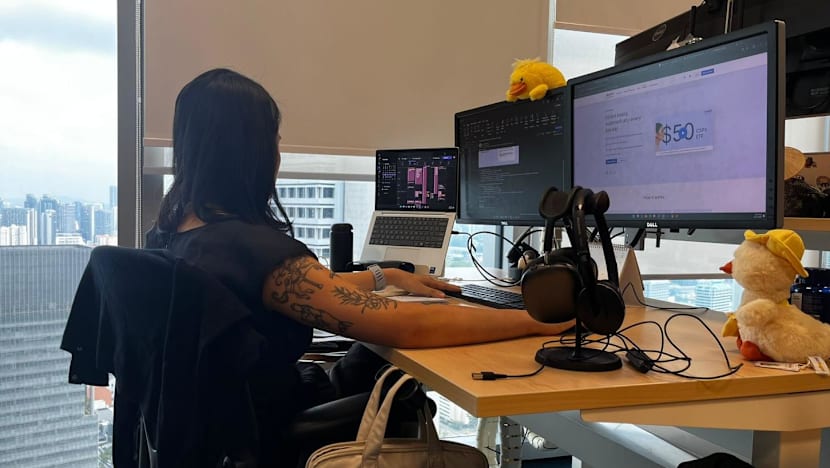
But there are also some like Ms Vera Lau, 28 and head of marketing at investment firm Saxo, who had no lack of support for flexibility in the workplace.
Ms Lau, who had a baby last January, works from home twice a week, keeping the same hours as her colleagues in the office.
Before this, the default was one day of remote work subject to approval by a manager, which Ms Lau said she rarely used.
She credits an understanding environment and strong company culture for how well her flexible work arrangement has worked out.
“My team and colleagues were accommodating, where possible, even scheduling our important meetings to the days I’m in the office,” she said.
An evaluation took place three months in to ensure her performance was not slipping, and there have been no concerns since. Her hybrid arrangement is now reviewed every six months.
“I’d say individuals feel more empowered and know that this option exists if needed,” Ms Lau said of the impact the guidelines have had on her company’s flexible work norms.
Mr Zhang, who asked to use his surname only and who works in the professional services industry, felt that the guidelines helped to sustain remote work arrangements from the pandemic.
The 36-year-old father of young children has made informal, ad hoc requests to work from home on certain days, which his employer granted easily.
A formal request to work from home regularly is more elusive. “Because my role deals with internal stakeholders … (the) employer has hinted at the importance of my physical presence,” he said.
Still, he felt the company culture was understanding of family needs and that flexible work requests were fairly considered.

PERSONAL PLANS
Despite some accounts of workplace cultures changing for the better, experts told CNA that there is room to improve how flexible work arrangements are perceived in the workplace.
For one, NUS’ Dr Wang noted that the introduction of the tripartite guidelines has been contextualised with discussion about more people becoming caregivers in an ageing society, which has given the guidelines “social legitimacy” by addressing an urgent demographic need.
But this also suggests such arrangements are a tool for fulfilling personal responsibilities, rather than a standard mode of high-performance work, he said.
This may in turn inadvertently strengthen the flexibility stigma in the corporate world, he added.
From the worker’s perspective, the existence of the stigma can discourage people from taking on such arrangements, which can impact family planning.
For instance, R, the hybrid worker with a toddler, said he and his wife only felt they could manage having a baby because remote work became the norm during COVID-19.
Likewise, they are now held back from having another child by the uncertainty over whether remote work will continue to be tolerated at his workplace.
“We can have money, we can have a lot of baby bonuses and all that, but if this kind of very crucial issues are not dealt with, it’s close to impossible to increase the birth rate, because these are very real day-to-day issues,” said R.
NTUC assistant secretary-general Yeo Wan Ling said that policies can enable and nudge change.
"But it is workplace culture that ultimately determines whether flexibility is truly accessible or merely theoretical," she said.
Ms Yeo, who is also director of NTUC Women and Family, added that for many caregivers, flexibility is not limited to working from home.
"Meaningful flexibility must take different forms, including adjusted work hours, roles located closer to home, and well-designed part-time or fractional positions.
"For these to truly work, employees must feel safe to come forward, and NTUC will protect workers from unfair treatment or career penalties when they request for such arrangements."
“AN OUTDATED SIGNAL”
Dr Wang was also asked if the existence of the stigma is related to the fact that Singapore’s guidelines require employers to consider flexible work requests, but not necessarily to grant such requests once they are made.
He said the requirement to consider requests – but not approve them – may create significant variation in managers’ perceptions, and that it places the burden of justification on employees.
“Managers who already hold traditional views may perceive those who request flexible work arrangements as less committed, potentially intensifying the stigma for those who ‘push’ for their rights under the guidelines,” he said.
MOM has previously said that the guidelines acknowledge employers’ prerogative to decide on work arrangements.
In a snap poll of about 140 employers by the Singapore National Employers Federation in late 2025, 13 per cent had no plans to start offering remote work.
The top reasons they gave were difficulty maintaining consistent communication, the nature of business operations, a lack of interaction among employees, and difficulty ensuring equity or fairness across all roles.
Rather than tightening the guidelines, experts agreed that implementation and developing managers’ capabilities should now be the priority.
To lead flexible teams, managers need to know how to set clear expectations, manage workers through outcomes and handle flexible work requests consistently and fairly, said IHRP's Mr Sardar.
"The next step is to build workplace norms where managers focus on outcomes, not just attendance, in performance appraisals, co-workers support one another, and flexible work arrangements can be used responsibly and without penalty," said NTUC's Ms Yeo.
Associate Professor Trevor Yu of the Nanyang Business School said: “Much of the stigma persists because of an outdated signal: being seen in the office is equated with commitment, while flexibility is read as lower ambition or reliability.”
He said the next step is to shift organisational leadership and managers from a “permission mindset” to a “performance and job design mindset”.
This means managing talent through deliverables and service standards, and not physical visibility.
To do this, he said employers must make decisions on flexible work transparent and clearly tie them to job requirements, ensure flexible workers are evaluated fairly without “hidden penalties”, and hold line managers accountable for their decisions.
“The guidelines are a strong initiator for reform. They standardise process, but the real challenge now is cultural,” said Assoc Prof Yu.
“If Singapore wants genuine acceptance of flexible work arrangements, the focus has to shift to how work is evaluated, how managers are trained, and how organisations ensure that flexibility does not become a quiet career penalty.”