







Economists see downside risks for Singapore GDP growth, but most stop short of revising forecasts for now
Deputy Prime Minister Gan Kim Yong warned that economic activity is likely to slow amid global trade and energy disruptions.
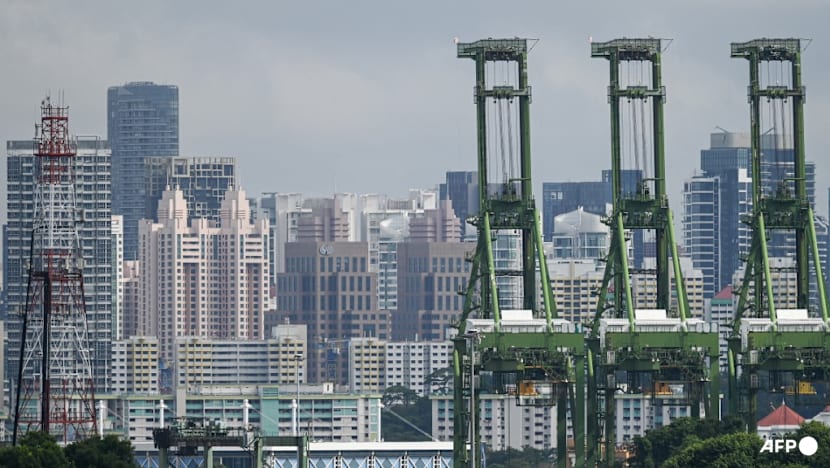
Cranes at Pulau Brani port terminal stand against the skyline in Singapore on Feb 25, 2025. (Photo: AFP/Roslan Rahman)

This audio is generated by an AI tool.


SINGAPORE: Private-sector economists who monitor the Singapore economy are mostly holding their growth forecasts steady for now, despite recognising risks from the conflict in the Middle East.
CNA contacted 11 economists on Tuesday (Apr 7) about their outlook for Singapore, and only two said they are downgrading their forecasts. Five economists shared their forecasts without elaborating on plans to lower their estimates, while the rest did not provide updated figures.
Ms Sheana Yue, senior economist at Oxford Economics, said the company downgraded its forecast for Singapore from 4.5 per cent to 4.1 per cent in March.
"We are also looking to nudge it down a bit more this month. Last month’s downgrades were more an initial move assuming a more temporary shock, but we have now moved to viewing the Middle East conflict to be a bit more prolonged than initially expected," she said.





The impact is likely to be more lasting as well, if previous oil shocks serve as a guide, she said. That adds to the need to lower the growth outlook.
The Economist Intelligence Unit also lowered its growth forecast for Singapore.
"We are downgrading our outlook for Singapore's real GDP growth in 2026 from 3.2 per cent to 2.7 per cent," said Asia analyst Tay Qi Hang.
He said higher energy costs are already compressing manufacturing activity and consumer spending in Singapore's key export markets, while increased uncertainty and elevated energy input costs will prompt companies to defer capital expenditure.
Other observers, however, are not making downgrades just yet.
"There is still too much uncertainty and I am awaiting the advance Q1 GDP estimates ... and whether there will be a further escalation in the Middle East conflict this week to get a better sense on the magnitude of any forecast changes," said head of Asia research at ANZ Khoon Goh.
He sees GDP growth for the year at 3.2 per cent, which takes into account some negative impact on activity from the Middle East conflict.
Mr Barnabas Gan, group chief economist at RHB, is also maintaining his growth forecast for Singapore at 3 per cent. The conflict is "largely transitory noise" against an otherwise resilient global and domestic economic backdrop, he said.
But he acknowledged the possibility that the conflict drags on and becomes more severe.
"Should hostilities persist into 2H26, downside risks could materialise, potentially dragging Singapore’s GDP growth down to 1.0 to 1.5 per cent under a more adverse scenario," he said.
Singapore's economy grew 5 per cent in 2025.
Listen:
BROAD FALLOUT?
Deputy Prime Minister Gan Kim Yong on Tuesday warned that economic activity is likely to slow in the coming quarters amid global trade and energy disruptions.
Manufacturing companies that rely on natural gas, crude oil and crude oil derivatives will be hit harder, he said, while energy-intensive industries, air and sea transport and tourism will also be affected by higher costs.
He said the Ministry of Trade and Industry will update its GDP forecast in May.
DBS senior economist Chua Han Teng said the petrochemical cluster is already under significant pressure, and electronics manufacturing faces downside risks from supply chain disruptions.
The electronics manufacturing cluster has been supported by global artificial intelligence tailwinds, but persistently tight supplies could lead to production cuts.
"Climbing fuel and raw material costs will weigh on growth in many sectors," said Mr Brian Lee, economist at Maybank Securities.
Rising business costs will eventually be passed on to consumers, he said, highlighting industries such as marine shipping and land transport among those under the most strain.
Mr Edward Lee of Standard Chartered Bank echoed the sentiment. "The impact is likely going to be broader than just confined to some sectors," said the bank's ASEAN and South Asia chief economist.


INFLATION CONCERNS
Prices are expected to be the "first area of discernible impact", added Mr Lee.
Standard Chartered raised its inflation forecast from 1.5 per cent to 2.5 per cent this month.
That is above the Monetary Authority of Singapore's (MAS) estimate of between 1 and 2 per cent.
"It will not just be a price issue," said Mr Lee. "While prices are likely the first area of discernible impact, there could be actual supply disruption affecting overall activity as the situation drags."
The Economist Intelligence Unit also revised its inflation forecast from 1.7 per cent to 2.1 per cent, predominantly because of the surge in global oil prices.
"Because Singapore has no fuel subsidy mechanism to absorb the pass-through, this surge translates immediately and fully into pump prices, electricity tariffs, and freight and logistics expenses," said Mr Tay.

Several economists said Singapore's central bank could tighten monetary policy at its April meeting and do so again later in the year.
HSBC now expects a tightening in April and in the fourth quarter of the year given that upside risks to core inflation are more imminent.
"The reason why we are not anticipating a back-to-back tightening move is that the MAS will likely take the time to assess the impact before moving again," said Ms Yun Liu, senior ASEAN economist at HSBC.
On the fiscal side, economists said the Singapore government could provide more support to ease cost of living pressures.
Mr Lee of Maybank Securities noted that the government announced a S$1 billion (US$779 million) support package on Tuesday, including targeted aid for the land transport sector.
"There remains ample fiscal space from the S$8.5 billion surplus in Budget FY2026 to roll out more measures," he said.





