analysis Asia
Why Indonesia is getting an aircraft carrier, and how Southeast Asian countries could respond
The acquisition of the Giuseppe Garibaldi would make Indonesia the second country in Southeast Asia to operate an aircraft carrier. Indonesia could modify the vessel so that it can deploy drones for intelligence missions and to carry deadly payloads, an analyst says.
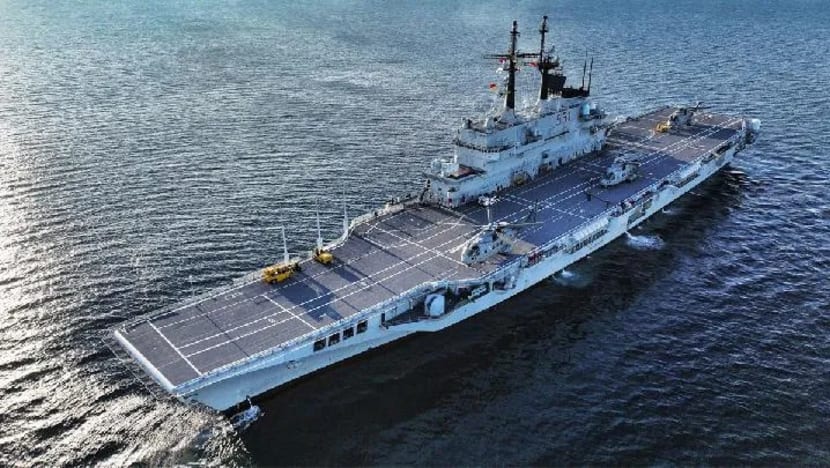
The Giuseppe Garibaldi aircraft carrier. (Photo: marina.difesa.it)

This audio is generated by an AI tool.


JAKARTA: Indonesia’s decision to operate its own aircraft carrier has divided analysts, with some arguing the move is strategically necessary and others warning it could become little more than an expensive symbol.
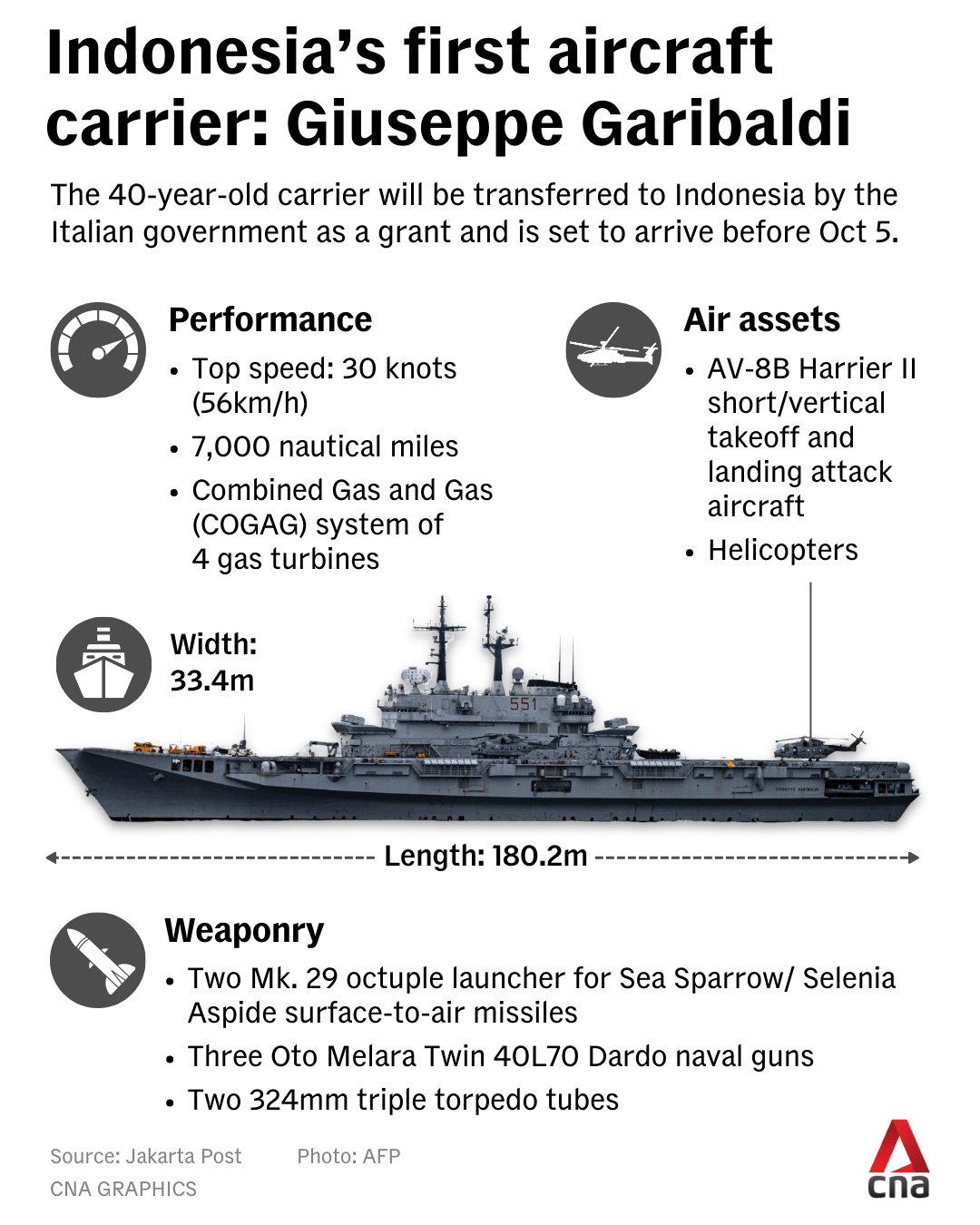
Jakarta recently announced it would acquire the Giuseppe Garibaldi aircraft carrier in the form of a grant from the Italian government. The decommissioned vessel, which served the Italian Navy from 1985 until 2024, is expected to arrive ahead of the Indonesian National Armed Forces anniversary on Oct 5.
The acquisition would make Indonesia the second country in Southeast Asia, after Thailand, to operate an aircraft carrier. Across Asia, only China, India and Japan currently field carriers of their own.
The Giuseppe Garibaldi is viewed as part of President Prabowo Subianto’s broader push to modernise Indonesia’s armed forces and expand its capabilities, which began during his tenure as defence minister from 2019 to 2024.
As defence minister, Prabowo oversaw the procurement of fighter jets, missile systems and warships as part of a sweeping military upgrade. However, the idea of acquiring an aircraft carrier only emerged after he assumed the presidency in late 2024.
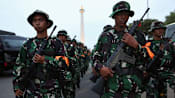
Several analysts say that, as a vast archipelagic nation with numerous strategic waterways and busy chokepoints, Indonesia’s geography alone justifies the need for an aircraft carrier.
“Such a vessel is more than capable of supporting various combat and non-combat operations,” said Beni Sukadis, a defence analyst at the Indonesia Institute for Defense and Strategic Studies (Lesperssi). He added that the carrier could also play a significant role in humanitarian assistance and disaster relief missions.
The aircraft carrier could also be repurposed to deploy drones for various purposes, including carrying deadly payloads, experts noted.
Other analysts, however, cautioned that the scale and cost of operating a carrier could place further strain on Indonesia’s finances, which are already stretched by Prabowo’s many ambitious social, economic and defence programmes.
According to defence and security news platform Defence Security Asia, its annual operating costs could range between US$50 million and US$80 million.
In an opinion piece published by Kompas news portal on Wednesday (Feb 18), Jannus TH Siahaan, a public policy expert at Indonesia’s Padjadjaran University, said it could take years to train the hundreds of crew members needed to operate the vessel.
“During that transition period, the ship’s combat effectiveness would be practically zero, while its maintenance costs would continue to run in full every second,” he wrote, adding that the ageing vessel may have a limited service life remaining.
“In short, the policy of accepting the Garibaldi grant amid an uncertain national fiscal storm reflects an ambition that is not grounded in reality.”
HOW INDONESIA COULD USE THE GIUSEPPE GARIBALDI
Aircraft carriers are large warships seen as a projection of military and naval power, and are part of a carrier strike group, or formations that include their aircraft and an escort fleet of other ships.
According to Defence Security Asia, Indonesia’s grant-and-refit arrangement with Italy will be combined with a foreign loan package “for acquisition and associated systems”, and the acquisition of transport helicopters and carrier-optimised utility helicopters, amounting to a deal worth about US$1 billion.
Brigadier General Rico Ricardo Sirait, spokesman for Indonesia’s Ministry of Defence, said negotiations and administrative processes related to the vessel are ongoing between Jakarta and Rome.
Under the arrangement, Indonesia is expected to bear the cost of restoring the decommissioned ship to operational condition.
“The Indonesian government will allocate a budget for retrofitting or adjustments to meet the operational requirements of the Indonesian Navy,” he said on Feb 18, as quoted by TribunNews.
The one-star general declined to provide further details about the recommissioning process, including the scope of upgrades being considered, their projected cost, or whether the ship’s original builder, Fincantieri, would be tasked with carrying out the refurbishment.
The Giuseppe Garibaldi first entered into service in September 1985 and was involved in operations in Somalia, Kosovo, Afghanistan and Libya.
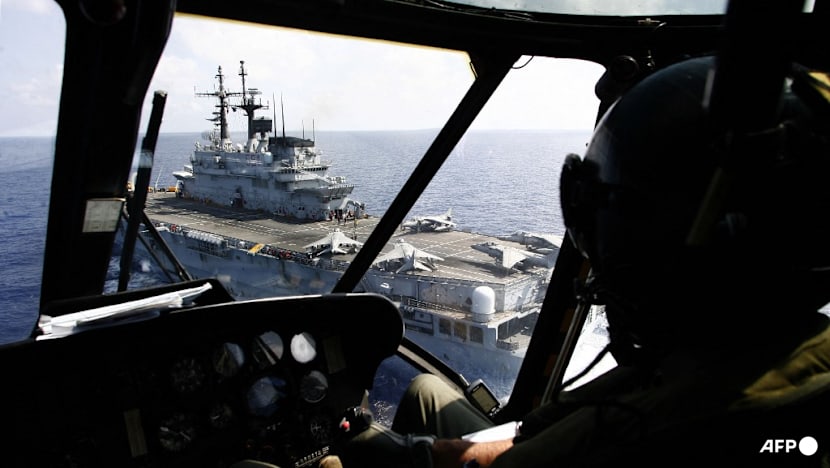
The 180m-long ship was designed to cater mainly to helicopters as well as jet and propeller aircraft capable of landing vertically such as the Harrier or the MV22 Osprey. The vessel is not equipped with catapults or heavy-duty arresting gear required for conventional fixed-wing fighters such as the F14 or the J-15T.
Indonesia currently does not have aircraft capable of landing vertically, a limitation that could restrict the ship’s role in combat operations, particularly if the 40-year-old carrier were to face off against aircraft carriers that are larger, more advanced and more heavily armed, such as any of China’s three.
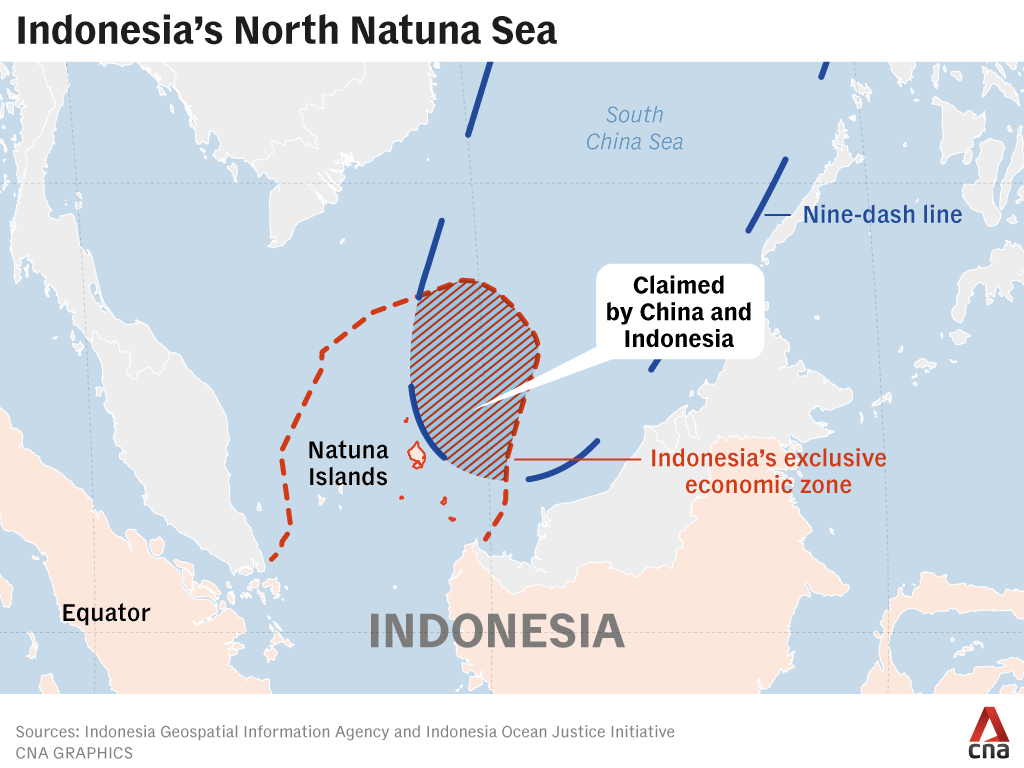
Beijing lays claim to much of the South China Sea, putting it at odds with several Southeast Asian states including Malaysia, Vietnam and the Philippines. Although Indonesia is not a formal claimant in the disputes, China’s so-called nine-dash line overlaps with parts of Indonesia’s exclusive economic zone near the Natuna islands.
“Indonesia is close to potential hotspots like the South China Sea and Taiwan, over which China is keen to assert its claims,” said Beni of Lesperssi, adding that such tensions are raising the stakes for regional stability and maritime security.
Khairul Fahmi of the think tank Institute for Security and Strategic Studies (ISESS) believes that Giuseppe Garibaldi’s limitations could be offset with the use of technology.
“Indonesia can have the vessel modified so that it can deploy drones for intelligence, surveillance and reconnaissance missions. Drones would be very useful in stopping illegal fishing, smuggling or encroachment of our maritime borders and economic zones,” Fahmi told CNA.
The carrier can extend the reach of small, tactical drones with a range of up to 160km as well as medium-altitude long-endurance drones which can remain airborne for more than 24 hours and have a range of thousands of kilometres, he said.
Drones can also be used to deliver deadly payloads, Fahmi highlighted, something which proved to be effective in the Russia-Ukraine war.
“A swarm of inexpensive drones can easily overwhelm an enemy’s defence system,” he said. “Which is why we are seeing more and more countries combining traditional manned aircraft and unmanned drones.”
But other experts argue aircraft carriers are not suitable for defensive purposes because they are slow and cannot be deployed quickly to vulnerable areas.
The United States and its European allies use carriers primarily to project power and launch offensives in distant places like Africa or the Middle East instead of protecting their own waters, noted Alfin Febrian Basundoro, a lecturer at Indonesia’s Airlangga University and Trystanto Sanjaya, a visiting fellow at the Norwegian Institute for International Affairs.
“An aircraft carrier is a slow and relatively large vessel, making it an easy target for enemy missiles,” the pair wrote in an article published by the Australian Institute of International Affairs in October 2025.
“In a hypothetical case of a military invasion against Indonesia, its aircraft carrier would be more of a liability than an asset.”

PRIMARILY FOR HUMANITARIAN MISSIONS
Indonesian Navy Chief of Staff Admiral Muhammad Ali told reporters on Feb 6 the carrier will likely be used primarily for humanitarian missions.
“It appears we need a carrier to carry out non-combat military operations,” Ali was quoted as saying by Sindo News.
He said the vessel is able to transport large volumes of aid to disaster-stricken areas and has a considerable operational range of 7,000 nautical miles (13,000km). Indonesia stretches more than 5,000km east to west and 1,700km north to south.
For its disaster relief efforts, Indonesia currently relies on five landing platform dock vessels, each capable of transporting more than 500 people as well as dozens of vehicles. The amphibious ships are also equipped with a helicopter landing deck.
Although these amphibious vessels can go up to 16 knots, nearly half of the Garibaldi’s speed, they have an operational range of 10,000 nautical miles.
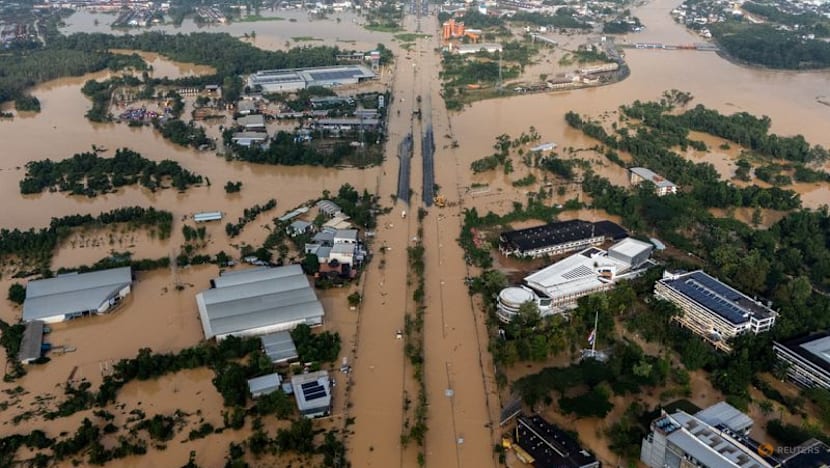
Thailand has frequently deployed its aircraft carrier, the Chakri Naruebet, for humanitarian missions since it entered service in 1997. During such operations, the vessel has functioned as a floating hospital and temporary refuge centre.
It was most recently deployed last November, when deadly floods swept through southern Thailand, killing more than 250 people.
However, Abdul Rahman Yaacob, a researcher at the Rabdan Security & Defence Institute (RSDI) in Abu Dhabi, argued that aircraft carriers such as the Garibaldi and the Chakri Naruebet are not ideal for disaster relief.
“Disaster response requires speed, flexibility, shallow-water access, and the ability to move personnel, engineering equipment, medical facilities, and relief supplies directly ashore,” Rahman wrote in an article on The Diplomat’s website on Jan 13.
Instead, he argued that Indonesia’s acquisition of an aircraft carrier could put other Southeast Asian countries on edge.
“Neighbours and external powers are unlikely to view a carrier primarily as a disaster-relief tool, regardless of how it is described domestically,” he said.
“In a region already sensitive to naval modernisation and balance-of-power dynamics, such an acquisition would inevitably be interpreted through a military lens.”
However, Fahmi of ISESS does not believe Indonesia’s acquisition will lead to a maritime arms race in the region.
“The ship is already 40 years old, it has limited capabilities compared to more modern aircraft carriers, it cannot accommodate the latest generation of jet fighters. These are the reasons why I don’t believe the acquisition of Garibaldi will upset regional stability,” he said.
PRUDENT FOUNDATION?
Without fighter jets capable of taking off from and landing on its deck, the Giuseppe Garibaldi could risk the same fate as Thailand’s Chakri Naruebet, which spends much of its time docked at Sattahip Naval Base in Chonburi province aside from occasional humanitarian deployments, analysts said.
One of the main reasons the US$336 million Thai carrier has been underutilised is cost. Forbes reported in 2021 that fuelling the vessel’s diesel-and-gas power plant alone could cost nearly US$50,000. The figure excludes the cost to feed hundreds of personnel and other expenditure.
The nine Harrier jets that initially operated from the carrier were also expensive to maintain since spare parts were becoming increasingly difficult to obtain. They were eventually decommissioned in 2006.
The Garibaldi is similarly costly to operate. In 2011, the Italian Navy reportedly spent about €80 million (US$94 million) to deploy the carrier during a NATO mission in Libya.
“Operating a carrier is costly,” Fahmi of ISESS said. He noted that at least 500 personnel are required to run the ship in a combat mission, with another 250 needed to manage air operations.
“And because they are vulnerable to attack and require extensive logistics support, carriers are always accompanied by two to four escort vessels,” he added.
Beni of Lesperssi, however, believes the Indonesian carrier is unlikely to suffer the same fate as its Thai counterpart. With more than 17,000 islands, Indonesia has stronger strategic incentives than Thailand to keep such a vessel operational.
“Indonesia has a greater need for a carrier like the Garibaldi to defend its territory,” he said.
Fahmi said Indonesia’s approach to acquiring the Giuseppe Garibaldi, rather than commissioning a brand-new carrier, may prove to be the more prudent path.
“Indonesia is right to begin small,” he said. “Unlike Thailand’s carrier, which was built from scratch, the Garibaldi allows Indonesia to learn at a lower initial cost.”
Fahmi said the ship could serve as a tool to help the Indonesian Navy train deck crews and pilots, and understand the logistical and maintenance demands of carrier operations before committing to a larger and more sophisticated vessel.
“If managed carefully, this could be the foundation for a stronger naval force,” he said.