analysis Asia
Why is UMNO welcoming back sacked and suspended stalwarts, and will it pay off at the polls?
Former UMNO Youth chief Khairy Jamaluddin could help win back urban and younger Malay voters, while former Defence Minister Hishammuddin Hussein still wields influence in the party’s power networks, say observers.
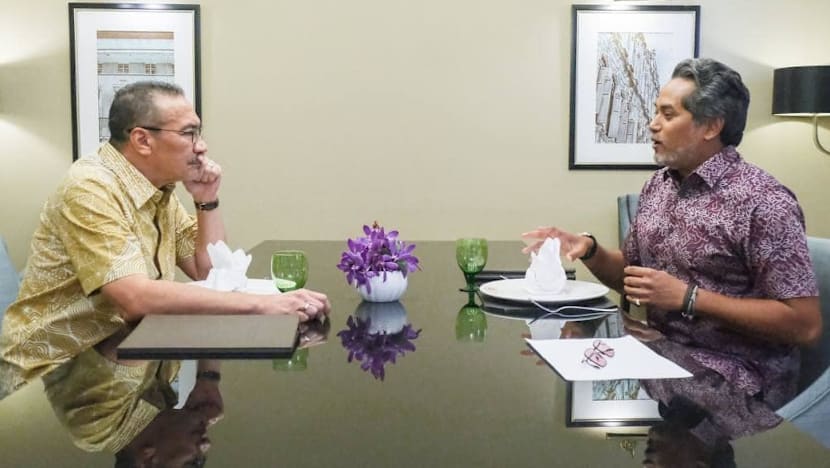
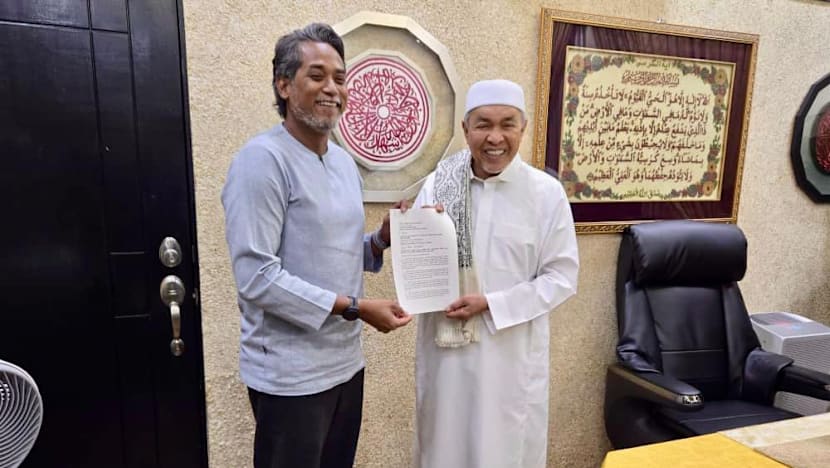
Former Malaysia Cabinet ministers Hishammuddin Hussein (left) and Khairy Jamaluddin, in a photo from 2023. (Photo: Facebook/Khairy Jamaluddin)

This audio is generated by an AI tool.

KUALA LUMPUR: The potential return of political heavyweights Khairy Jamaluddin and Hishammuddin Hussein to Malaysia’s United Malays National Organisation (UMNO) will give the erstwhile ruling party a vital shot in the arm in upcoming state and national polls, analysts say.
In contrast to cracks in the opposition and other parties, UMNO has emerged as a stable force in the current political landscape, they add. The return of stalwarts who were previously sacked or suspended will strengthen the party further.
While analysts anticipate some degree of internal friction – some quarters within UMNO reportedly remain wary of re-admitting figures previously sidelined for dissent – they do not believe this will disrupt party dynamics.
Khairy and Hishammuddin, both former Cabinet ministers, were among several high-profile figures purged in 2023. Khairy was sacked while Hishammuddin was suspended for six years.
In the past fortnight, they have formally applied to be part of the party again following UMNO president Ahmad Zahid Hamidi’s “unconditional” open-door policy under the Rumah Bangsa (House of the Race) initiative.
Hisommudin Bakar, executive director of research firm Ilham Centre, told CNA their return could raise party morale, particularly after a prolonged period of factional divides before, and after, the last general election in November 2022.
The developments signal that UMNO is transitioning to a consolidation phase in preparation for the 16th General Election (GE16), he added.
Malaysia’s GE16 is not due until February 2028 but sources have told CNA groundwork is being laid for a possible election in the second half of 2026.
With the Melaka and Johor state assemblies approaching the end of their terms, there is the possibility of concurrent national and state polls.
The current Melaka state government’s term ends in December 2026, while the current Johor state government’s term ends in April 2027. This means their state elections are due by February 2027 and June 2027, respectively.
“The underlying message being projected to Malay voters is one of experience, stability and renewed unity, positioning UMNO as a mature and reliable political vehicle capable of representing Malay-Muslim interests,” said Hisommudin.





STATURE AND INFLUENCE
The reintegration of both figures, especially former UMNO Youth chief Khairy — popularly known as KJ — is a major boost to the party because of his appeal to youths, observers said.
Since his sacking in 2023, Khairy, 50, has maintained a high public profile as a radio deejay and co-host of the Keluar Sekejap podcast, cementing his status as a key influencer among Malaysia's youths and urban Malays.
“Khairy commands a massive following, particularly among neutral and fence-sitting voters who may have previously turned away from the party,” said Azmi Hassan, a senior fellow at the Nusantara Academy for Strategic Research.
Hisommudin said Khairy has cultivated a distinct support base beyond traditional party structures, leveraging his podcast and mainstream media presence.
“This has enabled him to connect with urban and younger Malay voters, segments (in which) UMNO has shown relative weakness in recent electoral cycles.
“His reintegration could therefore help UMNO re-penetrate these demographics,” he said.
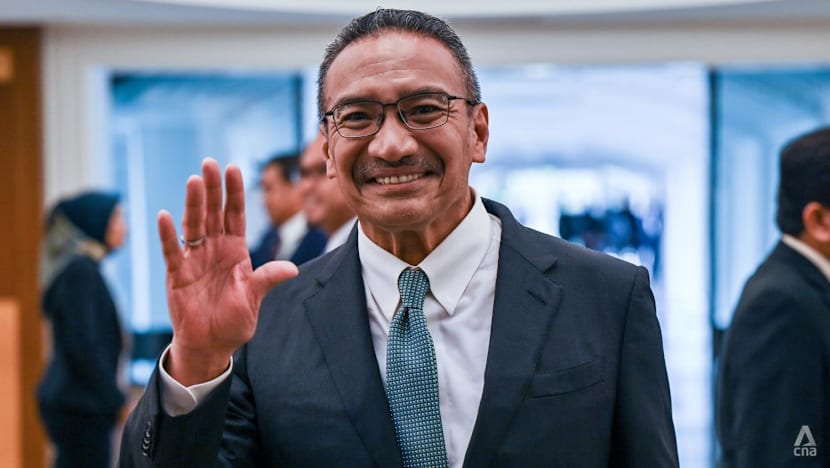
Former UMNO vice-president Hishammuddin, who is Sembrong Member of Parliament, is a different but equally significant asset, said analysts.
Despite keeping a relatively low profile during his suspension, Hishammuddin, 64, retains considerable influence within the party’s traditional power networks, especially among division chiefs and grassroots leaders, particularly in Johor where he is from.
The son of Malaysia’s third prime minister Hussein Onn, Hishammuddin has served in key ministerial portfolios including home affairs, education and defence.
“His stature within UMNO’s internal hierarchy could contribute to consolidating organisational discipline and strengthening electoral machinery at the divisional level,” said Hisommudin.
UMNO, which is Malaysia’s oldest political party, lost its 61-year grip on power when it was toppled by the Pakatan Harapan (PH) coalition, led at the time by former premier Mahathir Mohamad, during the 14th General Election in 2018.
The party, which was the anchor party of the governing Barisan Nasional (BN) coalition since the country’s independence, was voted out on the back of widespread public anger over the scandal at state-owned investment vehicle 1Malaysia Development Bhd (1MDB).
The 1MDB scandal subsequently led to the conviction and jailing of former prime minister Najib Razak for corruption.
UMNO won 26 seats at GE15, its worst-ever performance in a general election. It had won 54 seats in the 2018 election and 89 in the 2013 elections.
A bulk of seats previously held by UMNO were won by the Perikatan Nasional (PN) opposition coalition, in what was dubbed the "Green Wave" for its component Parti Islam Se-Malaysia (PAS), which saw significant electoral gains.
PN won 74 seats in the 222-seat parliament, establishing itself as the second-largest bloc behind PH, which won 82 seats.
PAS secured 43 parliamentary seats, a substantial gain of 25 seats, while coalition partner Parti Pribumi Bersatu Malaysia (Bersatu) secured 31 seats, representing a gain of 17 seats.
Despite its defeat, BN is a key partner in Prime Minister Anwar Ibrahim’s unity government - an alliance formed to resolve the hung parliament following the GE15.
CNA has reached out to UMNO vice-president Mohamed Khaled Nordin, who is the chairman of the Rumah Bangsa committee, for details on the initiative.
FORGIVE AND FORGET?
The move to welcome back former members marks a significant shift for UMNO president Zahid, said observers.
Zahid, Malaysia’s Deputy Prime Minister, had said in January during the party’s general assembly it would facilitate the return of former members and political rivals – whether individually or en bloc – as part of a broader mission to reposition UMNO as the “grand home for the Malays”.
After consolidating power through the suspensions and sackings, Zahid is now being described by some as "big-hearted" for prioritising party survival over personal grievances.
In a Facebook post on Mar 16, Zahid shared photos of a visit by Khairy the previous day to formally submit his appeal to rejoin UMNO.
“In the course of this struggle, as I have frequently mentioned — past disputes are like ripples behind a boat; the water lilies eventually knit back together,” he wrote. “Our priority is to seek the path of unification, not to let discord continue to separate us.”
Both UMNO's leadership and the sidelined members realise they cannot remain in limbo forever, political analyst Awang Azman Pawi of Universiti Malaya told CNA.
“The president is seeing that the party’s survival takes precedence over any individual ego. There is a realisation on both sides — those who were sacked and those who did the sacking — that they must heal the party to improve their prospects in upcoming polls,” Awang Azman said.
Hisommudin said Ahmad Zahid’s approach projected an image of inclusive leadership and strategic pragmatism.
“This reflects an inherent tension between institutional discipline and electoral expediency, where the urgency of consolidation ahead of future elections may outweigh concerns over past internal conflicts,” he said.
Some former UMNO members are, however, unswayed by the "Rumah Bangsa" initiative.
Former Selangor UMNO chief Noh Omar, who was sacked along with Khairy in January 2023, has rejected it, citing UMNO’s cooperation with the Democratic Action Party (DAP) in the ruling coalition as a deal-breaker.
“My soul is with UMNO. I can return to UMNO on condition that the party does not cooperate with DAP. That is my principle,” he was quoted as saying by Utusan Malaysia on Mar 12.
Former UMNO supreme council member Annuar Musa, who joined PAS in June 2023, said there was no reason for him to rejoin UMNO.
“I find that UMNO is not guided by principles of struggle. Even now, this person determines the party’s direction. This is very different from PAS, where the syura council takes priority,” he was quoted as saying by Free Malaysia Today on Mar 8. The syura council is PAS' highest decision-making body.
UMNO STILL “FIRST CHOICE”
UMNO’s newfound stability, said Universiti Malaya’s Awang Azman, contrasts with the turmoil within the opposition – specifically Bersatu, which recently sacked its deputy president Hamzah Zainudin and other leaders aligned with him.
“The opposition is perceived as failing in its role. In fact, many see former Economy Minister Rafizi Ramli as the de facto opposition within the government,” Awang Azman said. Rafizi has frequently criticised government policies since he resigned from the Cabinet last year, although he remains part of Anwar’s Parti Keadilan Rakyat.
Awang Azman believes Khairy and Hishammuddin have likely surveyed the opposition’s prospects and realised returning to UMNO was their “most viable path”.
In his podcast on Mar 19, Khairy, who was critical of Zahid post-sacking, acknowledged UMNO currently enjoys a level of internal stability and cohesion that its rivals have failed to match.
Khairy, a former health minister who is also son-in-law of the late PM Abdullah Ahmad Badawi, said he did not join other parties although there were direct and indirect offers.
“I said no because my first choice is to return to UMNO,” he said, adding that he still believed in the party’s struggle.
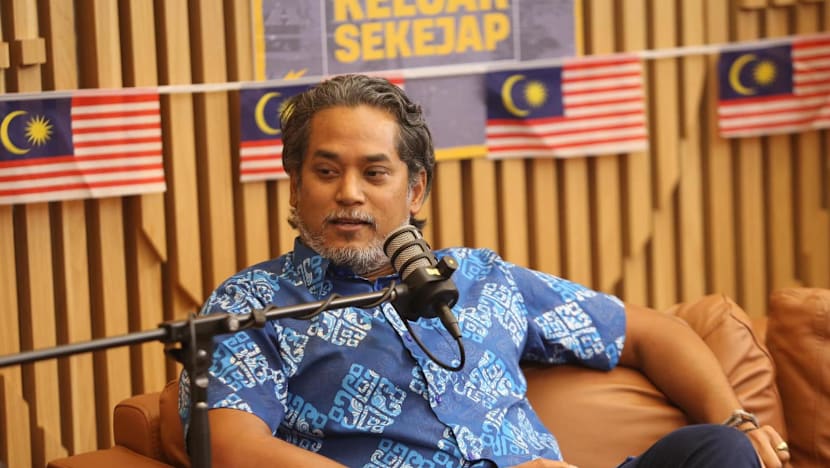
Although there were mistakes and weaknesses the party needed to learn from and improve on, Khairy likened it to a house with a solid foundation. Its "bones" — its core framework and pillars — remain strong, he said.
“If it can be decorated well, if it can be beautified, if it can be corrected here and there by everyone, not just me – I believe everyone is working towards what I mentioned – God willing, it will be seen in a different context compared to perhaps 2018 and onwards,” he said.
Hishammuddin, meanwhile, expressed his readiness to return to UMNO should his suspension be lifted. He maintained he never actually left the party throughout his three-year hiatus.
“If the party leadership is truly sincere and lifts my suspension, I will return to UMNO's struggle," Hishammuddin said in a video posted on his social media accounts on Mar 12.
RECONCILIATION MUST BE MANAGED
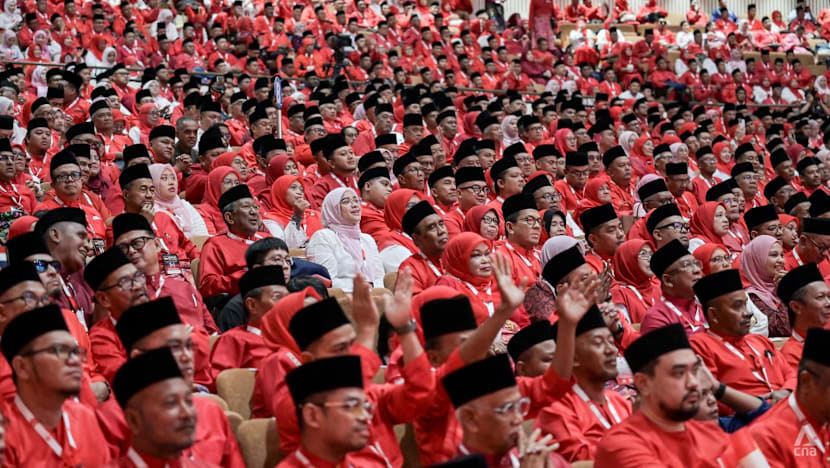
UMNO members are likely to have mixed reactions to their former comrades’ return, said analysts.
Hisommudin said within the party’s leadership and committees, there is a discernible sense of unease, particularly among those who remained loyal during the internal purge.
“For this group, the immediate reintegration of previously sanctioned leaders may be perceived as undermining party discipline and fairness, potentially creating tensions over legitimacy and reward structures within the organisation,” he said.
But among the broader grassroots, the move is more likely to be interpreted positively as a step towards reunification, he said.
“If managed effectively, this reconciliation process could help UMNO recover segments of protest votes that previously shifted to PN, particularly in Malay-majority constituencies,” he said.
Awang Azman dismissed concerns that the returnees would disrupt internal dynamics, and did not think they would in the running to be UMNO’s prime ministerial candidate.
“The returnees understand they cannot immediately demand high-ranking positions although I expect the likes of Khairy and Hishammuddin (will) eventually be fielded as candidates in the next general election,” he said.
At least one analyst, however, said the duo's potential return will not be enough to win back certain voters.
Their homecoming does little to fix UMNO’s fundamental flaws as well as its link to past scandals, said James Chin, director of the Asia Institute at Australia’s University of Tasmania.
Although Zahid is attempting to repair the party’s image, Chin said some Malay voters will continue to shun UMNO as long as he remains president because of corruption charges that were brought against him but later dropped.
The charges related to corruption, money laundering and criminal breach of trust involving more than RM31.06 million (US$7.64 million) of funds from Zahid’s charitable foundation Yayasan Akalbudi.
“I think UMNO is misreading the situation,” argued Chin. “In fact, Khairy’s own reputation as a progressive might take a hit."