Malaysia gearing up for 2026 polls, say sources; pundits cite opposition infighting and strong economy as reasons
Preparations are underway for a possible general election later this year, despite Prime Minister Anwar Ibrahim previously ruling it out, party insiders and civil servants tell CNA.

This audio is generated by an AI tool.


JOHOR BAHRU: Malaysia could head to the polls as early as this year amid shifting political currents that have created the potential for Prime Minister Anwar Ibrahim to seek a renewed mandate ahead of schedule, sources say.
Malaysia’s 16th General Election (GE16) is not due until February 2028 but multiple sources within government and political circles told CNA that groundwork is quietly being laid for a possible election in the second half of 2026.
A politician in Johor from the unity government told CNA the grassroots of his party have been informally told to begin ramping up preparations after Hari Raya Aidilfitri celebrations. This is in anticipation of a general election that could be held concurrently with upcoming state polls “in the latter half of this year”, the source said.
According to the source, it is possible that Melaka and Johor could hold state elections earlier than expected, potentially around June or July, and concurrently with general polls.
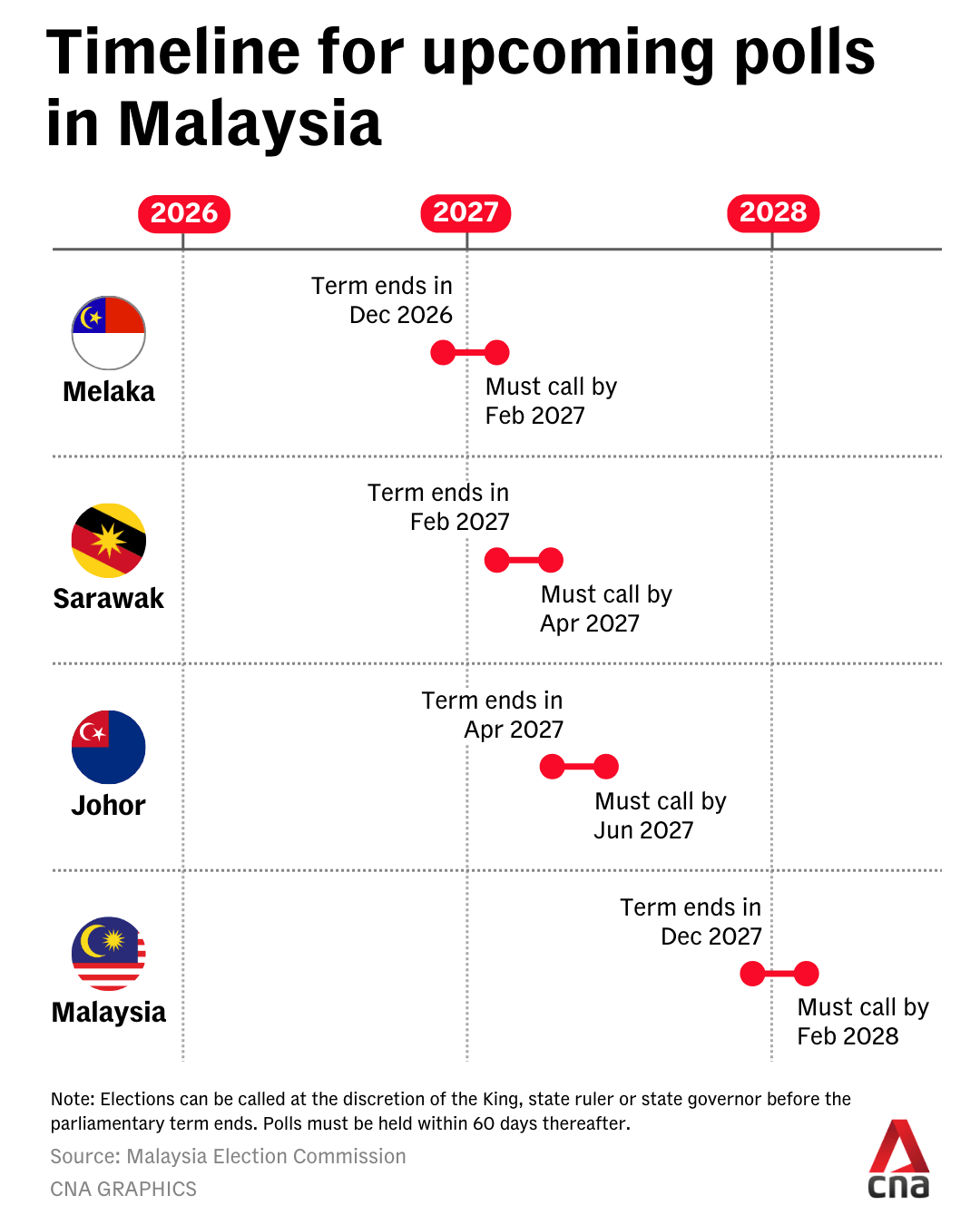
The current Melaka state government’s term ends in December 2026, while the current Johor state government’s term ends in April 2027. This means their state elections are due by February 2027 and June 2027, respectively.





Separately, a senior civil servant told CNA that government administrative officers have been placed on alert for a potential general election in the second half of 2026, with certain government resources placed “on standby” from June.
Recent remarks by politicians and observers, reported by the local media, have also fuelled speculation that the polls could be held from the second half of 2026.
Deputy chairman of Malaysia’s Election Commission (EC) Azmi Sharom reportedly said last week that the EC is prepared for the possibility of an early GE16, including holding parliamentary polls concurrently with state elections in Melaka and Johor to reduce costs.
“If state and parliamentary elections are held simultaneously, of course, the cost will be lower because there is no need to conduct two separate elections, and it provides advantages in terms of economies of scale,” he told Berita Harian.
Deputy Prime Minister and Barisan Nasional (BN) chairman Ahmad Zahid Hamidi reportedly said the Melaka state election could be held within the next two to 10 months.
Melaka is the next state polls on the calendar and BN is looking to defend its grip on the state assembly after securing more than three-quarters of the seats in the last election.
Anwar had earlier dismissed the prospect of snap polls in 2026, telling journalists last December that his priority was to implement reforms and alleviate cost of living issues for Malaysians.
However, analysts told CNA that the current state of play in politics, including perceived instability within the opposition ranks, may present an opportunity for Anwar’s Pakatan Harapan (PH) coalition and its allies to consolidate their position and return the 78-year-old for a second term.

SNAP POLLS WITH STATE ELECTIONS?
Malaysia’s electoral calendar offers potential strategic windows.
While GE16 must be held by early 2028, several states face earlier deadlines.
Besides Melaka and Johor, there is Sarawak, which must hold its state election by April 2027.
With Sabah’s state polls done and dusted in November 2025, United Malays National Organisation (UMNO) supreme council member Ahmad Maslan on Sunday (Mar 1) mooted the possibility of the Sarawak, Melaka and Johor polls being held this year, in tandem with the general election.
UMNO is the main component party of BN, a key ally of PH in the unity government.
“If there is a plan to hold these state elections together with the upcoming general election, then the general election must be brought forward. Otherwise, these three state elections can be done concurrently by themselves,” he told reporters.
Analysts said a realistic window for the Melaka polls is the fourth quarter of 2026, given the start of 2027 will coincide with Chinese New Year celebrations and Ramadan.
Former Democratic Action Party (DAP) Member of Parliament Ong Kian Ming, who is adjunct professor at Taylor’s University in Selangor, told CNA: “PM Anwar has good reasons to call for a concurrent state and general elections by the fourth quarter of 2026 or the first quarter of 2027.”
DAP is part of PH and the party with the largest number of MPs in the governing coalition.
Ong said holding the polls concurrently and ahead of schedule will increase the chances of PH and BN “having an electoral pact”, given that the two coalitions collaborated recently for the Sabah polls.

However, BN has recently appeared to position itself to be competing alone in the upcoming polls.
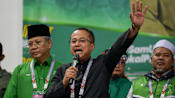
Following a meeting of BN leaders over the weekend, various local reports have cited how it is set to contest at least 115 seats in the upcoming general election, an indication that it is perhaps no longer willing to play second fiddle in the coalition with PH.
There are 222 seats in Malaysia’s legislative assembly and any party or coalition seeking to form the next government needs to win at least 112 for a simple majority.
During UMNO’s general assembly in January, Ahmad Zahid also proposed a “grand collaboration” involving all Malay-Islamic political parties in the country, an indication that the party is open to collaborating with key Malay conservative parties in the opposition Perikatan Nasional (PN) coalition, including Parti Islam Se-Malaysia (PAS) and Parti Pribumi Bersatu Malaysia (Bersatu).
However, analysts point out that PH-BN cooperation could be more beneficial to both sides, because competing against each other could split the moderate/centrist vote in marginal seats, increasing the likelihood of the opposition winning.
Moreover, UMNO, Bersatu and PAS are gunning for the same vote bank - the Malay Muslim voters.
“It’s looking more and more likely that there could be a possible fallout with UMNO (from the partnership with PH),” said political scientist Syaza Shukri of the International Islamic University Malaysia.
“If anything, holding a general election would help to re-position everyone … If they hold polls now and clarify expectations, (PH and BN) could go into the polls in a stronger position, provided each side can agree on the terms (such as not competing for the same seats),” she added.

OPPOSITION DISARRAY: WILL LATE-2026 BE TOO LATE?
Another factor potentially favouring early polls is turbulence within the opposition.
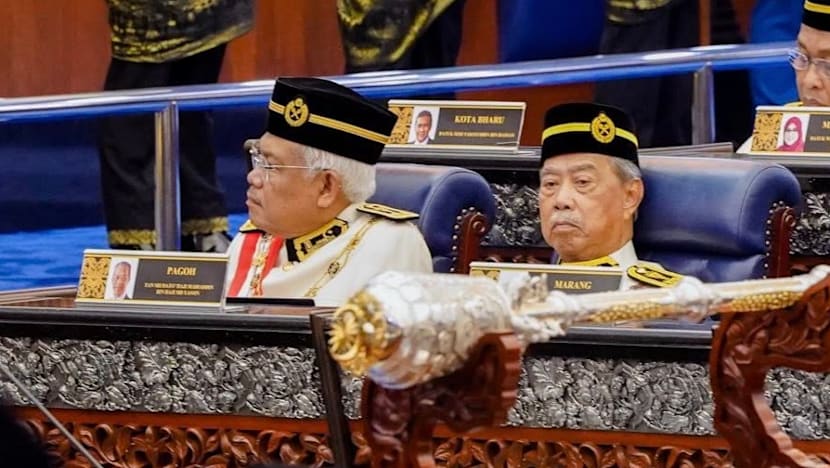
The dramatic rupture in Bersatu between president Muhyiddin Yassin and former deputy president Hamzah Zainudin in recent weeks has fuelled ill will between the pair and their respective camps.
Hamzah even said he was once Muhyiddin’s staunchest ally but, following his expulsion from Bersatu, has become the latter’s “number one enemy”.
During a press conference on Wednesday, Muhyiddin admitted he now feels “strange” sitting beside Hamzah in parliament and said he is prepared to block the latter’s application to rejoin PN under a new party.
According to local media reports, Hamzah and 19 other MPs in his camp are set to join a local Malay nationalist party Parti Keluarga Malaysia, and he is purportedly set to lead it.
Analysts say that it might take some time for Hamzah and his faction to be formally part of PN once again, and for the coalition to have an understanding between component parties.
Meanwhile, former economy minister Rafizi Ramli — once Anwar’s deputy in PKR — has hinted that he and aligned MPs could chart a separate course in the next election. He is expected to clarify his political plans in June.
The maverick and outspoken politician has been critical of the Madani government and its policies since resigning from the Cabinet last year.
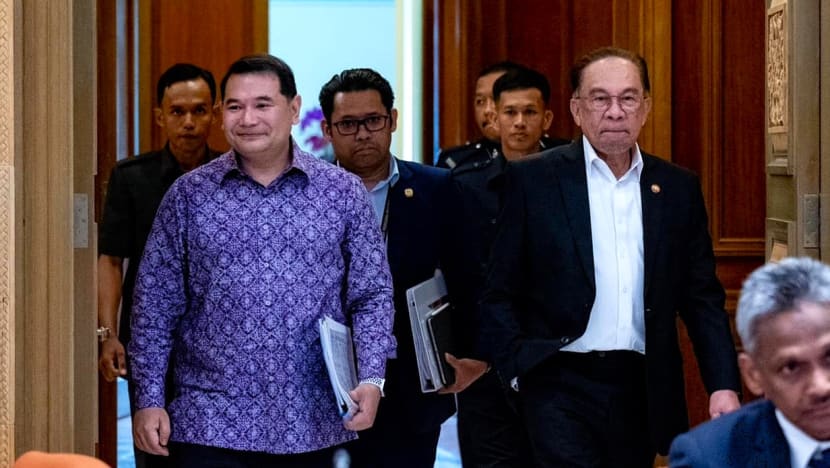
Ong said timing is crucial if Anwar wants to fully capitalise on fragmentation among his rivals.
“To fully take advantage of the state of opposition disarray, Anwar probably needs to call for snap polls before June, rather than … at the end of the year. By year’s end, Rafizi and Hamzah may have had time to regroup,” he said.
Syaza agreed delaying until late 2026 could give PN breathing room.
“If they can hold an election in the next few months, it might be in Anwar’s favour. But if it's later in the year, I’m afraid that might give PN enough time … to strategise and consolidate support,” she said.
Another variable is DAP’s special congress on July 12, where more than 4,000 delegates will vote in an internal referendum on whether party leaders should resign from government posts.
While DAP has said its MPs would continue backing Anwar regardless of the outcome, analysts say the vote will signal grassroots sentiment within PH’s largest component party.
If an overwhelming majority of DAP members vote for party leaders to resign from government leadership positions, it could leave a leadership vacuum in Anwar’s government and could destabilise PH ahead of the general polls.
Ong told CNA that the referendum is a way for the party to pressure Anwar to introduce substantive reforms before GE16.
“If these reforms are introduced in a timely manner, this would give more assurance to Anwar that he should call for a GE later this year,” he added.
Anwar’s government has attempted to push through reforms such as a landmark bill that would limit the tenure of a sitting prime minister to two terms - or a maximum of 10 years. But the Bill failed to pass this week, falling two votes shy of the 148 required to amend the Constitution.
The Bill is set to be retabled in June.
Syaza argued that if the referendum results are not favourable to Anwar’s government and the DAP leaders leave their leadership posts, it would not be good optics for his leadership.
“I think maybe the best is to hold an election soon to iron out all the internal issues. Otherwise, his government appears more fragile with time,” she added.
THE ECONOMIC FACTOR
The Malaysian economy could also affect the timing of polls, analysts say.
Malaysia has seen resilient growth under Anwar and, for 2026, is expected to exceed the government’s forecast of between 4 and 4.5 per cent growth, making it among the strongest performers in Southeast Asia.
The ringgit has appreciated against the US dollar over the past year, while Malaysia has seen record foreign investments. The unemployment rate has fallen to around 3 to 3.5 per cent, which is close to pre-COVID-19 pandemic levels.
There is concern, however, that this has not translated to benefits to the masses, analysts noted.
According to a survey by think tank Institute Masa published in late 2025, 42 per cent of Malaysians said that rising costs remain a key worry and just 41 per cent were satisfied with their income.
Meanwhile, a regional survey done by market researcher Milieu Inshight revealed that 70 per cent of Malaysian respondents expressed concern about rising cost-of-living pressures, and these figures are higher than most regional peers Singapore and Thailand.
“I think the government will definitely ride on the economy if they decide to go for election,” said Syaza. “But people still say they don’t feel this net positive so I’m not so sure if they should be too confident.”
Political analyst Sivamurugan Pandian argued Anwar should only hold the general election from 2027.
“A stable growth trajectory and improving income levels do provide political confidence. However, the stronger argument may be to allow these gains to mature further, ensuring that reforms translate to tangible long-term benefits before seeking a renewed mandate,” added the Universiti Sains Malaysia lecturer.
This will also give Anwar time to implement policies relating to his reform agenda, he said.
Anwar has been criticised by some quarters for not fulfilling some broad reform promises related to the judiciary, parliamentary empowerment as well as anti-corruption.
Sivamurugan said: “Delaying polls would allow further institutional reforms, subsidy rationalisation, and governance improvements under the Madani agenda to take root. A stronger reform track record would likely provide a more solid foundation for electoral endorsement.”