Asia’s EVolution: How Mongolia became a dumping ground for Japan’s hybrid electric vehicles
Over the decade, Mongolia has been flooded with cheap, end-of-life hybrid electric vehicles (EVs) from Japan. The final instalment of a CNA series on Asia’s EVs looks at how the country could be turning into a green technology dumping ground.
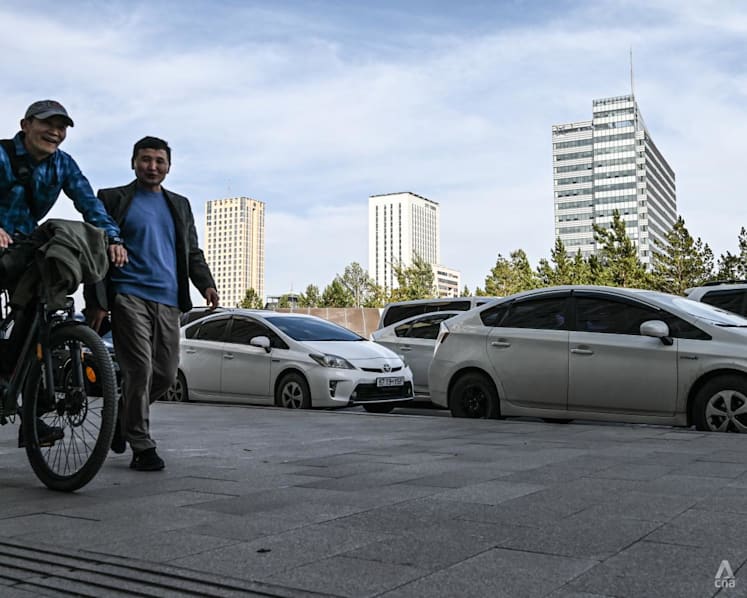
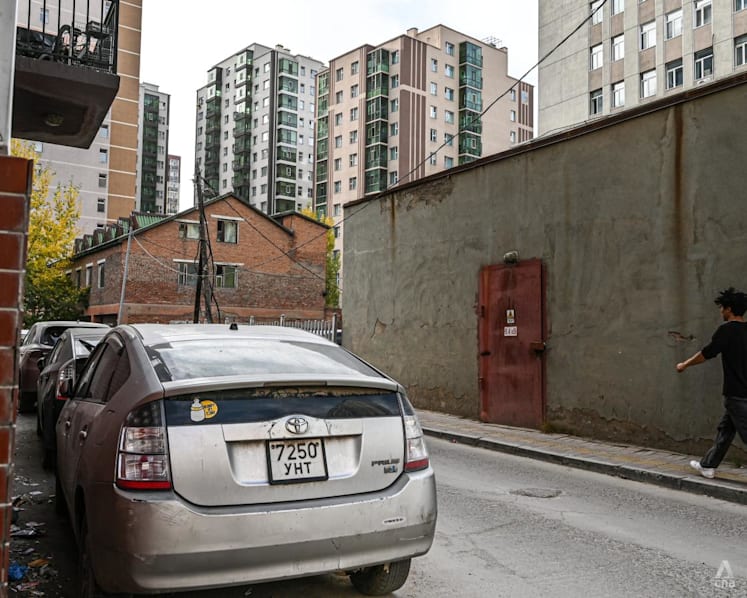
The Toyota Prius is the most common vehicle on the streets of busy Ulaanbaatar. (Photo: CNA/Jack Board)

This audio is generated by an AI tool.


ULAANBAATAR: Winter is coming on the Mongolian steppe. The wind has started to bite hard as it sweeps through the open grasslands and low granite hills that punctuate the landscape.
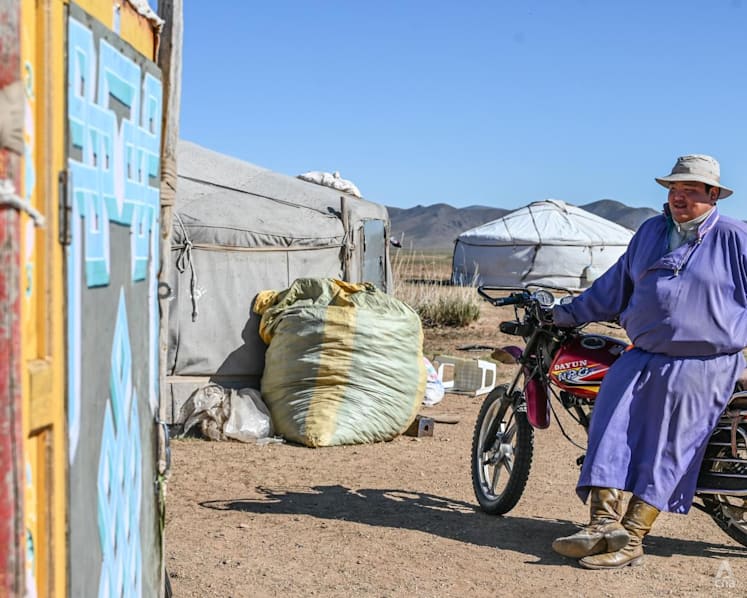
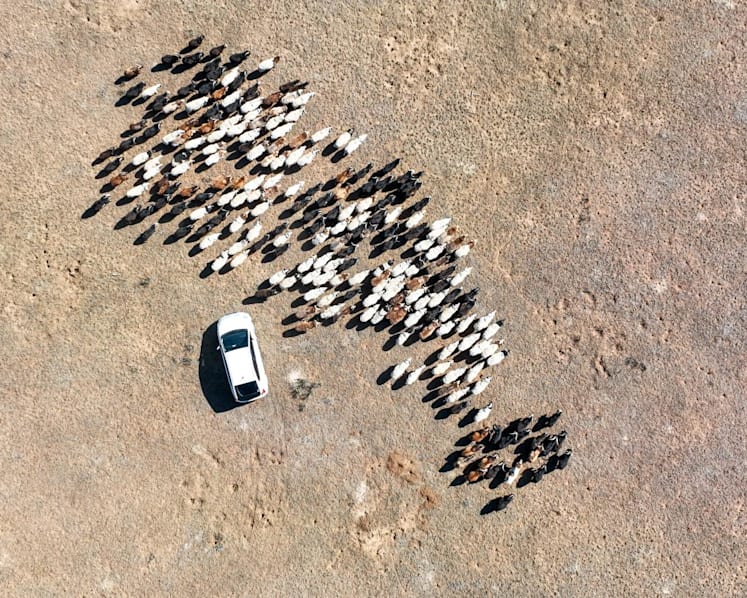
For Namnansuren Tuvdsuren and his family of nomadic herders, the temperature dropping means guiding their sheep, goats and cattle on horseback or motorcycle becomes a tougher proposition.
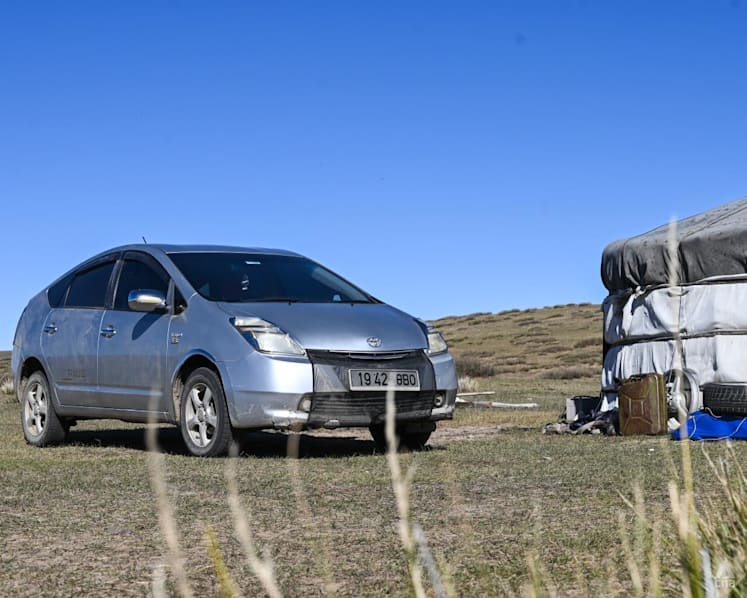
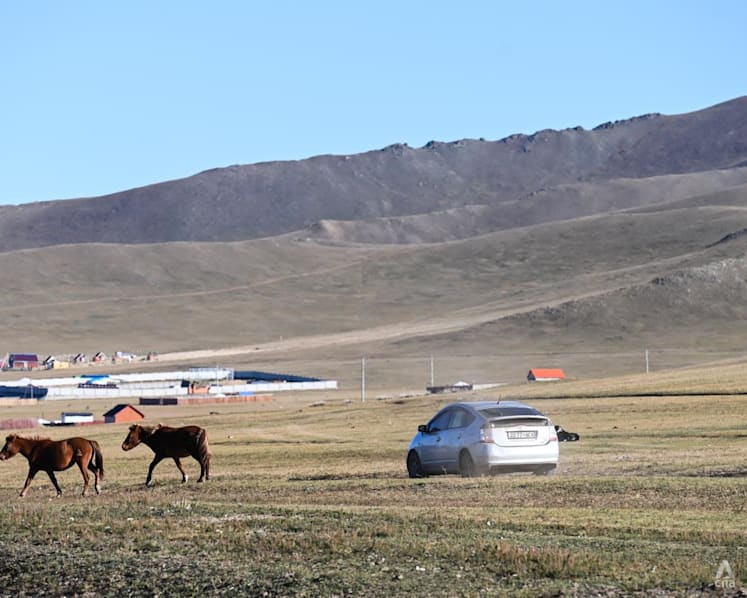
So, like many herders across Mongolia’s harsh expanse, they keep a more modern tool at hand: a Toyota Prius.
The hybrid electric vehicle (HEV), originally designed for the streets of Tokyo, is proving its worth in the wild.





“Basically, if we don’t have our motorcycle around, we just use the Prius,” Tuvdsuren explained as he navigated the open land from behind the wheel, shifting his animals in a tight flock.
“In winter, if a young horse or cow gets injured, we just tie their legs together, lay down the backseats in the car and load it in.”
Nationwide, hybrid vehicles account for 45 per cent of Mongolia’s total vehicle fleet of about 1.5 million, according to the Ministry of Road and Transport Development.
The vast majority of these are Priuses, attractive because of their reliability, cheap and available spare parts and fuel efficiency that offsets the high cost of petrol.
“If you throw a rock in Mongolia, chances are you’ll hit a Prius,” said a taxi diver in the capital.
“Climb up the Khüiten Peak and guess what, a Prius will be there,” he added, referring to the country’s tallest mountain that even the most rugged four-wheel drives struggle to ascend.
Mongolia is awash with cheap, end-of-life hybrids imported from Japan once they have served their purposes on tamer urban streets.
They can be found in every corner: from the jammed avenues of Ulaanbaatar to the depths of the Gobi Desert.
Read the other articles in this series here:
Ulaanbaatar has one of the coldest winters of any capital in the world and some of its dirtiest air. The Prius functions reliably even in such extremes, and its cleaner, battery-assisted motor helps cut the vehicle emissions driving the city’s air crisis.
Yet behind the affection for the Prius lies a more difficult reality - and a deep irony: in trying to reduce air pollution by promoting cleaner vehicles, Mongolia has inadvertently imported a new form of waste.
In a country with such brutal conditions and the roughest roads imaginable, those batteries, already expiring after years of use overseas, fail fast and need to be replaced.
With no permitted way to recycle or safely dispose of the depleted and hazardous battery packs, and recent legislation putting those who try on the wrong side of the law, experts warn that Mongolia is becoming a green technology dumping ground.
And it is an emerging lesson for other countries bracing for a wave of electric vehicles without plans in place for when they are no longer roadworthy.
THE PRIUS REPUBLIC
Where pure electric vehicles have struggled to take off due to a lack of charging infrastructure, minimal tax incentives, vast travel distances outside of Ulaanbaatar and climatic conditions slashing their performance, HEVs have proliferated.
“For a country like Mongolia, with vast distances, hybrids are much more practical. You can drive 100 to 150 km on electricity and then 800 to 1000 km with the gasoline engine”, said Baasanbayar Sambuu-Yondon, the executive director of the Mongolian Automobile Distributors Association (MADA).
Where many countries throughout Asia prohibit or severely restrict the importation of used vehicles, Mongolia’s policies have facilitated the deluge of second-hand hybrids from Japan.
For more than a decade, the country’s regulatory environment actively enabled the surge of used hybrid imports through a combination of low import taxes and duty exemptions on such vehicles, which were marketed as “clean” cars.
Approximately 80 per cent of vehicle imports to the country come from Japan, with 95 per cent of those used.
Priuses are purchased at auction typically once their Toyota battery service period and warranty have expired - after that the batteries become expensive to maintain and replace.
The vehicles are then brought into Mongolia by various industry players, Sambuu-Yondon explained.
“In other words, cars with expired or heavily deteriorated batteries are coming into Mongolia,” he said.
Only at the start of 2025 did the government start to enforce a rule that vehicles older than 10 years would no longer be eligible for registration in the capital.
It is still a flexible rule, far more lenient than countries in Southeast Asia, for example.
Countries such as Indonesia prohibit used car imports entirely, while Vietnam and Singapore impose much stricter age and registration limits.
Over the past decade, Mongolia has typically imported between 50,000 and 70,000 cars annually, both old and new, according to figures from MADA.
But in recent years, that number roughly doubled - to around 120,000 cars in 2023 and 130,000 cars in 2024.
“Mongolia’s vehicle fleet has reached a point where its age and need for renewal have become significantly pressing,” said Munkhnasan Enkhtaivan from Mongolia’s Ministry of Road and Transport Development.
The vast majority of imports are right-hand drive vehicles - opposite to what they are meant to be based on driving lanes in Mongolia - due to being from Japan, where right hand drive vehicles and driving on the left side of the road are the norm.
One major driver for the huge increase in imports was public fear that the government and city administration might ban right-hand-drive vehicles, prompting grey-market dealers to rush large numbers of cars into the country before any potential restriction, Sambuu-Yondon said.
He added that nearly every adult in the capital now owns close to two cars. More and more of them are old Toyota Priuses rolling across the border.
As a result, Ulaanbaatar is in the midst of a traffic nightmare. The city suffers chronic congestion, a bitter irony in the least densely populated country on earth.
“These cars are not owned out of necessity, but because anyone can afford one,” he said. “They are extremely cheap, ageing vehicles.”
In 2025, exporter listings show a ten-year-old Prius selling for roughly US$3,000-US$8,000 at source.
A BATTERY WASTELAND
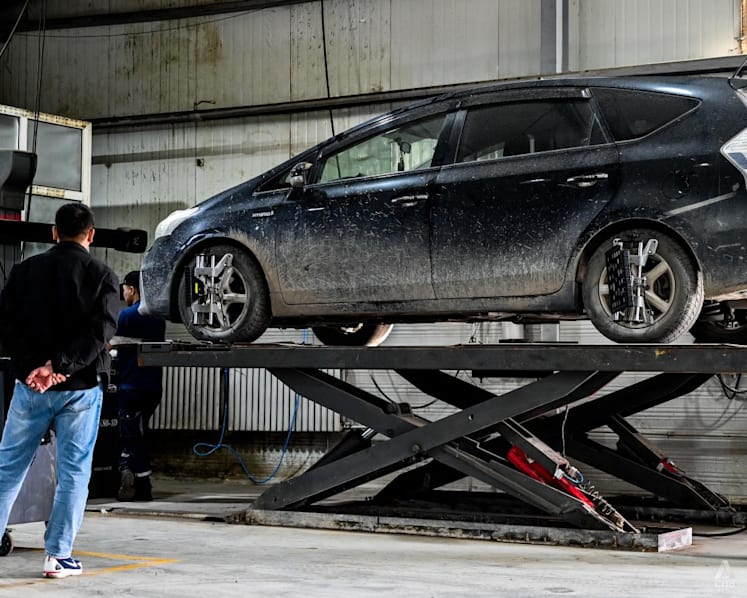
In the rural town of Kharkorin, more than 350 km west of the capital, a small garage is emblematic of the types of maintenance and repair being carried out on Priuses facing the toughest elements imaginable.
“These cars have already been driven for many years before they even get here, so naturally, the parts are worn,” said mechanic and business owner, Tseren-Osor Naidan.
“Extreme cold or heat causes wear and tear, and the rough terrain adds more strain. But still, these cars hold up surprisingly well. Toyota really built them strong.”
The cars may be tough but the batteries fail much faster in the extreme cold than they otherwise would.
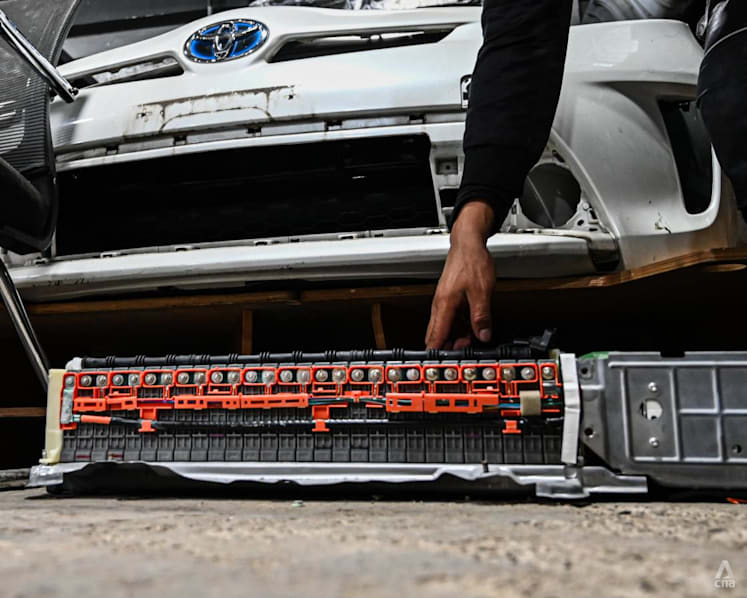
Servicing and replacing Prius battery modules - often done cell by cell - is a common practice.
Naidan does that too. But with no official waste channel, what is a necessary small-scale adaptation to keep hybrids alive has quietly become an environmental hazard.
Passenger cars contain different kinds of batteries. Nearly all - including EVs and HEVS contain a 12-volt lead unit used for starting the vehicle and operating its internal systems.
These are cheap, common and highly toxic if exposed to the environment or when smelted.
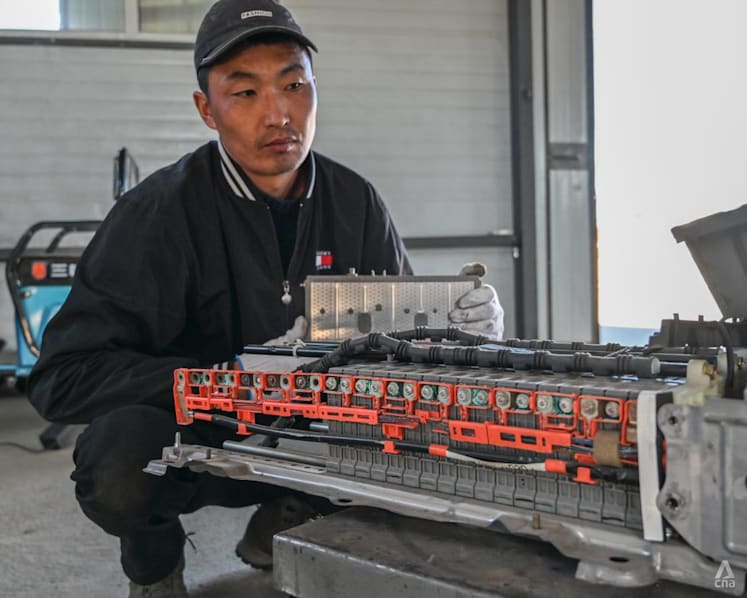
The new wave of electric vehicles use lithium batteries to run their motors.
But HEVs, especially older models, typically use a nickel-metal hydride (NiMH) battery, which while less toxic than lead batteries can still pose health and environmental risks if not handled properly at their end-of-life.
Even if a battery is completely dead or damaged, if it is not decommissioned and stored properly, it poses a fire hazard, said Munkhsukh Natsag, a battery engineer in Ulaanbaatar.
Related:
Mongolia is currently failing to keep track of where its battery waste is ending up.
“We are now facing serious challenges concerning hazardous waste, specifically how to dispose of, collect and store the batteries used in these vehicles,“ said Enkhtaivan.
“In Mongolia today, a discarded high-voltage battery might be sitting outside someone’s ger, in an open yard, where a child could easily be playing next to it. That is how dangerous the situation is,” she said, referring to the traditional tented communities common throughout the country.
Still, the metals within the batteries have value and there are informal collection systems at work throughout the country.
On the outskirts of Ulaanbaatar, what resembles a fairly anonymous vehicle repair garage is actually at the heart of the entire country’s dead battery disposal network.
What happens here is shrouded in secrecy.
The owner of the establishment was coy about any questioning of his activities and he requested his name not be published for fear of repercussions from the government, even though he is well known among the mechanics of the city.
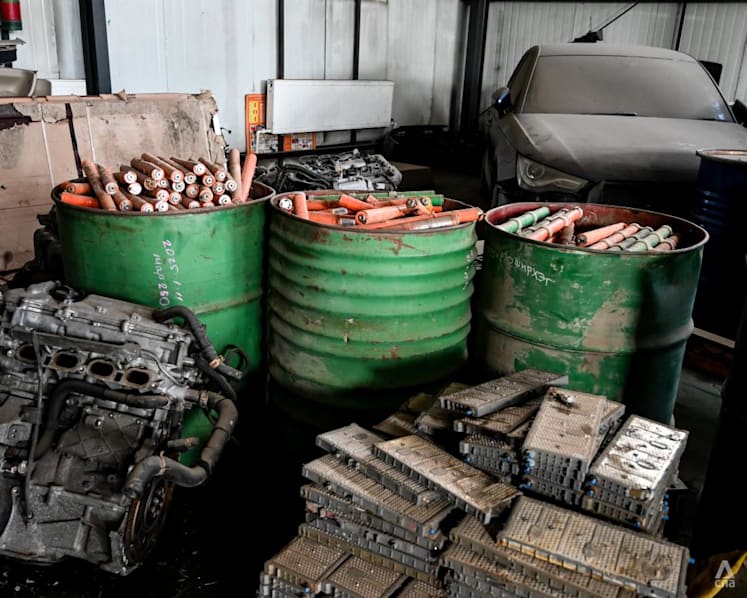
Dozens of unmarked green barrels sitting outside in the elements is a clue to what is happening here.
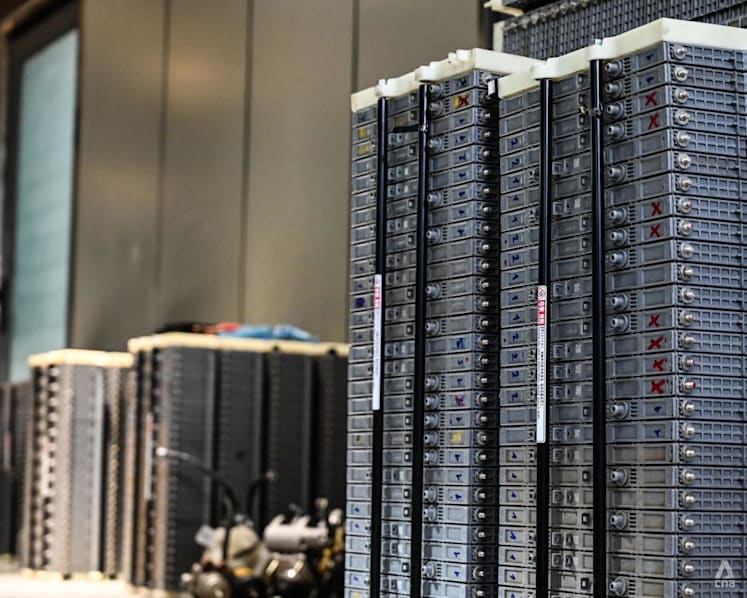
This is the place where right now nearly every single depleted Prius battery in the capital and beyond is collected, according to Bataar, an alias for the owner.
At the time of CNA’s visit, he was holding onto about 50,000 of them, a surfeit that had been gathering since the start of 2025.
“In Ulaanbaatar, I am confident I collect every single battery,” he said.
Realising both the economic potential and the environmental danger of discarded batteries, Bataar set his sights on Ulaanbaatar’s dense network of garages and service centres, buying up depleted hybrid packs from wherever he could find them.
“Before, they would end up dumped in landfills or buried in the hills. There is no official disposal site for them. People used to haul batteries by porter truck and dump them openly,” he said.
He received training support from Toyota’s subsidiary in Mongolia and from government officials on the procedures and safety requirements for exporting the units to Japan via Russia.
But now, he has a problem. Since early 2025, the government has made battery exports illegal. Bataar woke up to find his business on the wrong side of the law.
“I feel so suffocated that I could die. I’ve carried out this service properly for years, and now I’m suddenly forced to stop,” he said.
Both of Mongolia’s neighbouring countries, Russia and China, prohibit the cross-border transport of such hazardous materials through their territory, and third-country export is essentially banned, explained Enkhtaivan.
There are no officially authorised companies, repair shops or licensed facilities that are permitted to handle this work properly.
With hundreds of thousands of HEVs on the country’s books, the scale of the issue is concerning, she said.
“So these batteries - this waste - remain inside the country. It is all in Mongolia,” she said.
BUILDING NEW SYSTEMS
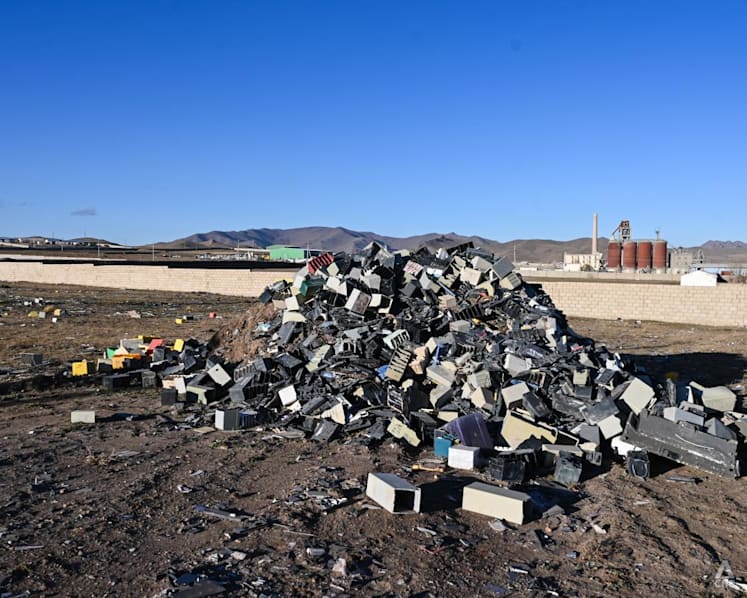
In a barren expanse one hour’s drive outside the capital, is evidence of the toxic outcomes of a lack of systematic management of battery waste. It is a common issue faced in developing economies.
In these patches, unregistered smelters had been processing all kinds of lead battery waste before being chased away by authorities.
What has been left in this landscape are the remnants of those activities: piles and piles of lead battery casings, elements and scorched earth.

Mongolia is trying to stop this. In March 2024, the country’s first lead-acid battery recycling facility commenced operations, with a 7,000 tonne annual capacity.
While this is helping to solve some issues, the Electrochem Mongol plant is unable to recycle hybrid-car batteries, a process that would require different technology and a separate purpose-built facility.
“At the moment, we’re still in the research and development phase for that next step,” said the company’s factory director Avirmed Munkhuu.
Electrochem Mongol’s CEO, Odonsuren Ulziibat, is optimistic that within three years, pending funding, that kind of plant could be built, with the ability to also process lithium batteries within a decade.
“In 10 years, we are going to need to be ready to process those EV batteries as waste too”, he said.
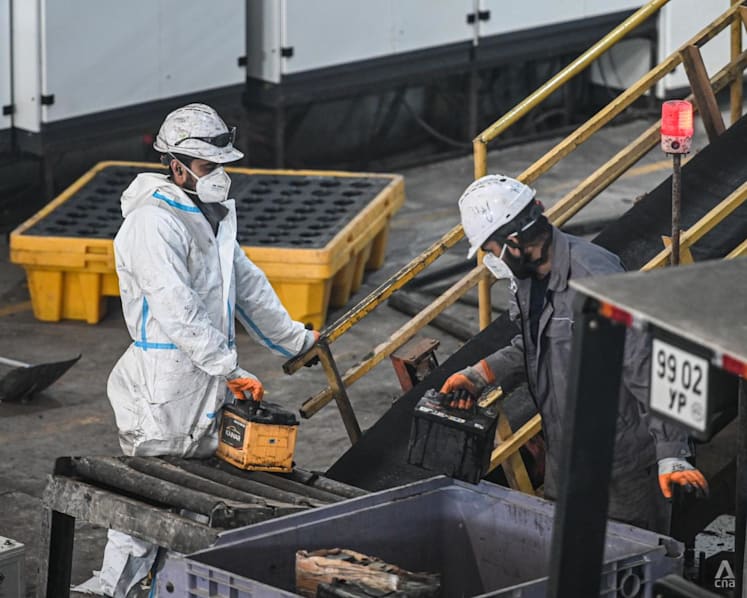
The government has been working with international partners such as the Asian Development Bank, the World Bank and JICA, and conducted several studies since 2016 on how to properly manage its battery waste issues.
Based on these studies, it has become clear that Mongolia urgently needs hybrid-vehicle battery waste facilities, Enkhtaivan said.
But its unique challenges - a small economy with a surplus of ageing hybrid vehicles - means funding for such projects is hard to secure, she said. Given Japan’s role in the trade, she said partners there have shown willingness to help.
Japan already has its own system for recycling NiMH batteries. It also has a utilisation fund from fees that consumers pay when they buy a new car to cover its eventual recycling.
But that system does not apply to the cars exported to Mongolia and the money can normally be refunded to the exporter in that case. The moment an aging Prius is sold overseas, its disposal obligations vanish.
Mongolia inherits not just the cars, but also their toxic aftermath.
Other countries also have the capability to deal with battery waste. China is considered the global leader in lithium-ion battery recycling.
South Korea has advanced battery reuse and remanufacturing capacity, while Singapore established a lithium-ion battery recycling facility, the first of its kind in Southeast Asia, in 2021. Malaysia, Thailand and Indonesia are currently building up their capacity to do the same.
For now, the Mongolian government is also working to establish an integrated system: linking customs, road transport authorities, vehicle registration agencies and auto-repair businesses to ensure a coordinated response to the problem.
There remains a lack of pre-export inspection on the quality of the cars and their battery units coming into the country.
“Mongolia could feasibly set a minimum battery health threshold that it will or will not accept in the future,” Enkhtaivan said.
As Mongolia struggles with a problem it did not solely create, its experience offers a warning to every country concerned about the EV transition, she added.
As more electric vehicles with lithium batteries enter the country, the problem will not disappear, only shift.
According to the International Energy Agency, global electric‐car sales in 2024 exceeded 17 million units. While sales in emerging economies including in Asia, Latin America and Africa were still low, they nearly doubled that year.
“You must build a complete, integrated waste-management system before these vehicles enter your market. If there is one lesson from Mongolia, it is this,” she said.
“That entire chain should be visible and traceable, as clearly as reading it on the palm of your hand. Now we are chasing after the problem.”
In Mongolia’s case, electric and hybrid vehicles were already coming in by the thousands before any safeguards were ready.
Even where countries do not permit second-hand vehicle imports, eventually lithium batteries from new vehicles will need replacing too.
China’s own electric revolution has produced its share of casualties. Satellite images have captured entire fields of discarded electric cars and batteries.
Countries without the means to handle the problem face grim environmental and logistical challenges.
“The result will be severe damage, but the most alarming part is this: we have no way of knowing what kind of harm will emerge, or how serious it will be, until years from now,” Enkhtaivan said.
Out on the steppe, the afterlife of a car that is used for herding livestock, fetching water and firewood and taking kids to school is far from top of mind for Mongolia’s nomadic communities.
But life on the land is steeped in tradition and connection to the living earth. The morning ritual of offering the first cup of tea in the morning to the sky and soil remains important to this day.
Yet as spent batteries and broken hybrids pile up on the edges of the land, that same bond between people and the earth is being truly tested.
Additional reporting by Khaliun Amarsaikhan.