China is betting on bigger tech hubs for growth, but analysts warn of old risks
Beijing is funnelling resources into scaled-up AI and chip clusters in its next five-year plan but analysts warn that supply-driven expansion could outpace viable market demand.

This audio is generated by an AI tool.


SHANGHAI: As China begins laying the groundwork for its 15th five-year plan, cities are accelerating efforts to scale up artificial intelligence (AI) and semiconductor hubs - a push that analysts say reflects both strategic intent as well as risks.
From new “AI+” task lists in Wuhan and electric vehicle (EV) and chip clusters in Chongqing to humanoid robots in Shenzhen and AI manufacturing pushes in Shanghai and Zhejiang, local governments are rolling out efforts to transform national priorities into results.
Observers say the real test will be whether these scaled‑up hubs can avoid repeating past mistakes and patterns of overcapacity and building faster than real demand to achieve tech self-reliance.
“(With) every national wave, there’s similar local waves,” said Chen Ling, an associate professor at Johns Hopkins University’s School of Advanced International Studies.





While they all promote AI, semiconductors and EVs, Chen noted that localities had different industrial bases.
“Over the long term they still accumulate some unique characteristics,” she said.
Tilly Zhang, a technology and industrial policy analyst at Gavekal Dragonomics, said the latest push is also about forcing harder choices.
“Competition always fosters pressure, and pressure fosters innovation and hard work - so you still need industrial competition locally but you don't want too many unqualified players in the same areas,” Zhang said.
WHAT BEIJING’S NEW TECH LANGUAGE SIGNALS
The clearest signal of what Beijing now wants from its AI and tech sectors came from this year’s Two Sessions meetings.
This year’s government work report and the 15th five-year plan have vowed to “drive advances in original innovation and breakthroughs in core technologies in key fields”, as well as to “move faster to achieve greater self‑reliance and strength in science and technology”.
But commentaries about the new plans have shifted emphasis: the goal is to no longer just plug “chokepoints” and survive export controls - but to build what Beijing calls “new quality productive forces” - high‑productivity, tech‑heavy industries that can raise incomes and underpin future growth.
That shift will reframe how success is defined, said Gavekal Dragonomics’ Zhang.
“The previous five‑year plan was more (about) emphasising technologies for national security,” she told CNA.
“But in this new plan, it's more about stressing how we should use new technologies to generate economic benefits. Not only developing advanced technologies, but also how (they) can optimise entire supply chains to build more successful products.”
That means local governments are now under greater pressure to ensure that flagship projects - from AI to semiconductors - feed into viable industrial chains, Zhang said.
The language might have evolved but policy tools remain largely unchanged.
The plan continues to prioritise supply-side support, including higher research spending and the use of government-guided funds to channel capital into strategic sectors.
AI alone is referenced dozens of times across policy documents, alongside calls for “AI+” applications, large-scale computing infrastructure and open-source ecosystems.
“The emphasis is still on inputs on the supply side,” said Chen. “That has to be matched by demand - and the two may not align.”
That gap is already visible on the ground, experts added, citing how while China has demonstrated rapid advances in areas like AI - turning those gains into sustainable profits remains uneven.
The case of Chinese AI model DeepSeek that drew global attention in 2025, illustrates that challenge, says Chen.
Although its developers highlighted strong cost-efficiency metrics, actual revenues have lagged, with limited commercialisation beyond open-source releases and low-cost APIs.

And analysts said this reflects a broader issue: technological capability does not automatically translate into scalable business models.
“Everyone thinks DeepSeek is so great… but it doesn’t earn that much money,” Chen said. “It cannot be the pillar of industrial or economic growth in China.”
Instead, analysts point to companies more deeply embedded in industrial supply chains - such as chip-equipment makers and AI chip designer Cambricon - as closer to what Beijing is now prioritising: firms that can deliver both technological advances and consistent profitability.

HOW CHINESE CITIES ARE MOVING
To drive that shift, China has drawn a bigger map.
Instead of just naming Beijing, Shanghai and the Guangdong‑Hong Kong‑Macao Greater Bay Area as innovation centres, the new outline also upgrades the full Beijing‑Tianjin‑Hebei region, the Yangtze River Delta and the Greater Bay Area to international science‑and‑technology hubs.
The Chengdu-Chongqing region, along with cities like Wuhan and Xi’an have also been designated as regional innovation centres.
That shift in scale - from single cities to whole economic corridors - is what local governments are now responding to, said analysts.
“(China) is not saying every city should rush to the new sectors again like what they did before - but instead they are naming out those three important clusters,” said Zhang.
“They are saying these three hubs are the new international sci‑tech innovation hubs and in order to support their growth, resources and opportunities should be better allocated instead of (being) evenly spread across the country.”
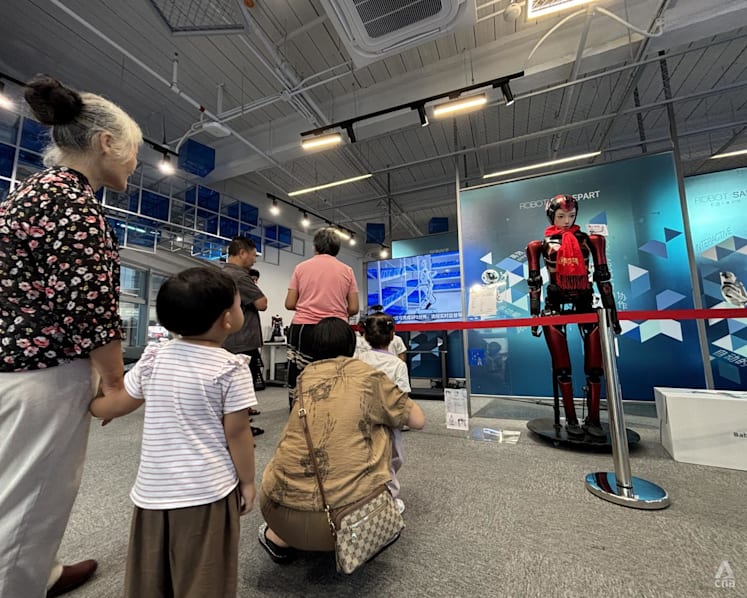

In Shanghai, Beijing and Shenzhen, the new mandate has already turned into detailed checklists for how to scale AI and related industries.
In Shanghai’s Pudong district, a new 31‑point plan was unveiled on Mar 14 to “bolster innovation and global investment” around AI, advanced manufacturing, autonomous driving and new materials.
Officials said they want to build an “end‑to‑end industrial ecosystem” rather than stand‑alone projects, promising a city‑level AI computing hub - giving smaller firms cheaper access to computing power.
Other promised measures include an online platform connecting about 800,000 suppliers, pilot testbeds for emerging technologies such as humanoid robots and advanced materials where companies can test and deploy AI‑enabled products.
Local AI firms like MiniMax, which listed in Hong Kong in January, are reporting surging usage and are crediting the city’s policies and data resources.
Robotaxi operator Pony.ai is running trials in Pudong while augmented reality (AR) glasses maker Xreal has invested in new facilities for chip design and AI development as it prepares to ship more volumes of headsets overseas.
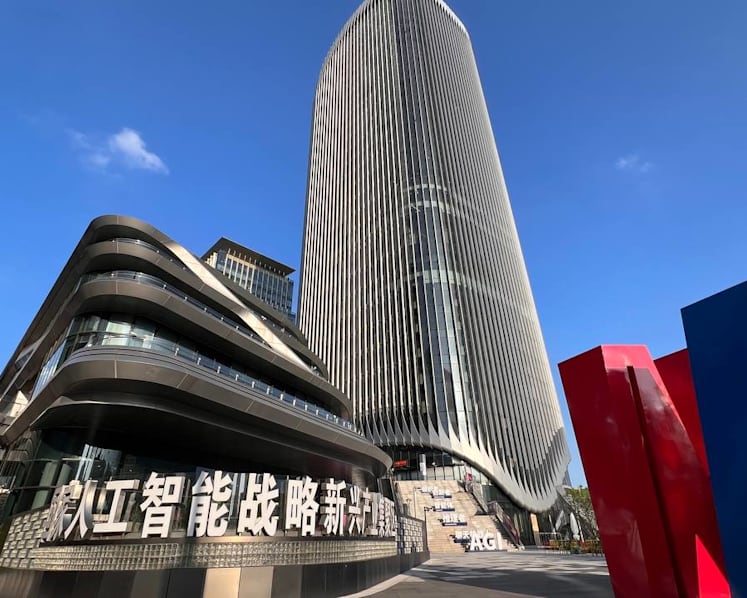
Zhang sees that as a step towards the kind of product‑focused AI Beijing is pushing for.
Cities like Shanghai, she said, are now expected “not only to develop advanced technologies, but also optimise (their) entire supply chain in order to build more successful products in the end”.
Beijing, by contrast, is leaning on its strength as a research hub - aiming to grow its core AI industry to over 1 trillion yuan (US$145 billion) within two years and building on a base of thousands of AI firms and research institutions.
The capital has pledged to advance its AI Plus Initiative “across the board” while also upgrading intelligent‑computing facilities and accelerating the development of future industries like 6G and quantum technology.
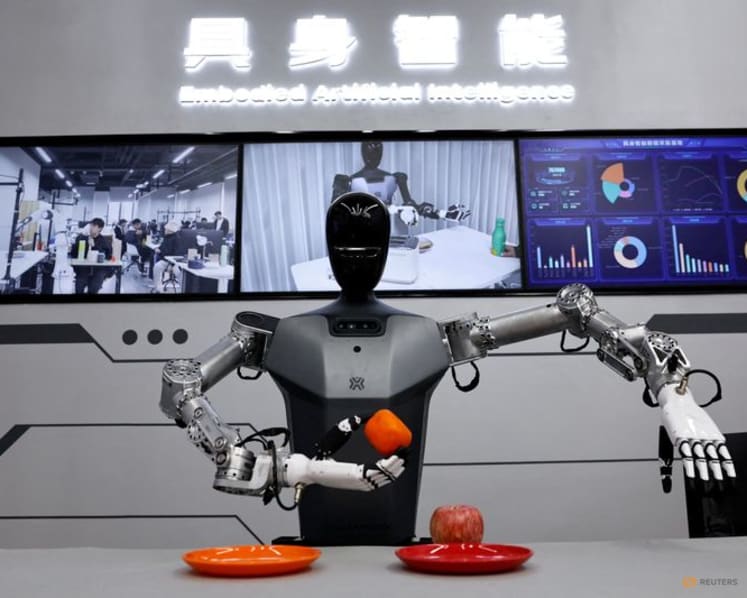
In Shenzhen, districts are positioning themselves as testbeds for “embodied intelligence”.
Longgang district, home to Huawei and BYD, released draft measures in March to support OpenClaw, a local embodied-AI and agent platform.
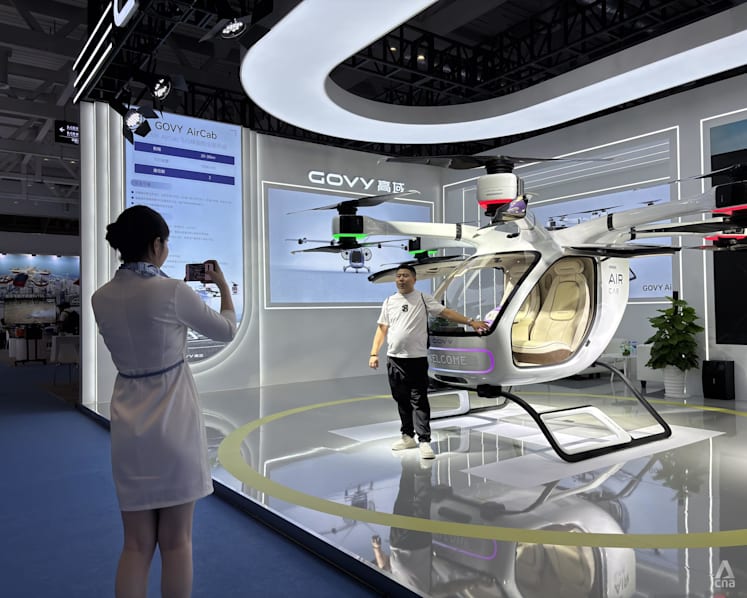
At the same time, the southern Chinese tech hub is cementing its role in emerging sectors like the low‑altitude economy and autonomous driving.
It is one of six designated flying‑car pilot zones and already hosts more than 1,500 enterprises in the drone and eVTOL chain, with around 70 per cent of global consumer drone sales tied to local firms.
Pony.ai reported its latest robotaxi fleet achieving positive monthly per‑vehicle operating profitability in February - signs that autonomous driving is moving towards a sustainable commercial scale.
These three cities are in a “better position than before”, Zhang said, because resources and opportunities are now being tilted towards them rather than spread across the country.
“If they have more resources and more capable players from the ground, they can kind of be in a better position to compete, not only locally, but also globally,” she added.
NEW FRONT‑LINE REGIONS
But innovations and developments are not confined to the coast.
Inland and central provinces are using AI as a lever to climb the industrial ladder.
In central China, the city of Wuhan is pivoting its Optics Valley - an area long known for fibre‑optic production - into an AI‑plus optics and sensor hub.
On Mar 17, it held an AI+ Action Advancement Conference and announced that its AI industry had grown to over 60 billion yuan in 2025, accounting for more than 60 per cent of Wuhan’s total - with new products including an AI‑chip‑plus‑large‑model CNC system and the Zidong Taichu 4.0 model.
Wuhan officials said its AI industry was moving from “foundation laying” to “comprehensive development” and has set ambitious targets for 2026: more than 80 billion yuan in AI‑industry output, over 1,000 AI firms and around 500 one‑person AI companies.
Down south, the city of Chongqing is scaling up along three axes: EVs, AI and chips.
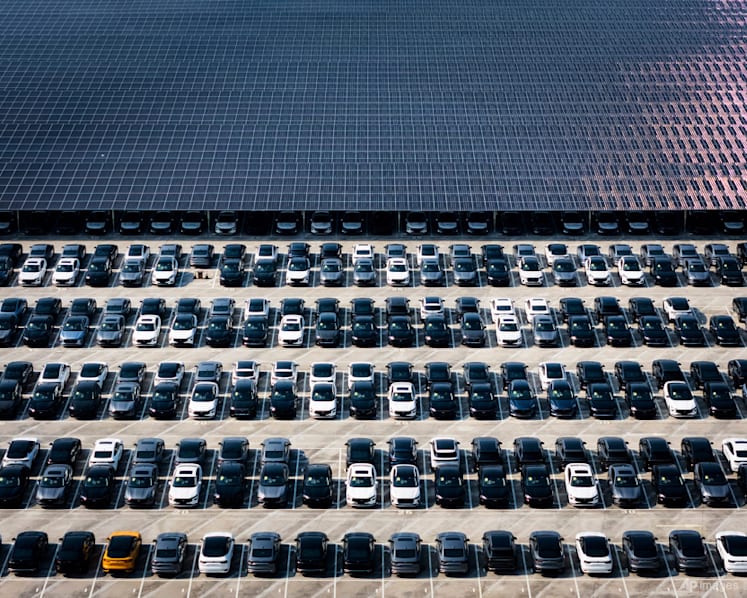
At its local “Two Sessions” in early March, officials reported that the Chengdu‑Chongqing economic circle had become China’s third‑largest auto cluster, with nearly 4 million vehicles produced in 2025, including 2.79 million in the city alone.
It now wants to build a “world‑class cluster” for intelligent connected new‑energy vehicles (NEVs) - spanning vehicle assembly, core components, advanced materials, software and services.
Elsewhere, other provinces are focusing on narrower roles.
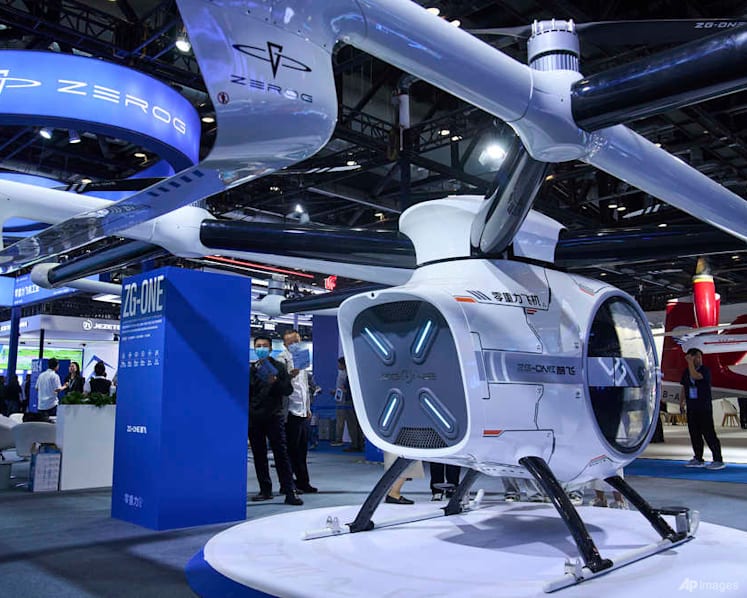
In the Yangtze River Delta, Suzhou Industrial Park has an action plan to build a low‑altitude‑economy cluster of more than 50 firms by 2026, linking drones and flying cars to its manufacturing and robotics base.
In Zhejiang, officials are rolling out “AI+” projects to transform factories - and Guizhou, branded as China’s “digital valley”, continues to position itself as a national computing hub - expanding data power capacity to support AI workloads.
“To be honest, I don't think every city in China (should expect) to be as big as Shanghai or Shenzhen,” Zhang said.
“But the most important thing for any city is to find themselves a good position in the supply chain… maybe they can build a specialty of industry instead of trying to be the same as everybody else.”
THE RACE TO BUILD - WITHOUT INVOLUTION
As cities race to build the next generation of tech clusters, experts said the challenge will be turning that momentum in durable market growth - without slipping into “involution-style” competition that Beijing has been trying to avoid.
Sharpening competition between cities calls for more coordinated and efficient development, they added.
But involution is not just driven by industrial policies.
It’s also tied to how local governments compete for growth and resources - and if Beijing truly wants to scale back on involution, it must either “reduce growth rates”, remove them altogether or scale back its “emphasis on developing high-tech industries”, said Chen from John Hopkins University.

Others noted that it will be a delicate balancing act.
They have to better grow new sectors to still meet growth targets while also “preventing” involutionary problems, which will be “very hard”, said Zhang of Gavekal Dragonomics.
That tension is already playing out in cities like Shenzhen and Hefei, which have moved quickly to roll out supportive new policies around AI.
But “competing on speed” comes with trade-offs, said Zhang, who noted that some local governments may not be fully “considering the long-term consequences”.
Now as attention turns to newer sectors like the “low-altitude economy”, there are signs that local ambitions could once again run ahead of demand.
China’s central government is “trying to encourage more long-term, coordinated planning - not just a rush to capture subsidies”, said Trivium China’s Kendra Schaefer, adding that competition between regions remains strong.